Wednesday, 12 June 2019

Apollo raises $22M for its GraphQL platform

Apollo, a San Francisco-based startup that provides a number of developer and operator tools and services around the GraphQL query language, today announced that it has raised a $22 million growth funding round co-led by Andreessen Horowitz and Matrix Partners. Existing investors Trinity Ventures and Webb Investment Network also participated in this round.

Today, Apollo is probably the biggest player in the GraphQL ecosystem. At its core, the company’s services allow businesses to use the Facebook-incubated GraphQL technology to shield their developers from the patchwork of legacy APIs and databases as they look to modernize their technology stacks. The team argues that while REST APIs that talked directly to other services and databases still made sense a few years ago, it doesn’t anymore now that the number of API endpoints keeps increasing rapidly.
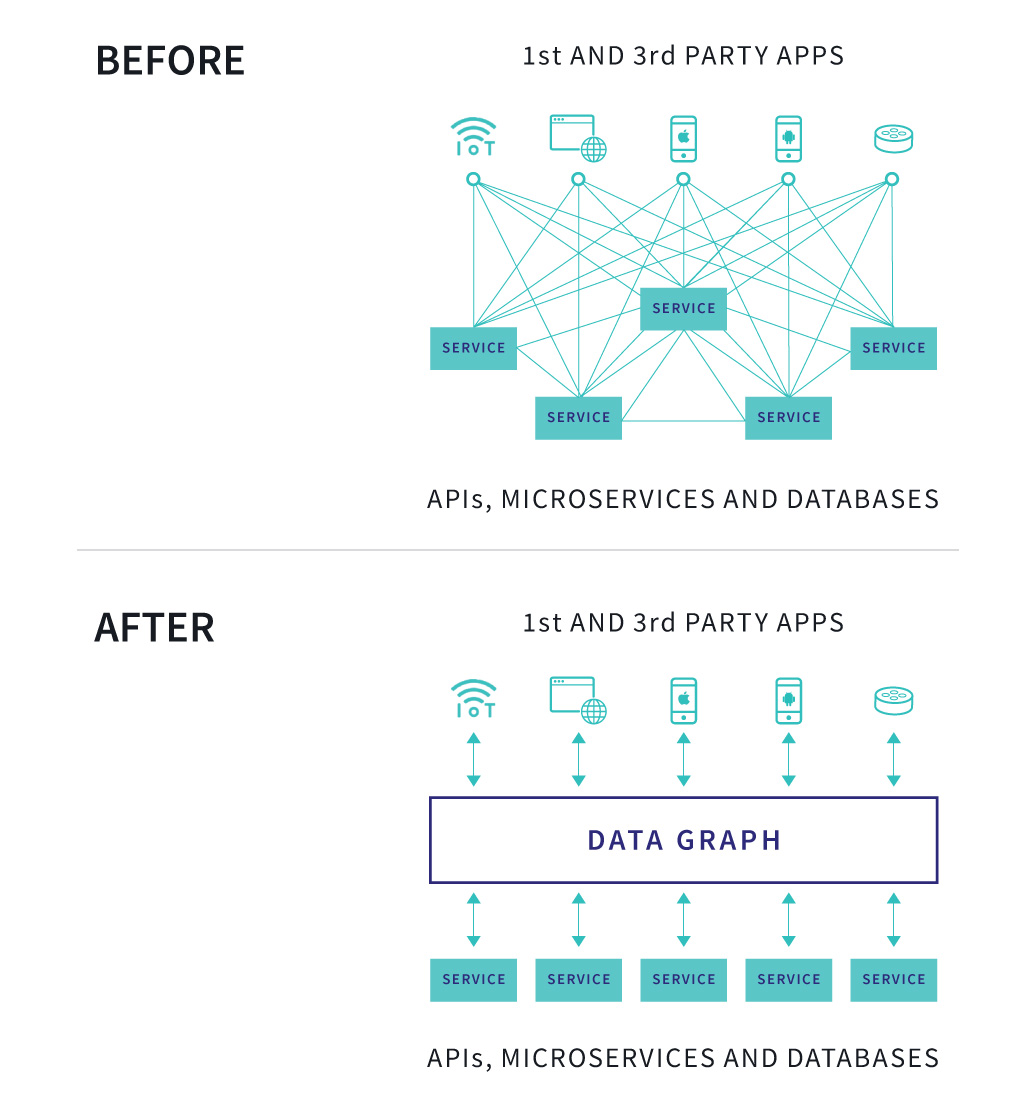
Apollo replaces this with what it calls the Data Graph. “There is basically a missing piece where we think about how people build apps today, which is the piece that connects the billions of devices out there,” Apollo co-founder and CEO Geoff Schmidt told me. “You probably don’t just have one app anymore, you probably have three, for the web, iOS and Android. Or maybe six. And if you’re a two-sided marketplace you’ve got one for buyers, one for sellers and another for your ops team.” Managing the interfaces between all of these apps quickly becomes complicated and means you have to write a lot of custom code for every new feature. The promise of the Data Graph is that developers can use GraphQL to query the data in the graph and move on, all without having to write the boilerplate code that typically slows them down. At the same time, the ops teams can use the Graph to enforce access policies and implement other security features.

“If you think about it, there’s a lot of analogies to what happened with relational databases in the 80s,” Schmidt said. “There is a need for a new layer in the stack. Previously, your query planner was a human being, not a piece of software, and a relational databased is a piece of software that would just give you a database. And you needed a way to query that database and that syntax was called SQL.”

Geoff Schmidt, Apollo CEO, and Matt DeBergalis, CTO.

GraphQL itself, of course, is open source. Apollo is now building a lot of the proprietary tools around this idea of the Data Graph that make it useful for businesses. There’s a cloud-hosted graph manager, for example, that lets you track your schema, as well as a dashboard to track performance, as well as integrations with continuous integration services. “It’s basically a set of services that keep track of the metadata about your graph and help you manage the configuration of your graph and all the workflows and processes around it,” Schmidt said.

The development of Apollo didn’t come out of nowhere. The founders previously launched Meteor, a framework and set of hosted services that allowed developers to write their apps in JavaScript, both on the front-end and back-end. Meteor was tightly coupled to MongoDB, though, which worked well for some use cases but also held the platform back in the long run. With Apollo, the team decided to go in the opposite direction and instead build a platform that makes being database agnostic the core of its value proposition.

The company also recently launched Apollo Federation, which makes it easier for businesses to work with a distributed graph. Sometimes, after all, your data lives in lots of different places. Federation allows for a distributed architecture that combines all of the different data sources into a single schema that developers can then query.

Schmidt tells me that the company started to get some serious traction last year and by December, it was getting calls from VCs that heard from their portfolio companies that they were using Apollo.

The company plans to use the new funding to build out its technology to scale its field team to support the enterprises that bet on its technology, including the open source technologies that power both the service.

“I see the Data Graph as a core new layer of the stack, just like we as an industry invested in the relational databased for decades, making it better and better,” Schmidt said. “We’re still finding new uses for SQL and that relational database model. I think the Data Graph is going to be the same way.”


from Android – TechCrunch https://tcrn.ch/2XChBkk
via IFTTT

Google opens its Android security key tech to iPhone and iPad users

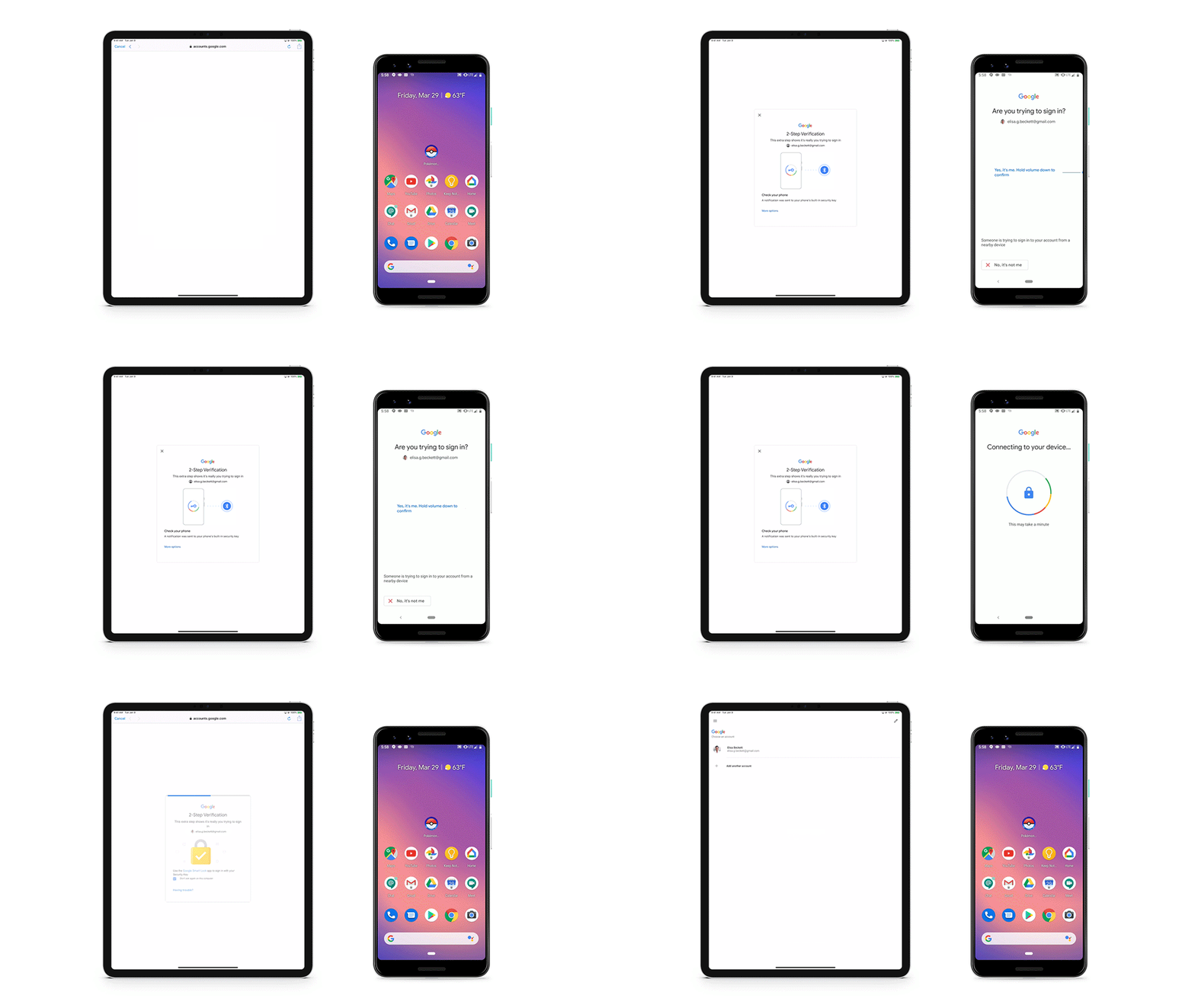
Google will now allow iPhone and iPad owners to use their Android security key to verify sign-ins, the company said Wednesday.

Last month, the search and mobile giant said it developed a new Bluetooth-based protocol that will allow modern Android 7.0 devices and later to act as a security key for two-factor authentication. Since then, Google said 100,000 users are already using their Android phones as a security key.

Since its debut, the technology was limited to Chrome sign-ins. Now Google says Apple device owners can get the same protections without having to plug anything in.

Signing in to a Google account on an iPad using an Android 7.0 device. (Image: Google)

Security keys are an important security step for users who are particularly at risk of advanced attacks. They’re designed to thwart even the smartest and most resourceful attackers, like nation-state hackers. Instead of a security key that you keep on your keyring, newer Android devices have the technology built-in. When you log in to your account, you are prompted to authenticate with your key. Even if someone steals your password, they can’t log in without your authenticating device. Even phishing pages won’t work because only legitimate websites support security keys.

For the most part, security keys are a last line of defense. Google admitted last month that its standalone Titan security keys were vulnerable to a pairing bug, potentially putting it at risk of hijack. The company offered a free replacement for any affected device.

The security key technology is also FIDO2 compliant, a secure and flexible standard that allows various devices and running different operating systems to communicate with each other for authentication.

For now, Google said the Android security key will be limited to sign-ins to Google accounts only.


from Android – TechCrunch https://tcrn.ch/2F5L2E2
via IFTTT

iMovie’s big iOS update adds 80 new soundtracks, green screen effects, image overlays

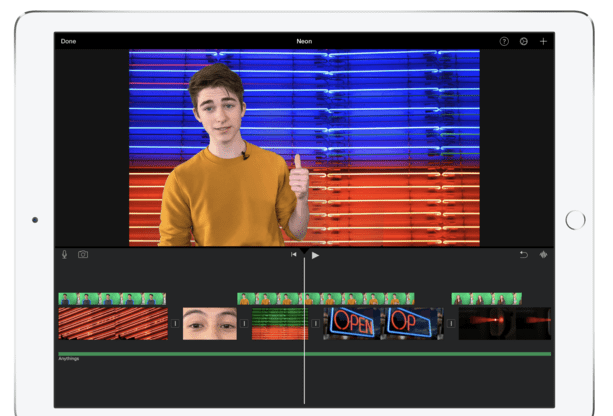
Ahead of the public launch of Apple’s revamped suite of first-party apps on iOS 13, the company has rolled out a new version of its popular video editor, iMovie for iOS. With the app’s most recent update, iMovie has received a host of new features — most notably, support for a green screen effect that lets you remove the background from clips, as well as the addition of 80 new soundtracks across a variety of genres.

The green screen support, in particular, could make iMovie a better competitor to the third-party video editors which tend to offer more advanced feature sets, while also keeping things simple for less savvy users.

Apple says users of the new version (2.2.7) will be able to remove backgrounds from any clips shot in front of a blue or green screen, as well as adjust the clip with a 4-point mask and strength slider.


Its 80 new soundtracks include genres like pop, chill and sentimental that will automatically adjust to the length of the movie.

In terms of new effects, iMovie will now allow users to add photos as overlays to create picture-in-picture and split screen effects as well as opt to hide the border on those. These were some of iMovie’s more requested features, in fact, and one of the reasons why people went elsewhere for video editing apps.

Other new features are designed to make iMovie easier to use. For example, when you switch back to the iOS app from other applications, it will take you right to the edit screen of your project. It has also tucked away access to iMovie Theater from the three-dot ( … ) more menu, as it’s shifting users to share videos to iCloud instead.

And, as part of other classroom-focused updates, iMovie now supports ClassKit, which means students can deliver their video assignments directly the teachers via Apple’s Schoolwork app.

Because iMovie is designed to work across Apple’s platforms, users can begin editing projects on their phone then transfer them to other devices like the iPad or Mac in order to complete edits, including those that may benefit from working via a larger screen — such as the green screen effect or color corrections, for example.

The updated iMovie is available for both iPhone and iPad from the App Store.


from Apple – TechCrunch https://tcrn.ch/2RbKMbC

Xiaomi’s budget Mi Band wearable now sports a color screen and voice assistant

Xiaomi has refreshed its smart fitness tracker and unveiled a range of other gadgets in China, giving a glimpse at some of its affordable products that it will likely be bringing to other markets in the coming future.

The wearable fitness tracker, called Mi Smart Band 4, sports a bigger AMOLED display (39.9% increase in screen size) than its popular year-old predecessor and features support for XiaoAI, the company’s voice assistant that can be activated with a voice command.

The bigger display, which supports 16 million colors and 77 customized themes, will allow users to quickly glance at notifications and fitness stats. The tracker also supports offline payments via AliPay. It is still very affordable, priced at just RMB 169 (roughly $24.5).

Coupled with the long durability that previous generation smart bands have offered, it is no wonder that the Chinese giant has emerged as the second largest wearable maker in the world. According to IDC, Xiaomi shipped 7.5 million wearable units in the waning quarter of last year, second only to Apple, which shipped 16.2 units.

The company has also launched a smart lock, dubbed Mi Smart Door Lock, that offers up to six unlocking modes and allows users to track its status in real time. It also works with the NFC variant of Mi Smart Band 4 that when paired can serve as a key. It is priced at RMB 1699 (roughly $245).

The announcement comes as Xiaomi, which went public last year and is increasingly trying to expand its services business, struggles to meet analysts expectations. The Chinese group, once thought of worth over $100 billion, has a market cap of under $30 billion currently.

Xiaomi also launched a smart washing machine, induction cooker, e-skate hover, digital translator, and pens. The washing machine, called Mi Smart Combo Wash Dryer, sports OLED smart buttons and supports voice controls for activating or halting a washing cycle. It is priced at RMB 2999 (roughly $433).

Shaped like a smartphone, the Mi AI Translator, comes preloaded with Oxford and Collins dictionary as well as Chinese dictionaries. It is aimed at people who are trying to learn a new language and want to improve their pronunciation. It supports real-time translation between 34 languages. It starts at RMB 499 (roughly $72).


from Apple – TechCrunch https://tcrn.ch/2KdIUhG

Tuesday, 11 June 2019

Tesla completing ‘small acquisition’ which will help launch its insurance product

Tesla CEO Elon Musk says that the company is in the process of completing a “small acquisition” that will help it release its own insurance product, something it said in April that it was only around “a month” away from bringing to market. One month is at least two months when translated from Musk time to rest-of-us time, so that tracks.

Musk made the remark at Tesla’s Annual Shareholders Meeting, adding that the company is “pretty close to being able to release [its insurance product],” and that in addition to this acquisition in progress, Tesla also has “a bit of software to write” to make it ready for market.

Insurance for Tesla vehicles can be expensive when sourced from traditional insurance providers (it ranked 15th highest in the U.S. in a recent third-party survey) but Tesla says it has a key advantage when compared to third-parties that will help it price insurance for its customers correctly – ample and detailed information about their driving habits.

No word yet on who the acquisition target is, but it makes sense that Apple might seek to pick up a small insurer to supplement its own driving and user data, rather than trying to build an insurance business in-house from scratch.


from Apple – TechCrunch https://tcrn.ch/2MHXb8n

Apple joins the open-source Cloud Native Computing Foundation

The Cloud Native Computing Foundation (CNCF), the home of open-source projects like Kubernetes, today announced that Apple is joining it as a top-level Platinum End User Member. With this, Apple is joining 89 existing CNCF end-user members like Adidas, Atlassian, Box, GitHub, the New York Times, Reddit, Spotify and Walmart.

Apple, in typical fashion, isn’t commenting on the announcement, but the CNCF notes that end user memberships are meant for organizations that are “heavy users of open source cloud native technologies” and that are looking to give back to the community. By becoming a CNCF end-user member, companies also join the Linux Foundation.

As part of its membership, Apple also gets a seat on the CNCF’s Governing Board. http://bit.ly/2XyZ6gx, a senior engineering manager at Apple, will take this seat.

“Having a company with the experience and scale of Apple as an end user member is a huge testament to the vitality of cloud native computing for the future of infrastructure and application development,” said Chris Aniszczyk, CTO of the Cloud Native Computing Foundation. “We’re thrilled to have the support of Apple, and look forward to the future contributions to the broader cloud native project community.”

While you may not necessarily think of Apple as a major open source company, the company has open sourced everything from the XNU kernel that’s part of the Darwin operating system to its Swift programming language. The company has not typically participated all that much in the open source cloud infrastructure community, though, but today’s move may signal that this is changing. Apple obviously runs its own data centers, so chances are it is indeed a heavy user of open source infrastructure projects, though the company doesn’t typically talk about these.


from Apple – TechCrunch https://tcrn.ch/2wP8DV8

Mobile games now account for 33% of installs, 10% of time, and 74% of consumer spend

Mobile gaming continues to hold its own, accounting for 10% of the time users spend in apps — a percentage that has remained steady over the years, even though our time in apps overall has grown by 50% over the past two years. In addition, games are continuing to grow their share of consumer spend, notes App Annie in a new research report out this week, timed with E3.

Thanks to growth in hyper-casual and cross-platform gaming in particular, mobile games are on track to reach 60% market share in consumer spend in 2019.

The new report looks at how much time users spend gaming versus using other apps, monetization, and regional highlights within the gaming market, among other things.

Despite accounting for a sizable portion of users’ time, games don’t lead the other categories, App Annie says.

Instead, social and communications apps account for half (50%) of the time users spent globally in apps in 2018, followed by video players and editors at 15%, then games at 10%.

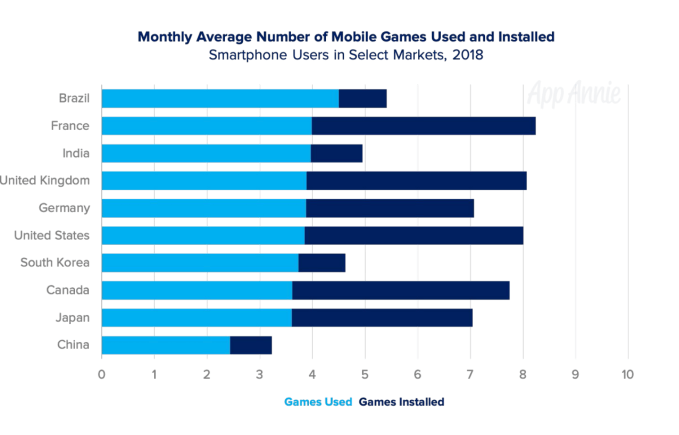
In the U.S., users generally have 8 games installed per device and globally, we play an average of 2 to 5 games per month.

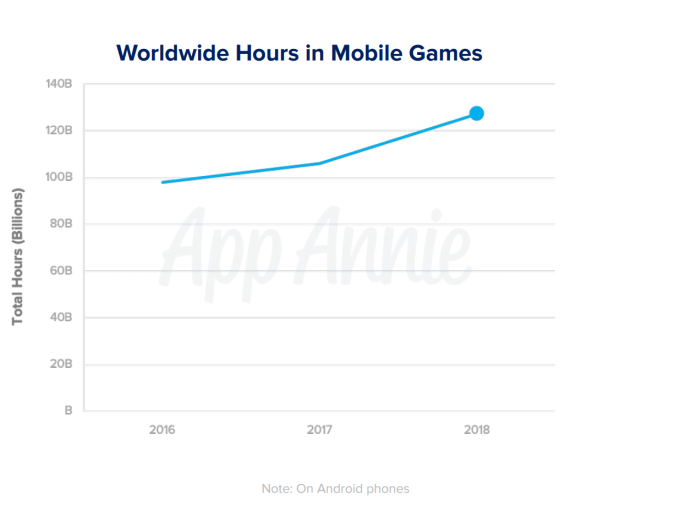
The number of total hours spent games continues to grow roughly 10% year-over-year, as well, thanks to existing gamers increasing their time in games and from a broadening user base including a large number of mobile app newcomers from emerging markets.

This has also contributed to a widening age range for gamers.

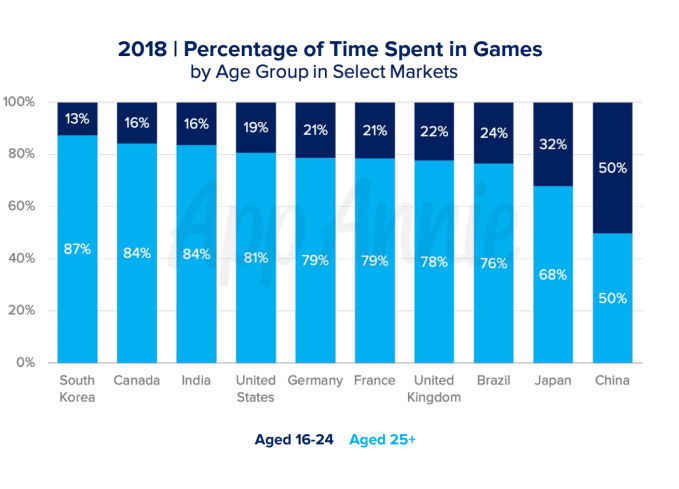
Today, the majority of time spent in gaming is by those aged 25 and up. In many cases, these players may not even classify themselves as “gamers,” App Annie noted.

While games may not lead the categories in terms of time spent, they do account for a large number of mobile downloads and the majority of consumer spending on mobile.

One-third of all worldwide downloads are games across iOS, Google Play, and third-party app stores.

Last year, 1.6+ million games launched on Google Play and 1.1+ million arrived on iOS.

On Android, 74 cents of every dollar is spent on games with 95% of those purchases coming as in-app purchases not paid downloads. App Annie didn’t have figures for iOS.

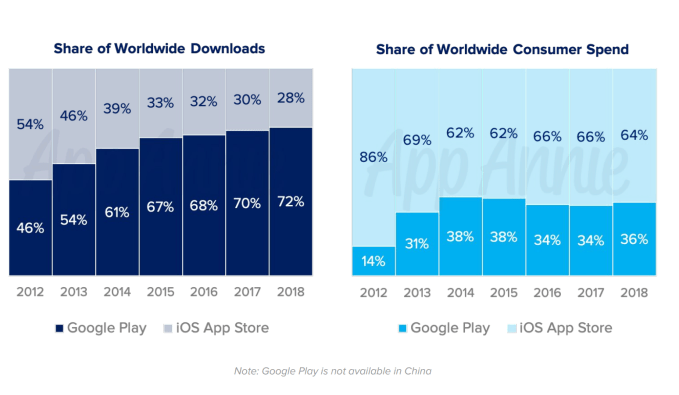
Google Play is known for having more downloads than iOS, but continues to trail on consumer spend. In 2018, Google Play grabbed a 72% share of worldwide downloads, compared with 28% on iOS. Meanwhile, Google Play only saw 36% of consumer spend versus 64% on iOS.

One particular type of gaming jumped out in the new report: racing games.

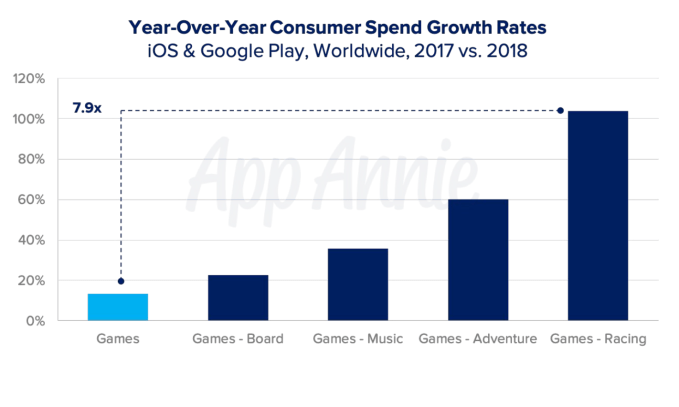
Consumer spend in this subcategory of gaming grew 7.9 times as fast as the overall mobile gaming market. Adventure games did well, too, growing roughly 5 times the rate of games in general. Music games and board games were also popular.

Of course, gaming expands beyond mobile. But it’s surprising to see how large a share of the broader market can be attributed to mobile gaming.

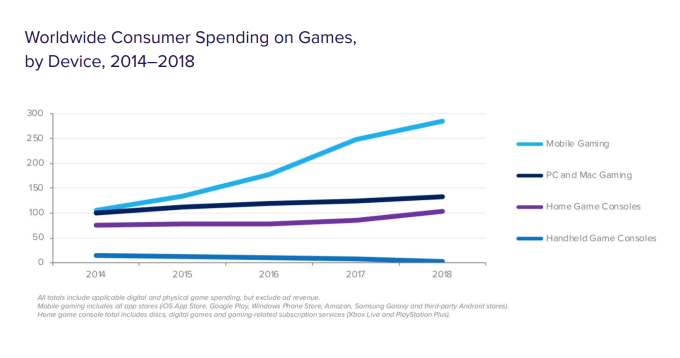
According to App Annie, mobile gaming is larger than all other channels including home game consoles, handheld consoles, and computers (Mac and PC). It’s also 20% larger than all these other categories combined — a shift from only a few years ago, attributed to the growth in the mobile consumer base, which allows mobile gaming to reach more people.

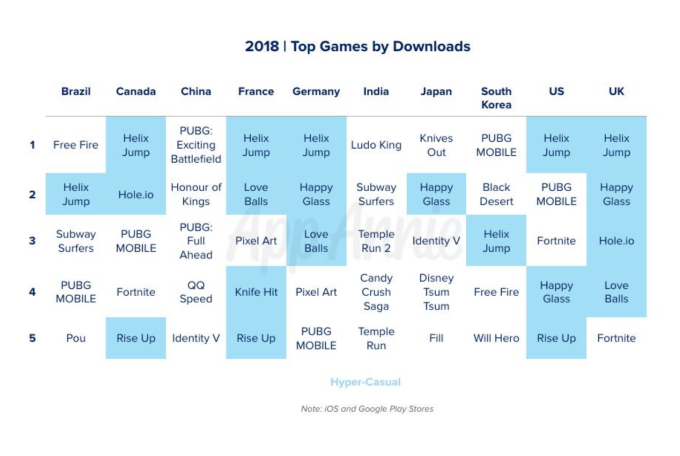
Cross-platform gaming is a key gaming trend today, thanks to titles like PUBG and Fortnite in particular, which were among the most downloaded games across several markets last year.

Meanwhile, hyper-casual games are appealing to those who don’t think of themselves as gamers, which has helped to broaden the market further.

App Annie is predicting the next big surge will come from AR gaming, with Harry Potter: Wizards Unite expected to bring Pokémon Go-like frenzy back to AR, bringing the new title $100 million in its first 30 days. The game is currently in beta testing in select markets, with plans for a 2019 release.

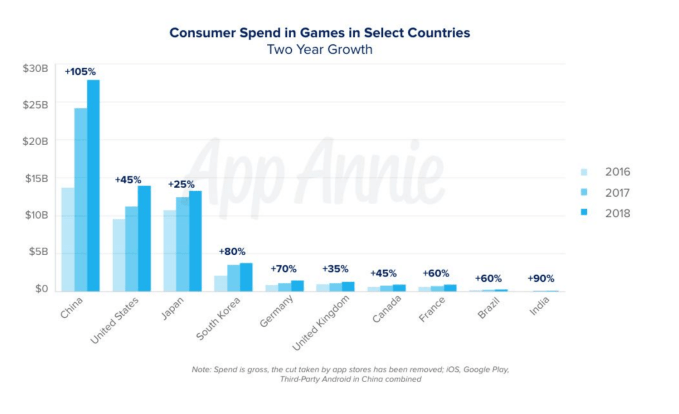
In terms of regions, China’s impact on gaming tends to be outsized, but its growth last year was limited due to the game license regulations. This forced publishers to look outside the country for growth — particularly in markets like North America and Japan, App Annie said.

Meanwhile, India, Brazil, Russia and Indonesia lead the emerging markets with regard to game
downloads, but established markets of the U.S. and China remain strong players in terms of sheer numbers.

With the continued steady growth in consumer spend and the stable time spent in games, App Annie states the monetization potential for games is growing. In 2018, there were 1900 games that made more than $5 million, up from 1200 in 2106. In addition, consumer spend in many key markets is still growing too — like the 105% growth in two years in China, for example, and the 45% growth in the U.S.

The full report delves into other regions as well as game publishers’ user acquisition strategies. It’s available download here.


from Android – TechCrunch https://tcrn.ch/2R7skRg
via IFTTT