Sunday, 26 January 2020

Sundance: In Miss Americana, Taylor Swift demotes the Internet

In nearly a decade of attending Sundance, I’ve never seen a scene like the premiere of the documentary Miss Americana, detailing the last year and a half or so of Taylor Swift’s life. The crowd before letting into the theater was huge, blistering with rumors about whether or not there was so many guests and press that there wouldn’t be room for ticketed attendees and whispers about which door Swift would use when arriving.

A large crowd of hopeful waitlister fans, largely young women (not extremely common for Sundance) sang Swift songs in the 30 degree chill. When Swift did arrive, the cheers were off the charts for a normally relatively reserved crowd used to seeing celebrities.

All of this buildup, of course, served to underscore the major themes of Lana Wilson’s intimate and focused profile of Swift during a period of her life that typified a major shift in her attitude towards her public and private life.

If you’re like most people, your feelings about what kind of person Swift might be are decided by crowd-sourced panel of the top few percent of the most vocal Internet users. Among those, of course, are the media.

We’re far enough now into the Internet’s third age where it’s not represented as some sort of holistic and separate entity. Instead it’s woven like a tapestry into the daily life of Swift and her camp. Tweets, Instagram posts and articles on sites like this one are presented as a third conversant in any conversation, both between Swift and Wilson and between Swift and her family.

Basically, Swift is like most of us in that regard, we have all begun to treat the collective output of the internet as an entity with a right to wedge itself into any two beings attempts to reason.

But Miss Americana is not just about Taylor vs. The Internet, it’s also reflection on how that same panel lowers its gavel differently for women, especially young women, than it does men.

The closest parallel for me is probably Lady Gaga’s 2018 documentary Five Feet Two. There are similar segments that show the teardown of the modern pop song-making process.

Swift says that those were her most nerve wracking to film because of the messy way songs sometimes come together. But they were fascinating to me, and are some of the most fun bits. Swift and her collaborators often write and sing words right off of their iPhones (I saw no Android devices at all) as they work through a track. Songs that come to have intense meaning for fans are often snapshots of Swift’s life quickly jotted down in the notes app.

About that oddity, and pretty much every other way that the public perceives her, Swift proves to be firmly and calmly self-aware. She even acknowledges that this very awareness of how she is perceived often comes across as calculation or manipulation on her part.

While Swift gets all of this criticism powered by attention economy jet fuel, her self-awareness is not unique. I see it on TikTok and other young platforms, as teens and young people come to grips with and analyze how they are manipulated and judged by those very platforms. Swift may represent a sort of prime exemplar, but the attitude is generational, imo.

The Kids are just more capable of awareness of the systems at work on them than any previous generation.

The aforementioned Gaga doc, for me, worked very well when it showcased the real physical and psychological toll of a pop career. Miss Americana does this as well, even though Gaga has focused on her ability to challenge and provoke, while Swift has — as she herself admits in the doc — held onto the concept of being a ‘good girl’, liked by everyone as her guiding principle.

Swift’s realization of the completely impossible task of pleasing the networked apparatus of fickle outrage machines that pass as the deciding body of public opinion now is the core pivot point for the doc.

That’s typified by a scene where she is faced by a panel of people, all men, who are telling her all of the reasons taking a public political stance would be dangerous, costly to her brand and damaging to her financially. The impetus is Swift’s opposition to Tennessee Senator Marsha Blackburn’s re-election. Swift’s experience with her sexual assault trial and Blackburn’s opposition to the Violence Against Women Act are the tipping point that pushes her to take a public political stance for the first time. Provoking her team to have a conversation that takes the rough shape of an intervention.

There are sincere elements of concern for Swift — her father gets all of her death threats and arranges for security, she said after the screening. But the comments from her staff and team included by Wilson are telling — “what is the most effective way we could ensure that half as many people come to a Taylor Swift show?”

What you won’t find in this doc is some sort of lurking personal demon. Instead the demon is the way that internet culture reduces anyone with a modicum of fame to slivers of projected personality. And, by extension, becomes the most potent engine of self doubt ever invented.

By demoting the Internet to a tool vs. a deciding force in her well being, Swift is showing fans and viewers a healthier path forward.

The two major themes explored include Swift’s desire to please an ever-demanding audience, and the endemic separation between the way creative men are judged and the way creative women are judged in the public sphere.

Both are addressed cleverly, if not in a wholly (and perhaps impossibly) satisfying way.

Wilson has executed the prime directive of a documentary film with Miss Americana. If you were of a slightly negative opinion of Swift going in, based on casual impressions generated for you by vocal minorities amplified via algorithm you will find yourself coming away with more empathy, understanding and likely respect for the Swift presented here. A portrait of a powerful woman in control coming to grips with the current costs of that command.

People on the other side of the love/hate coin are unlikely to be converted. But given that one of the through lines of the doc is Swift’s increasing ability to separate opinion from directive, it’s not likely that it will bother her — as much.

Image: Sundance


from Android – TechCrunch https://ift.tt/2TVAdfU
via IFTTT

Saturday, 25 January 2020

This Week in Apps: Apple antitrust issues come to Congress, subscription apps boom, Tencent takes on TikTok

Welcome back to ThisWeek in Apps, the Extra Crunch series that recaps the latest OS news, the applications they support and the money that flows through it all.

The app industry is as hot as ever with a record 204 billion downloads in 2019 and $120 billion in consumer spending in 2019, according to App Annie’s recently released “State of Mobile” annual report. People are now spending 3 hours and 40 minutes per day using apps, rivaling TV. Apps aren’t just a way to pass idle hours — they’re a big business. In 2019, mobile-first companies had a combined $544 billion valuation, 6.5x higher than those without a mobile focus.

In this Extra Crunch series, we help you keep up with the latest news from the world of apps, delivered on a weekly basis.

This week, there was a ton of app news. We’re digging into the latest with Apple’s antitrust issues, Tencent’s plan to leverage WeChat to fend off the TikTok threat, AppsFlyer’s massive new round, the booming subscription economy, Disney’s mobile game studio sale, Pokémon GO’s boost to tourism, Match Group’s latest investment and much more. And did you see the app that lets you use your phone from within a paper envelope? Or the new AR social network? It’s Weird App Week, apparently.

Headlines


from Android – TechCrunch https://ift.tt/30Un2NV
via IFTTT

This Week in Apps: Apple antitrust issues come to Congress, subscription apps boom, Tencent takes on TikTok

Welcome back to ThisWeek in Apps, the Extra Crunch series that recaps the latest OS news, the applications they support and the money that flows through it all.

The app industry is as hot as ever with a record 204 billion downloads in 2019 and $120 billion in consumer spending in 2019, according to App Annie’s recently released “State of Mobile” annual report. People are now spending 3 hours and 40 minutes per day using apps, rivaling TV. Apps aren’t just a way to pass idle hours — they’re a big business. In 2019, mobile-first companies had a combined $544 billion valuation, 6.5x higher than those without a mobile focus.

In this Extra Crunch series, we help you keep up with the latest news from the world of apps, delivered on a weekly basis.

This week, there was a ton of app news. We’re digging into the latest with Apple’s antitrust issues, Tencent’s plan to leverage WeChat to fend off the TikTok threat, AppsFlyer’s massive new round, the booming subscription economy, Disney’s mobile game studio sale, Pokémon GO’s boost to tourism, Match Group’s latest investment and much more. And did you see the app that lets you use your phone from within a paper envelope? Or the new AR social network? It’s Weird App Week, apparently.

Headlines


from Apple – TechCrunch https://ift.tt/30Un2NV

Friday, 24 January 2020

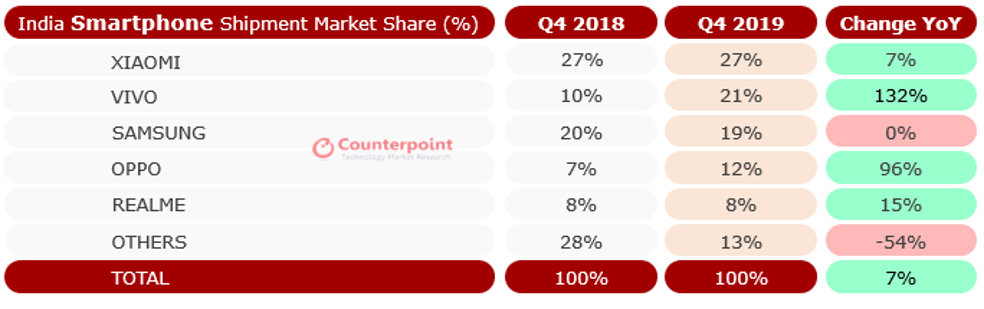
Vivo beats Samsung for 2nd spot in Indian smartphone market

Samsung, which once led the smartphone market in India, slid to the third position in the quarter that ended in December, even as the South Korean giant continues to make major bets on the rare handset market that is still growing.

According to research firm Counterpoint, Chinese firm Vivo surpassed Samsung to become the second biggest smartphone vendor in India in Q4 2019. Xiaomi, with command over 27% of the market, maintained its top spot in the nation for the tenth consecutive quarter.

Vivo’s annual smartphone shipment grew 76% in 2019. The Chinese firm’s aggressive positioning of its budget S series of smartphones — priced between $100 to $150 (the sweet spot in India) — in the brick and mortar market and acceptance of e-commerce sales helped it beat Samsung, said Counterpoint analysts. Vivo’s market share jumped 132% between Q4 of 2018 and Q4 of 2019, according to the research firm.

Realme, which spun out of Chinese smartphone maker Oppo, claimed the fifth spot. Oppo assumed the fourth position.

Realme has taken the Indian market by storm. The two-year-old firm has replicated Xiaomi’s playbook in the country and so far focused on selling aggressively low-cost Android smartphones online.

The report, released late Friday (local time), also states that India, with 158 million smartphone shipments in 2019, took over the U.S. in annual smartphone shipment for the first time.

India, which was already the world’s second largest smartphone market for total handset install base, is now also the second largest market for annual shipment of smartphones.

Tarun Pathak, a senior analyst at Counterpoint, told TechCrunch that about 150 million to 155 million smartphone units were shipped in the U.S. in 2019.

More to follow…


from Android – TechCrunch https://ift.tt/2tMAtmV
via IFTTT

The App Store is down

Midday on Friday it appeared that Apple’s App Store, a critical piece of the digital and mobile economies, struggled with uptime issues. Apple’s own status page indicated that the application vendor was having an “ongoing” issue that affected “some users.”

The company said that it was investigating the issue, according to its website.

Users weren’t pleased. A quick Twitter search shows a host of complaints from users noting that they can’t make purchases on the App Store, were struggling with sign-on issues and that downloads had ground to a halt.

Despite launching after the original iPhone, the App Store has become an industry to itself. According to certain data, the App Store drove $50 billion gross sales in 2019 — Apple takes a cut of transactions and sales, generating material revenue for itself.

The App Store will come back, but Apple is losing money along with its developer partners as we speak. More when it’s back. Until then, well, there’s Android or a walk.


from Apple – TechCrunch https://ift.tt/38B0zYJ

Thursday, 23 January 2020

US regulators need to catch up with Europe on fintech innovation 

Fintech companies are fundamentally changing how the financial services ecosystem operates, giving consumers powerful tools to help with savings, budgeting, investing, insurance, electronic payments and many other offerings. This industry is growing rapidly, filling gaps where traditional banks and financial institutions have failed to meet customer needs.

Yet progress has been uneven. Notably, consumer fintech adoption in the United States lags well behind much of Europe, where forward-thinking regulation has sparked an outpouring of innovation in digital banking services — as well as the backend infrastructure onto which products are built and operated.

That might seem counterintuitive, as regulation is often blamed for stifling innovation. Instead, European regulators have focused on reducing barriers to fintech growth rather than protecting the status quo. For example, the U.K.’s Open Banking regulation requires the country’s nine big high-street banks to share customer data with authorized fintech providers.

The EU’s PSD2 (Payment Services Directive 2) obliges banks to create application programming interfaces (APIs) and related tools that let customers share data with third parties. This creates standards that level the playing field and nurture fintech innovation. And the U.K.’s Financial Conduct Authority supports new fintech entrants by running a “sandbox” for software testing that helps speed new products into service.

Regulations, if implemented effectively as demonstrated by those in Europe, will lead to a net positive to consumers. While it is inevitable that regulations will come, if fintech entrepreneurs take the action to engage early and often with regulators, it will ensure that the regulations put in place support innovation and ultimately benefit the consumer.


from Android – TechCrunch https://ift.tt/2NUzfgp
via IFTTT

US regulators need to catch up with Europe on fintech innovation 

Fintech companies are fundamentally changing how the financial services ecosystem operates, giving consumers powerful tools to help with savings, budgeting, investing, insurance, electronic payments and many other offerings. This industry is growing rapidly, filling gaps where traditional banks and financial institutions have failed to meet customer needs.

Yet progress has been uneven. Notably, consumer fintech adoption in the United States lags well behind much of Europe, where forward-thinking regulation has sparked an outpouring of innovation in digital banking services — as well as the backend infrastructure onto which products are built and operated.

That might seem counterintuitive, as regulation is often blamed for stifling innovation. Instead, European regulators have focused on reducing barriers to fintech growth rather than protecting the status quo. For example, the U.K.’s Open Banking regulation requires the country’s nine big high-street banks to share customer data with authorized fintech providers.

The EU’s PSD2 (Payment Services Directive 2) obliges banks to create application programming interfaces (APIs) and related tools that let customers share data with third parties. This creates standards that level the playing field and nurture fintech innovation. And the U.K.’s Financial Conduct Authority supports new fintech entrants by running a “sandbox” for software testing that helps speed new products into service.

Regulations, if implemented effectively as demonstrated by those in Europe, will lead to a net positive to consumers. While it is inevitable that regulations will come, if fintech entrepreneurs take the action to engage early and often with regulators, it will ensure that the regulations put in place support innovation and ultimately benefit the consumer.


from Apple – TechCrunch https://ift.tt/2NUzfgp