Thursday, 6 February 2020

Advocating reform, activist investor Elliott Management takes a $2.5B stake in SoftBank

The activist investment firm Elliott Management has steadily amassed a $2.5 billion stake in the headline-grabbing, Japanese technology conglomerate SoftBank even as a series of missteps battered the company’s share price.

Famous for its investments in companies like Slack and Uber and infamous for betting billions on the co-working real estate marketplace and development company, WeWork, SoftBank presented an enticing target for Elliott’s brand of financial speculation, according to an initial report in The Wall Street Journal.

Last November, SoftBank Group reported a $6.5 billion loss thanks in part to its efforts to bail out its investment in WeWork — a company once valued in private markets at $47 billion.

Those losses sent the stock price tumbling, but despite its troubles, SoftBank still holds a vast stable of portfolio companies. It’s those assets that Elliott Management thinks are appealing enough to carve out some of its $34 billion in assets under management for a minority stake.

Elliott’s substantial investment in SoftBank Group reflects its strong conviction that the market significantly undervalues SoftBank’s portfolio of assets,” a spokesperson for the firm wrote in an email. “Elliott has engaged privately with SoftBank’s leadership and is working constructively on solutions to help SoftBank materially and sustainably reduce its discount to intrinsic value.”

SoftBank made waves in the technology investment world with its massive $100 billion Vision fund, which was designed to take stakes in emerging technology companies that required lots of cash, but could potentially transform various industries.

The audacious investment strategy was financed by working with sovereign wealth funds like the Saudi Arabian Public Investment Fund (whose principals are linked to a leadership known for ordering the assassination of journalists) and companies like Apple and Microsoft.

Through its limited partners and with its own cash, SoftBank was able to take large equity stakes in companies across a range of different industries. However, it now appears that those large equity stakes will be difficult to maintain or justify.

Over the last year, several of SoftBank’s portfolio companies have run into trouble, and it’s an open question whether any changes Elliott might be able to effect at the top of the organization would have an impact on the performance of the underlying portfolio.

Indeed, given SoftBank founder Masayoshi Son’s 22% ownership stake in the business, any corporate activism that Elliott may initiate or advocate for could have limited results.

There are good businesses in the SoftBank portfolio, and public investors have rushed in to buy the company’s stock on the back of the disclosure of Elliott Management’s investment.

However, the flood of capital that came into the venture market in 2018 seems to have crested, which could leave SoftBank and its new investors soaked.


from Apple – TechCrunch https://ift.tt/31zq7mF

Where are wearables going in 2020?

Apple has throttled the competition in another category.

During the company’s recent earnings call, CEO Tim Cook noted the company’s wearable division now rivals the size of a Fortune 500 company. He failed to give more specifics, but the point is striking: between Apple Watch and AirPods, Cupertino has another juggernaut on its hands.

Apple’s wearable fortunes come from two distinct sub-categories: more mature wrist-worn devices that include smartwatches and wearable trackers (and all of the overlap therein) and fully wireless earbuds or “hearables,” as they’re sometimes known.

I’m pulling IDC numbers from December for the latest, but these seem to mostly comport with what I’ve been seeing from firms over the past year. Apple’s on top with a little more than a third of total global market share — nearly 200 percent growth over the prior year. That’s thanks in no small part to the addition of AirPods Pro to the mix. Though getting back to Apple’s recent earnings, Cook notes that three-quarters of Apple Watch purchases in the previous quarter were by people who were buying the device for the first time. So there’s plenty of growth there, as well.

Xiaomi is at a distant number two with around 15 percent of the market. That’s still a commanding presence, as the company has expanded into new markets (mostly in Europe) with devices that undercut the competition. Samsung found success at around 10 percent of the global market with its diversification (watches, earbuds and fitness trackers), while Huawei maintained a strong presence in China with 80 percent of its total shipments in its home country as it struggles with other issues abroad.


from Apple – TechCrunch https://ift.tt/375eGUU

Netflix begins streaming in AV1 on Android

Netflix announced this week that it has started to stream titles in AV1 on Android in what could significantly help the two-year-old media codec gain wider adoption.

The world’s biggest streaming giant said on Wednesday that by switching from Google’s VP9 — which it previously used on Android — to AV1, its compression efficiency has gone up by 20%.

At the moment, only “select titles” are available to stream in AV1 for subscribers “who wish to reduce their cellular data usage by enabling the ‘Save Data’ feature,” the American firm said.

Netflix hasn’t shared much about the benefit AV1 will provide to customers, but the new media codec’s acceptance nonetheless sends a message by itself.

Tech giants, including Google, have spent years developing and improving media codecs as consumption of data skyrocketed and low-cost devices began to sell like hotcakes. But they just can’t seem to settle on one media codec and universally support it.

Think of Safari and YouTube, for instance. You can’t stream YouTube videos in 4K resolution on Safari, because Apple’s browser does not support Google’s VP9. And Google does not support HEVC for 4K videos on YouTube.

AV1 is supposed to be the savior media codec that gets universal support. It’s royalty-free and it works atop of open-source dav1d decoder that has been built by VideoLAN, best known for its widely popular media player VLC and FFmpeg communities. It is sponsored by the Alliance for Open Media.

Who are the members of Alliance for Open Media? Nearly all the big guys: Apple, Google, Amazon, Netflix, Nvidia, ARM, Facebook, Microsoft, Mozilla, Samsung and Tencent, among others.

But that’s not to say there aren’t roadblocks in the adoption of AV1. Compared to HEVC — the format that AV1 is supposed to replace in popularity — encoding in AV1 was noticeably slower a year ago, as per some benchmark tests.

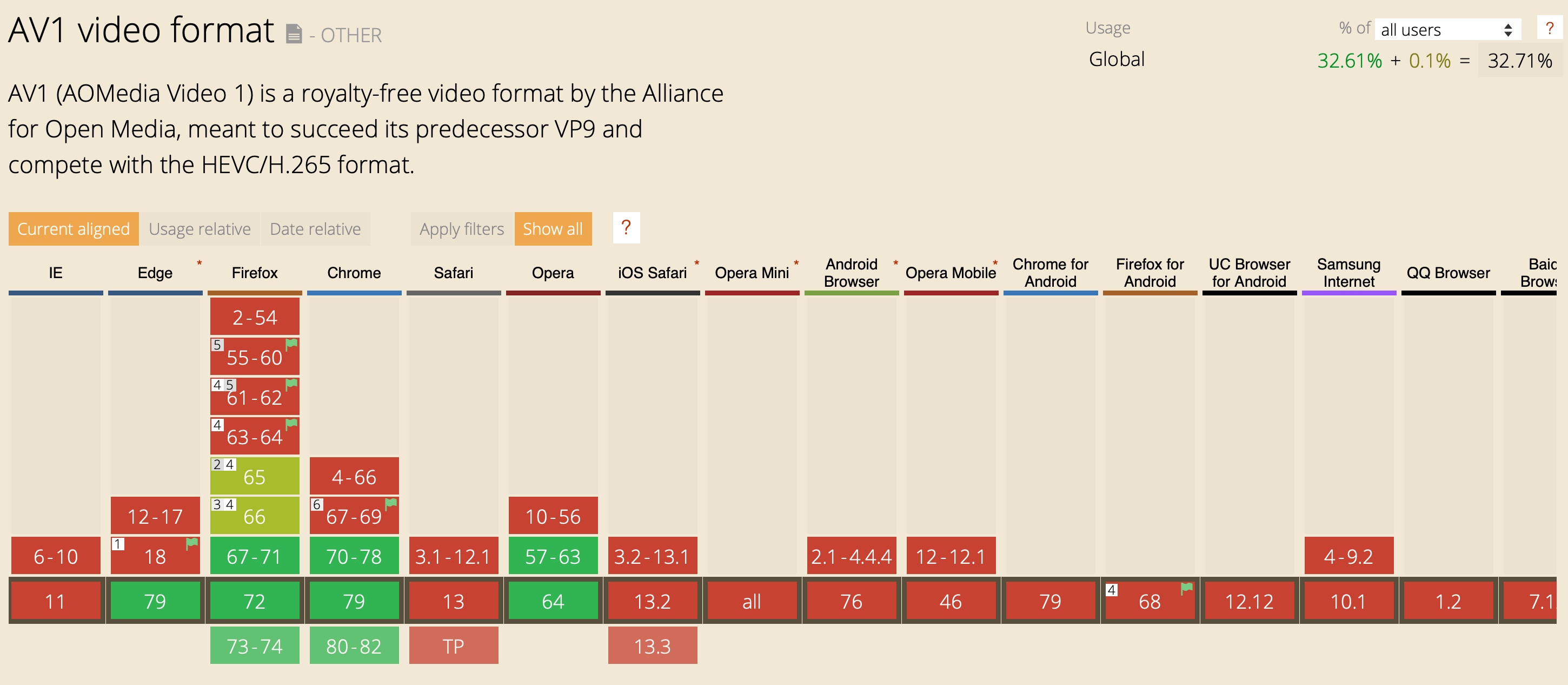
Adoption of AV1 by various browsers, according to analytics firm StatCounter. Safari is yet to support it.

Netflix’s announcement suggests that things have improved. The streaming giant said its goal is to support AV1 on all of its platforms. “In the spirit of making AV1 widely available, we are sponsoring an open-source effort to optimize 10-bit performance further and make these gains available to all,” it said in a blog post.


from Apple – TechCrunch https://ift.tt/376cBZ8

Netflix begins streaming in AV1 on Android

Netflix announced this week that it has started to stream titles in AV1 on Android in what could significantly help the two-year-old media codec gain wider adoption.

The world’s biggest streaming giant said on Wednesday that by switching from Google’s VP9 — which it previously used on Android — to AV1, its compression efficiency has gone up by 20%.

At the moment, only “select titles” are available to stream in AV1 for subscribers “who wish to reduce their cellular data usage by enabling the ‘Save Data’ feature,” the American firm said.

Netflix hasn’t shared much about the benefit AV1 will provide to customers, but the new media codec’s acceptance nonetheless sends a message by itself.

Tech giants, including Google, have spent years developing and improving media codecs as consumption of data skyrocketed and low-cost devices began to sell like hotcakes. But they just can’t seem to settle on one media codec and universally support it.

Think of Safari and YouTube, for instance. You can’t stream YouTube videos in 4K resolution on Safari, because Apple’s browser does not support Google’s VP9. And Google does not support HEVC for 4K videos on YouTube.

AV1 is supposed to be the savior media codec that gets universal support. It’s royalty-free and it works atop of open-source dav1d decoder that has been built by VideoLAN, best known for its widely popular media player VLC and FFmpeg communities. It is sponsored by the Alliance for Open Media.

Who are the members of Alliance for Open Media? Nearly all the big guys: Apple, Google, Amazon, Netflix, Nvidia, ARM, Facebook, Microsoft, Mozilla, Samsung and Tencent, among others.

But that’s not to say there aren’t roadblocks in the adoption of AV1. Compared to HEVC — the format that AV1 is supposed to replace in popularity — encoding in AV1 was noticeably slower a year ago, as per some benchmark tests.

Adoption of AV1 by various browsers, according to analytics firm StatCounter. Safari is yet to support it.

Netflix’s announcement suggests that things have improved. The streaming giant said its goal is to support AV1 on all of its platforms. “In the spirit of making AV1 widely available, we are sponsoring an open-source effort to optimize 10-bit performance further and make these gains available to all,” it said in a blog post.


from Android – TechCrunch https://ift.tt/376cBZ8
via IFTTT

Wednesday, 5 February 2020

Apple unifies its app stores by extending the universal purchase option to Mac apps

Apple surprised its app developer community today with the official announcement that they’ll soon be able to sell their cross-platform apps as one universal purchase, including, for the time, apps that run on macOS. For consumers, a universal purchase option allows them to just pay once for an app that works across devices, including iPhone, iPad, Apple TV and/or Mac. Developers, meanwhile, will be able to entice customers to buy their Mac and iOS app together, or other combinations of apps. They’ll also be able to more easily sync customers’ in-app purchases and subscriptions across platforms.

Apple says support for universal purchase will roll out in March 2020.

In preparation for the changes, the App Store categories will be unified across the iOS App Store and Mac App Store, to make apps more “discoverable,” Apple says.

Apple’s App Store categories are rarely updated, so this too is a notable change that will impact all developers — including those without a universal app bundle to sell. By listing their app in a new category, developers may have a better shot at ranking higher on the list of Top apps, compared with competing in an existing category alongside far more apps.

On iOS, developers will be able to list their app in two new categories: “Developer Tools” and “Graphics & Design.”

The Mac App Store is gaining several other categories coming from iOS, including “Books,” “Food & Drink,” “Magazines & Newspapers,” “Navigation” and “Shopping.”

In addition, the “Photography” and “Video” categories on the Mac App Store will be combined into “Photo & Video,” to better sync up with iOS. And “Kids” will no longer be a subcategory within “Games” on the Mac App Store.

Apple says developers can choose to either create a new app for these platforms using a single app record in App Store Connect, or they can add platforms to an existing app record to take advantage of the new universal purchase option. The feature will be enabled by default for Mac Catalyst apps and made available to non-Catalyst apps, too.

Developers can download the Xcode 11.4 beta update released today to get started, but the option doesn’t go live for the public until the March launch date.

This isn’t the first time that developers have been able to distribute their apps together as one purchase, to be clear. If you’ve ever bought an iPhone app and gained the iPad or Apple Watch app alongside it, for example, you are already familiar with this universal purchase option. What’s new is that Apple is now bringing this same functionality to Mac apps for the first time.

Of course, a universal purchase doesn’t make sense for all apps, so developers will need to weigh the pros and cons for themselves, based on how they want to do business. But the option does represent a significant step in unifying the separate app ecosystems Apple offers, which could spur more Mac app development in years to come.

The Xcode beta was released today alongside other macOS and iOS betas, which together are bringing new features like screen time communication limits on Mac, head pointer tech for Mac, new Memoji stickers, CarPlay updates and iCloud folder sharing.


from Apple – TechCrunch https://ift.tt/2vatbtG

Tuesday, 4 February 2020

Russia’s push back against big tech has major consequences for Apple

Last month, Donald Trump took to Twitter to criticize Apple for not unlocking two iPhones belonging to the Pensacola shooter, another volley in the struggle between big tech and the world’s governing bodies. But even the White House’s censure pales in comparison to the Kremlin’s ongoing plans. Apple, as the timing would have it, also happens to be in Vladimir Putin’s sights.

The company’s long-running policy of not preloading third-party software onto its devices is coming up against a new piece of Russian legislation requiring every smart device to be sold with certain applications already installed, many of which are produced by the government. Inside the country, the policy has even been called the zakon protiv Apple, or the “law against Apple,” for how it disproportionately affects the tech giant. While the law was passed last November, the Russian Federal Antimonopoly Service released the full list of apps only last week.

These regulations form the latest move in what’s turning out to be one of the largest national campaigns for digital control outside of Asia. These laws have been steadily accumulating since 2014 and are described as a way of consolidating sovereignty over the digital space — threatening to push companies out of the country if they fail to comply. Apple, for instance, will have to choose by July 1 whether maintaining access to the Russian market is worth making a revolutionary change in their policy. The same choice is given to any company wishing to do business in the country.


from Apple – TechCrunch https://ift.tt/2UtdEQ3

Russia’s push back against Big Tech has major consequences for Apple

Last month, Donald Trump took to Twitter to criticize Apple for not unlocking two iPhones belonging to the Pensacola shooter, another volley in the struggle between big tech and the world’s governing bodies. But even the White House’s censure pales in comparison to the Kremlin’s ongoing plans. Apple, as the timing would have it, also happens to be in Vladimir Putin’s sights.

The company’s long-running policy of not preloading third-party software onto its devices is coming up against a new piece of Russian legislation requiring every smart device to be sold with certain applications already installed, many of which are produced by the government. Inside the country, the policy has even been called the zakon protiv Apple, or the “law against Apple,” for how it disproportionately affects the tech giant. While the law was passed last November, the Russian Federal Antimonopoly Service released the full list of apps only last week.

These regulations form the latest move in what’s turning out to be one of the largest national campaigns for digital control outside of Asia. These laws have been steadily accumulating since 2014 and are described as a way of consolidating sovereignty over the digital space — threatening to push companies out of the country if they fail to comply. Apple, for instance, will have to choose by July 1 whether maintaining access to the Russian market is worth making a revolutionary change in their policy. The same choice is given to any company wishing to do business in the country.


from Android – TechCrunch https://ift.tt/2UtdEQ3
via IFTTT