Tuesday, 18 February 2020

Daily Crunch: Apple blames coronavirus for revenue miss

Apple says the coronavirus outbreak will hurt its manufacturing and sales, Jeff Bezos makes a big commitment to fighting climate change and SpaceX launches more Starlink satellites. Here’s your Daily Crunch for February 18, 2020.

1. Apple will miss revenue forecast as coronavirus impacts its manufacturing and sales

In a letter to investors, Apple said that it “do[es] not expect to meet the revenue guidance we provided for the March quarter” due to impacts stemming from the coronavirus that has shuttered large parts of China, and is reverberating through the global economy.

As China’s return to work has proved halting, and the coronavirus itself more intractable than some anticipated, the company’s change in guidance is almost unsurprising — but that hasn’t stopped Apple’s stock price from falling this morning.

2. Jeff Bezos announced a $10 billion fund to fight climate change

Jeff Bezos announced on Instagram that he’s creating a $10 billion fund to combat climate change. He said the Bezos Earth Fund will finance “scientists, activists, NGOs — any effort that offers a real possibility to help preserve and protect the natural world.”

3. SpaceX successfully launches 60 more Starlink satellites but misses booster landing

SpaceX has launched a batch of 60 Starlink satellites into orbit, marking its fifth overall launch of a group of 60 of the small spacecraft, and its third this year alone. This launch brings the total Starlink constellation to 300 satellites in orbit, extending SpaceX’s lead as the largest commercial satellite operator in the world.

4. Redbox enters the free, ad-supported streaming market

Oddly, Redbox Free Live TV isn’t live at all — at least, not in the way that you’d get with a TV streaming service like YouTube TV or Hulu with Live TV. Instead, it offers a curated set of ad-supported movies and TV shows, similar to The Roku Channel, IMDb TV or TiVo Plus.

5. How TikTok decides who to make famous

The co-founders of video startup Trash take a deep dive into the TikTok ecosystem, particularly its extensive content moderation. (Extra Crunch membership required.)

6. Atomico raises new $820M fund to back ‘mission-driven’ European founders at Series A and beyond

The London-headquartered VC firm’s previous fund closed at $765 million, so this is an increase over three years ago. However, the remit remains largely the same. Atomico says it plans to double down on its strategy of backing “mission-driven” European founders at Series A, but with the ability to invest in what it calls “breakout” companies at the Series B and C stage.

7. Black haircare startup Naza Beauty just raised $1 million from Alexis Ohanian’s Initialized Capital

At its most basic level, it’s like Drybar — with a menu of styles — but for women of color. On the tech side, Naza’s software functions as a booking and payments platform, which also learns the styles of each customer and then makes product recommendations.

The Daily Crunch is TechCrunch’s roundup of our biggest and most important stories. If you’d like to get this delivered to your inbox every day at around 9am Pacific, you can subscribe here.



from Apple – TechCrunch https://ift.tt/2SEg3Gd

Monday, 17 February 2020

Apple will miss revenue forecast as coronavirus impacts its manufacturing, sales

Today Apple announced that its prior financial forecast, provided during its January earnings cycle, is no longer valid. In a letter to investors today, the technology giant said that it “do[es] not expect to meet the revenue guidance we provided for the March quarter” due to impacts stemming from the coronavirus that has shuttered large parts of China, and is reverberating through the global economy.

In its letter Apple said that its prior guidance was based on its “best estimates about the pace of return to work following the end of the extended Chinese New Year holiday on February 10.” As China’s return to work has proved halting, and the coronavirus itself more intractable than some anticipated, the company’s change in guidance is almost unsurprising.

The Cupertino-based firm cited two key reasons for the change in guidance: First, that “worldwide iPhone supply will be temporarily constrained.” This is not surprising given what we’ve learned about Foxconn’s less-than-quick return to capacity at various factories. Apple also said that “demand for our products within China has been” impacted by the virus. (Apple has moved away from hardware revenues as the key driver of its financial health in recent quarters, but the company’s services push is still nascent compared to its iPhone incomes.)

The American hardware company also said that it “is more than doubling our previously announced donation” to help combat the disease.

How investors will deal with Apple stock after this news will help detail what is ahead for other companies that have large manufacturing operations or concentrated sales in China. If Apple’s shares falls sharply following this announcement, it could inspire fear and bring down other stocks that investors view as newly risky. In reverse, however, if Apple shakes off what investors could read as a short-term disruption to production and sales, other stocks could maintain short-term price integrity.

Regardless, after Singapore cut its economic growth forecast, and Apple is part of that mix, the chance of the coronavirus having a modest impact on the global economy is fading.

This is not the first time that Apple has changed its guidance. A year ago the company reduced expectations due to trade tensions.


from Apple – TechCrunch https://ift.tt/2SCWPAV

Sunday, 16 February 2020

Original Content podcast: ‘Mythic Quest’ is a likable comedy with a single standout episode

There’s plenty to like about “Mythic Quest: Raven’s Banquet,” a new series on Apple TV+ — its sympathetic-but-critical portrayal of the video game industry, its goofy-but-likable characters and a couple of big surprises that come at the end of the season.

But what really stood out to us — as we discuss on the latest episode of the Original Content podcast — was a single episode, “A Dark Quiet Death.”

Without getting into spoilers, it’s probably safe to reveal that the episode mostly stands apart from the rest of the season, telling a self-contained story about two characters (played by Jake Johnson and Cristin Milioti) who, after they create a quirky horror video game that turns into a surprise hit, discover that success isn’t all its cracked up to be.

Where the rest of “Mythic Quest” is a broad comedy (with the aforementioned likable characters and surprising plot), “A Dark Quiet Death” is more of a drama that quietly — but agonizingly — portrays the tensions between commerce and art. And if we have a criticism, it’s that the episode’s achievement can make the rest of the show feel a little silly in comparison.

We also discuss Anthony’s interview with the creators of the show and how “Mythic Quest” might have been shaped by the involvement of video game company Ubisoft. And before we begin the review, we react to this year’s Oscars.

You can listen in the player below, subscribe using Apple Podcasts or find us in your podcast player of choice. If you like the show, please let us know by leaving a review on Apple. You can also send us feedback directly. (Or suggest shows and movies for us to review!)

And if you’d like to skip ahead, here’s how the episode breaks down:

0:00 Intro
0:27 Oscars discussion
17:54 “Mythic Quest” review
50:31 “Mythic Quest” spoiler discussion


from Apple – TechCrunch https://ift.tt/3bIhYkQ

Saturday, 15 February 2020

This Week in Apps: YouTube TV cancels Apple’s rev share, more bad news for mobile voting, WhatsApp hits 2B users

Welcome back to This Week in Apps, the Extra Crunch series that recaps the latest OS news, the applications they support and the money that flows through it all.

The app industry is as hot as ever, with a record 204 billion downloads in 2019 and $120 billion in consumer spending in 2019, according to App Annie’s recently released “State of Mobile” annual report. People are now spending 3 hours and 40 minutes per day using apps, rivaling TV. Apps aren’t just a way to pass idle hours — they’re a big business. In 2019, mobile-first companies had a combined $544 billion valuation, 6.5x higher than those without a mobile focus.

In this Extra Crunch series, we help you keep up with the latest news from the world of apps, delivered on a weekly basis.

This week, we look at YouTube TV’s decision to stop revenue-sharing with Apple, another mobile voting app with serious flaws, new Apple launches in coding and AR, Microsoft’s game-streaming service Project xCloud arrival on iOS and other notable app news and trends, including WhatsApp’s big 2 billion user milestone, and more.

Headlines

YouTube TV fights back against Apple’s cut of in-app subscription revenue

This week, YouTube emailed customers subscribed to its YouTube TV service by way of Apple’s in-app purchases to let them know that this subscription offering will be discontinued starting on March 13, 2020. Current subscribers will have their subscription canceled automatically on their billing date after March 13, the letter said.

This is a pretty severe way for Google to end its subscription revenue-sharing with Apple, however. Most companies that decide to shut off in-app subscriptions still continue to honor those from existing subscribers — they just stop selling to new customers. In YouTube TV’s case, it’s actually ending its relationship with all its customers on Apple devices with the hope they’ll return and resubscribe. That’s quite a risk, given that YouTube TV is not the only streaming TV service out there, and customers getting their subscription canceled may take this opportunity to shop around. The timing is also poorly thought-out, given that YouTube TV just picked up new subs following Sony’s PlayStation Vue shutdown — and now it’s kicking them out.

The move makes Google the latest company to rebel against Apple’s 30% cut of all in-app payments (which drops to 15% in year two). A growing number of app publishers are refusing to share a cut of their revenue with Apple — even saying that Apple’s decision to charge this fee is anti-competitive. For example, Spotify believes Apple’s fee makes it more difficult to compete with Apple’s built-in music service, and has raised the issue repeatedly to regulators. Netflix also stopped paying the “Apple tax” over a year ago.

Mobile voting app Voatz, used by several states, was filled with security flaws

Above: Voatz, via The NYT

Last week, we looked at how a smartphone app meant to tabulate votes from the caucuses really screwed things up in Iowa. This week, MIT researchers took a look at mobile voting app Voatz, which has been used to tally votes for federal elections in parts of West Virginia, Oregon, Utah and Washington as part of various mobile voting pilot programs. The researchers found the app was riddled with security flaws that would let attackers monitor votes or even change ballots or block them without users’ knowledge. Attackers could also create a tainted paper trail, making a reliable audit impossible — despite Voatz’s promise of using blockchain technology to increase security. One security expert, speaking to VICE, called the app “sloppy” and filled with “elementary” mistakes.

Coming on the heels of the Iowa caucus mobile voting disaster, this latest news delivers another huge blow to the promise of mobile voting in the U.S.


from Apple – TechCrunch https://ift.tt/2SRwWfs

Thursday, 13 February 2020

Apple expands “Quick Look” to let retailers sell things directly in augmented reality

That couch you’re thinking about sure would look good in your living room… or would it?

To drag up a decade (!) old catchphrase: there’s an app for that. There’s a ton of apps for that, really. Seeing what furniture might look like in a room is one of the go-to examples of what augmented reality is good for, and there’s no shortage of retailers doing it in their apps.

But when you’ve already got someone interested in making a purchase and poking around the item in, say, Safari, getting them to stop and download an app is kind of a big ask.

With cases like that in mind, Apple introduced a feature in 2018 that baked the “See this thing, but in your room!” concept right into iOS/iPad OS.

Called “Quick Look“, it allows for instant/one-tap AR experiences right within the apps the user already has, like Safari, Messages, Mail, etc. The retailer provides the 3D model (as a USDZ, a file format built in collaboration with Pixar), and Apple taps ARkit to render it as it would appear in the real world, handling everything from scaling to lighting and shadows.

At first, though, Quick Look was really just for that — looking. You could look at an item in AR, but that was about it.

Apple is expanding upon the concept a bit, allowing developers to bring a customizable button into the mix. It could be a purchase button, triggering an Apple Pay prompt on the spot. Or it can be wired up to do just about any other single action a retailer might want. It could initiate a customer support chat, to let a customer ask about color options — or it could point them to local retailers who have it in stock so they can see it in person.

Apple is also quietly rolling support for spatial audio into Quick Look in the latest developer builds of iOS and iPad OS, allowing these 3D models to emanate sound — like, say, the bleeps and bloops of a toy, or music from a speaker — from wherever they’ve been virtually placed in the room. Move around the room, and the sound should shift accordingly.

Bringing more of the user experience directly into the built-in AR tool may seem like  a small move, but it’s an interesting one. In 2018, Houzz CEO Adi Tatarko said that users of their AR tools were 11x more likely to make a purchase. Build.com found that people who checked an item out in AR were 22% less likely to return it. There are clearly benefits to AR in the mobile purchasing process — but the whole thing only works if it’s easy to use, quick, and feels native. The more friction there is in the mix, the more people will drop out along the way.

Apple first previewed the feature at WWDC last year; this week, a handful of big retailers — Home Depot, Wayfair, Bang & Olufsen, and 1-800-Flowers – are rolling out their implementations. If improved sales/return numbers like the aforementioned hold true here, I’d expect it to become fairly commonplace across major retailers… and just like that, AR takes one big step closer to the mainstream.


from Apple – TechCrunch https://ift.tt/2Spxg69

Wednesday, 12 February 2020

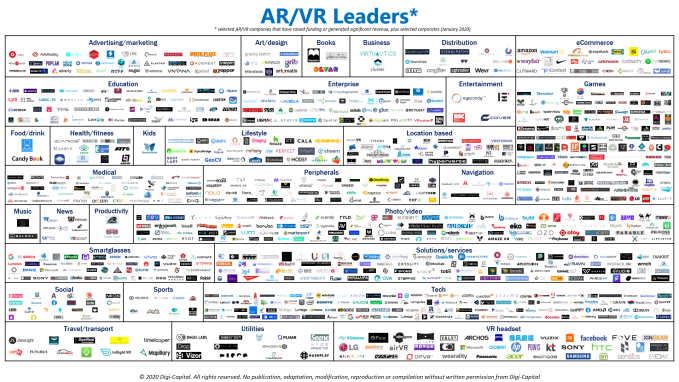
Will Apple, Facebook or Microsoft be the future of augmented reality?

Apple is seen by some as critical to the future of augmented reality, despite limited traction for ARKit so far and its absence from smartglasses (again, so far). Yet Facebook, Microsoft and others are arguably more important to where the market is today.

While there are more AR platforms than just these companies, they represent the top of the pyramid for three different types of AR roadmap. And while startup insurgents could make a huge difference, big platforms can exert disproportionate influence on the future of tech markets. Let’s see what this could mean for the future of AR.


Facebook: The messaging play

Facebook has talked about its long-term potential to launch smartglasses, but in 2020, its primary presence in the AR market is as a mobile AR platform (note: Facebook is also a VR market leader with Oculus). Although there are other ways to define them, mobile AR platforms can be thought of as three broad types:

  1. messaging-based (e.g. Facebook Messenger, Instagram, TikTok, Snapchat, Line)
  2. OS-based (e.g. Apple ARKit, Google ARCore)
  3. web-based (e.g. 8th Wall, Torch, others)


    from Apple – TechCrunch https://ift.tt/39ASxzP

Google’s Gboard introduces Emoji Kitchen, a tool to mash up emojis to use as stickers

If you’re ever felt like there just weren’t enough emoji options to express how you’re feeling, a new addition to Google’s Gboard keyboard, launching today, aims to help. Gboard for Android is introducing a feature called “Emoji Kitchen” which allows users to mash up different emoji then use them as stickers when messaging.

The stickers will work across apps, including Gmail, Messages by Google, Messenger, Snapchat, Telegram, WhatsApp, and others.

For example, you could add glasses to the various smiley emoji, add a cowboy hat to a ghost, have a robot cry tears, put a monkey face on a cactus (idk either), make the happy poop emoji express love with a heart, and so on.

[gallery ids="1945466,1945465,1945464,1945463,1945462,1945461,1945460,1945458"]


To be clear, you can’t just mash up any of the thousands of emoji with any other one — it only works with those Google supports, which are mainly variations on the smileys. That’s because the emoji aren’t being mashed up in real-time through some sort of A.I. system. Instead, Google designers have created this set of mashups for Gboard, specifically.

To use the option, you first tap on any smiley emoji and Emoji Kitchen will show which mashups are available to you.

Google’s Gboard has long been an experimental app for trying out new ideas in self-expression, including with launches like its own set of personalized emoji, called Emoji Minis, as well as with features like doodling, Morse code input, emoji suggestions and GIFs, and others in years past.

The app has been well-received by Android users, as a result — despite being years old, it’s still in a top 50 app in the Tools category and has over a billion downloads worldwide to date. It’s also now the default keyboard on some Android devices, like Google’s Pixel smartphones.

However, Google’s larger goal with Gboard is to make it compelling enough for users to keep it installed, giving the company a way to bring Google’s properties, like Search, directly to the end-user. That’s more important than ever at a time when mobile search has become bigger than desktop. Unfortunately for Google, mobile search has been much more expensive,  as the company now relies on deals with mobile device makers, like Apple, to make its search engine the default.

Gboard gives Google another way to hedge its bets — by skipping the need to use a browser app to get to Google. Users can just use their keyboard instead.

Google says Emoji Kitchen rolls out today to Android users.


from Android – TechCrunch https://ift.tt/31LUgiS
via IFTTT