Thursday, 9 April 2020

MIT develops privacy-preserving COVID-19 contact tracing inspired by Apple’s ‘Find My’ feature

One of the efforts that’s been proposed to contain the spread of COVID-19 is a contact trace and track program, that would allow health officials to keep better tabs on individuals who have been infected, and alert them to potential spread. Contract tracing has already seemingly proven effective in some parts of the world that have managed to curb the coronavirus spread, but privacy advocates have big reservations about any such system’s implementation in the U.S.

There are a number of proposals of how to implement a contact tracing system that preserves privacy, including a decentralization proposal for a group of European experts. In the U.S., MIT researchers have devised a new method to would provide automated contact tracing that taps into the Bluetooth signals sent out by everyone’s mobile devices, tying contacts to random numbers that aren’t linked to an individual’s identity in any way.

The system works by having each mobile device constantly be sending out random strings of numbers that the the researchers liken to “chirps” (though not actually audible). These are sent via Bluetooth, which is key for a couple of reasons, including that most people have Bluetooth enabled on their device all the time, and that it’s a short-range radio communication protocol that ensures any reception of a “chirp” came from someone you were in relatively close contact to.

If any person tests positive for COVID-19, they can then upload a full list of the chirps that their phone has broadcast over the past 14 days (which at the outside, should represent the full time they’ve been contagious). Those go into a database of chirps associated with confirmed positive cases, which others can scan against to see if their phone has received one of those chirps during that time. A positive match with one of those indicates that an individual could be at risk, since they were at least within 40 feet or so of a person who has the virus, and it’s a good indicator that they should seek a test if available, or at least self-quarantine for the recommended two-week period.

MIT’s system sidesteps entirely many of the thorniest privacy-related issues around contact tracing, which have been discussed in detail by the ACLU and other privacy protection organizations: It doesn’t use any geolocation information at all, nor does it connect any diagnosis or other information to a particular individual. It’s still not entirely left to individual discretion, which would be a risk from the perspective of ensuring compliance, because MIT envisions a health official providing a QR code along with delivering any positive diagnosis that would trigger the upload of a person’s chirp history to the database.

The system would work through an app they install on their phone, and its design was inspired by Apple’s “Find My” system for locating lost Mac and IOS hardware, as well as keeping track of the location of devices owned by loved ones. Find My also uses chirps to broadcast locations to passing Apple hardware.

“Find My inspired this system,” ays Marc Zissman, the associate head of MIT Lincoln Laboratory’s Cyber Security and Information Science Division and co-principal investigator of the project in a blog post describing the research. “If my phone is lost, it can start broadcasting a Bluetooth signal that’s just a random number; it’s like being in the middle of the ocean and waving a light. If someone walks by with Bluetooth enabled, their phone doesn’t know anything about me; it will just tell Apple, ‘Hey, I saw this light.’”

The system could be adapted to automate check-ins against the positive chirp database, and provide alerts to individuals who should get tested or self-isolate. Researchers worked closely with public health officials to ensure that this will suit their needs and goals as well as preserving privacy.

MIT’s team says that a critical next step to making this actually work broadly is to get Apple, Google and Microsoft on board with the plan. This requires close collaboration with mobile device platform operators to work effectively, they note. Extrapolating a step further, were iOS and Android to offer these as built-in features, that would go a long way towards encouraging widespread adoption.


from Android – TechCrunch https://ift.tt/2Xyg1Tt
via IFTTT

Wednesday, 8 April 2020

Mozilla names long-time chairwoman Mitchell Baker as CEO

Mozilla Corporation announced today that it has chosen long-time chairwoman Mitchell Baker to be CEO, replacing Chris Beard, who announced last August he would be stepping down at the end of the year.

Baker represents a logical choice to lead the company. At a time of great turmoil in the world at large, she brings the stability of someone who has been with Mozilla Corporation since 2003. Writing in a company blog post, she certainly recognized the challenges ahead, navigating the current economic uncertainty and the competitive challenges the company faces with its flagship Firefox browser.

“It’s a time of challenge on many levels, there’s no question about that. Mozilla’s flagship product remains excellent, but the competition is stiff. The increasing vertical integration of internet experience remains a deep challenge. It’s also a time of need, and of opportunity. Increasingly, numbers of people recognize that the internet needs attention,” Baker wrote.

Baker has been acting as interim CEO since December when Beard officially left the company. In a blog post from the board announcing Baker’s official new title, they certainly recognized that it would take someone with her unique combination of skills and experience to guide the company through this next phase.

“Mitchell’s deep understanding of Mozilla’s existing businesses gives her the ability to provide direction and support to drive this important work forward,” they wrote. Adding, “And her leadership style grounded in openness and honesty is helping the organization navigate through the uncertainty that COVID-19 has created for Mozillians at work and at home.”

Mozilla Corporation was founded in 1998 and is best known for its flagship, open-source Firefox browser. The company faces stiff competition in the browser market from Google, Apple and Microsoft.


from Apple – TechCrunch https://ift.tt/3e2eESN

Phos, the UK fintech that offers a software-only POS for smartphones, raises €1.3M

Phos, the U.K. fintech that offers a software-only PoS so that merchants can accept payments directly on their phones without the need for additional hardware, has raised €1.3 million in funding. The round was led by New Vision 3, an early-stage VC based in Bulgaria (where a part of the Phos team is based), with participation from a number of unnamed angel investors.

It brings the total raised by Phos to date to €2.5 million, and will be used to grow the development team. This will see new features introduced, such as ‘PIN on Phone,’ a Software Development Kit (SDK), and a new integrated loyalty system.

Founded in 2018, Phos has developed software that turns any NFC-equipped Android device into a payments terminal, negating the need for additional hardware and reducing total cost of ownership. The startup says its solution is quick to deploy, and is “uniquely” phone and bank agnostic i.e. any bank can act as the acquirer.

“Millions of traders and merchants do not accept card payments because they find the current hardware inconvenient or expensive,” Phos co-founder Ivo Gueorguiev tells TechCrunch. “Most of the merchants who accept card payments find the cost of ownership of the hardware high, [while the] current POS hardware offers no additional value, with the exception of very expensive smart terminals like Clover”.

To remedy this, Gueorguiev says Phos’ technology accepts contactless card payments directly on Android phones and other Android devices without the need for additional hardware, as well as helping merchants make better use of data.

“We offer merchants an alternative to old and expensive technology, namely [by using] devices they already own – their phones,” he explains. “We also offer merchants the ability to use their transaction data for other business applications. This includes e-commerce tools, marketing automation, loyalty, payroll, and more.

In terms of go-to-market, Phos is focused on a B2B model, seeing the fintech work with partners to distribute the product, such as banks, acquirers, PSPs/ISOs, large direct merchants, and platform players.

“The final user of the product will be mostly merchants at the long tail of the business, who are notoriously difficult to reach in a cost effective way,” adds Gueorguiev.

He cites use cases as small merchants and market traders, where traditional POS solutions are not appropriate due to costs and maintenance issues; direct sales and multilevel marketing; couriers and delivery services (“in certain markets ‘pay on delivery’ is still a predominant payment method with over 90% in cash,” says Gueorguiev); tradespeople; taxi drivers; insurance field sales; and even large retailers that can empower sales people to close sales in the aisles and reduce queues.

Adds Konstantin Petrov, Partner at NV3: “We are very happy to lead the investment round in phos and truly believe in the high potential of the company. The all important prerequisites for success are there: a strong and visionary team with years of experience in the field, a huge under-served market of small merchants who do not accept payments other than cash and an innovative technology providing first-mover advantage. In addition, fintech is considered a strategic vertical in the investment strategy of NV3 Fund, so phos is clearly a perfect add to our portfolio.”


from Android – TechCrunch https://ift.tt/2RkR3CN
via IFTTT

Tuesday, 7 April 2020

Securitization platform Cadence surpasses $125M deal volume and raises $4M

Securitization is a critical function of the modern financial system. Banks “package” individual loans, say a mortgage or an auto loan, into a group with similar characteristics and sell them to other investors. That gets the debt off the originator’s balance sheet so that they can offer more loans, while also offering private investors alternative investment opportunities to buy up.

Despite the scale of the market — the trade association SIFMA’s research shows that the volume for asset-backed securities reached more than $300 billion in 2019 (excluding mortgages) — much of that structuring remains relatively ad hoc, with structuring agents and buyers constantly seeking each other out.

Much in the way that real estate and startup crowdsourcing platforms democratized access to those alternative investments, Cadence wants to expand access to securitized products while increasing the velocity of transactions for originators and lowering prices. Founder and CEO Nelson Chu said that “our job is to bring transparency and efficiency to this market and through all the various things that we do.” The company operates on top of the Ethereum blockchain network.

Founded in 2018 and launched publicly in 2019, the New York City-based capital markets startup has now structured $88 million in notes across 76 offerings and 12 originators according to the company. The firm’s public leaderboard shows that the largest originators were Sellers Funding with more than $23 million and Wall Street Funding with almost $26 million in transaction volume. Chu said that “I think we are the 21st largest structuring agent the United States in 2020 so far,” which is not a bad place to be for a young startup in a massive multi-trillion dollar market.

In addition to that $88 million volume processed on the company’s retail platform, Cadence also structured a $40 million whole business securitization with FAT Brands, the owner of restaurant chains like Fatburger and Yalla Mediterranean. The company notes that the structuring reduced the company’s interest costs by $2 million.

The company has hit a number of milestones over the past two years. It closed a seed round of $4 million in December led by Revel VC, with Revel’s Thomas Falk, Navtej S. Nandra, former President of E*Trade, and portfolio manager Oliver Wriedt joining the company’s board.

In addition, back in 2019, the company said that it also became the first digital asset company to launch a digital asset ticker on Bloomberg Terminal and also the first to join the Bloomberg App Portal. It also secured the first financial debt rating for a digital asset.

The company has a variety of revenue streams from different areas of its platform. It takes transaction fees on each deal, but also derives revenues from hosting data related to the performance of the underlying loans. Given the company’s technology stack, it has better and more verified data about how the underlying assets that back each security are performing, giving all investment holders a much more robust look at the health of their portfolio.

Longer term, Cadence’s goal is to move to a mostly SaaS model for originators and buyers. “We can be very, very beneficial to every single counterparty involved when we become that,” Chu said, adding “we essentially are Switzerland … because our incentives are all aligned.”

I asked about how the company is responding to the COVID-19 situation, and Chu said that as the world saw in the 2008 global financial crisis, “there are pockets of opportunity here that we continue to find, and we allow retail, accredited investors to get access to that.” Chu gave the example of game developers waiting on payments from Apple and Google who need short-term loans to cover costs.

In addition to Revel, other investors in the seed round included Morgan Creek Digital, Nimble Ventures, Argo, Tuesday Capital, Manatt, and Recharge Capital. R&R Venture Partners, a joint VC firm of former Citi chairman Richard D. Parsons and Clinique chairman Ronald S. Lauder, also participated.


from Apple – TechCrunch https://ift.tt/3dZdyqV

Jack Dorsey creates $1B COVID-19 relief fund using Square equity

Jack Dorsey announced in a series of tweets today that he is shifting $1 billion in his Square equity to create a fund dedicated to COVID-19 relief. The Twitter and Square CEO is calling the fund Start Small and posting a tally of disbursements and recipients in a public spreadsheet.

Dorsey said in his announcement that the new initiative will shift the focus to other causes at some point.

The first Start Small contribution listed is $100,000 to America’s Food Fund — an effort led by Leonardo DiCaprio and Laurene Powell Jobs dedicated to providing meals to vulnerable populations disrupted by the COVID-19 pandemic.

Other top backers of America’s Food Fund include Oprah Winfrey ($1 million) and Apple ($5 million), according to the organization’s GoFundMe page.

That’s what we know so far from a tweet posted Tuesday afternoon by the American tech entrepreneur who co-founded and leads not one, but two publicly listed companies.

There’s still a lot to learn about Dorsey’s new initiative, including how it will be managed, whether it will make investments (along with donations) and how to apply for funding. TechCrunch has asked Square for additional details and will update this post when we hear back.


from Apple – TechCrunch https://ift.tt/3aUlkAf

WhatsApp introduces new limit on message forwards to fight spread of misinformation

WhatsApp is imposing additional restriction on how frequently a message can be shared on its platform in its latest effort to curtail the spread of misinformation.

The Facebook-owned instant messaging service said today that any message that has been forwarded five or more times will now face a new limit that will prevent a user from forwarding it to more than one chat (contact) at a time.

A spokesperson told TechCrunch that WhatsApp will roll out this change to users worldwide today.

Today’s move builds on WhatsApp’s effort from last year when it limited users from forwarding a message to more than five users at once. The service, used by more than 2 billion users, said the move allowed it to reduce the volume of message forwards globally by 25%.

The end-to-end encryption on WhatsApp — which the company is fighting for in several markets — prevents it from reading the content of a message, so it relies on metadata of a message to gauge its spread.

“Is all forwarding bad? Certainly not,” the company wrote in a blogpost today. “However, we’ve seen a significant increase in the amount of forwarding which users have told us can feel overwhelming and can contribute to the spread of misinformation. We believe it’s important to slow the spread of these messages down to keep WhatsApp a place for personal conversation.”

More than a dozen deaths in recent years — several in WhatsApp’s biggest market, India — have been linked to viral circulation of misinformation on Facebook’s service.

Facebook has moved to take several efforts in recent weeks as the world grapples with the coronavirus pandemic. Last month, it announced free developer tools for Messenger to combat COVID-19, and introduced an info centre atop of the news feed to prominently showcase reliable information.

Additionally, the company is also working with nonprofit organizations such as the WHO to build helplines, and has committed to donate millions of dollars. The World Health Organization’s helpline on Messenger and WhatsApp has already reached more than 10 million users, days after its launch. The Indian government also launched a helpdesk bot on WhatsApp last month.

But the vast reach of Facebook has also attracted scammers. “Unfortunately, scammers may try to take advantage of people’s vulnerability and generosity during this time,” wrote Stan Chudnovsky, VP of Messenger.

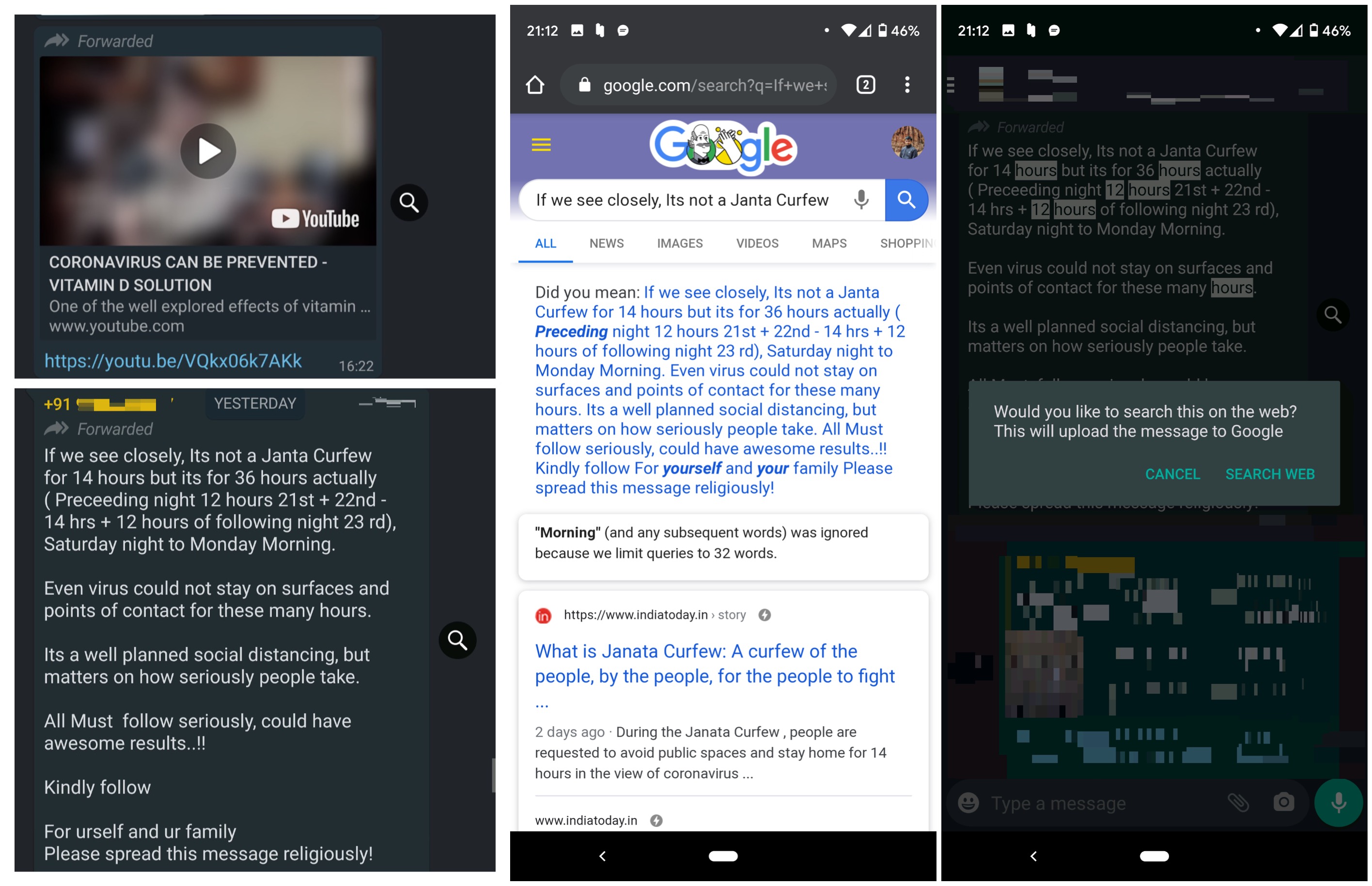
WhatsApp has also been testing a feature on the beta version of its Android app that gives users the ability to quickly comb through the web with the text or video they have received for more context.

Images credit: @shrinivassg

A spokesperson said the platform plans to roll out this feature in the near future.


from Android – TechCrunch https://ift.tt/2wlbZCD
via IFTTT

Monday, 6 April 2020

COVID-19 crisis spurs triple-digit growth for refurbishing startup Back Market

While a number of startups have been hard hit by efforts to curb the spread of the COVID-19 virus, refurbishing firm Back Market is showing increased growth globally.

The Paris-based startup encourages customers to send in their old devices so they can be refurbished and resold into the e-commerce secondhand market. The growth achieved in the midst of the COVID-19 crisis is partly due to increased laptop sales as people seek better devices to work remotely.

For people who are unsure whether refurbished products are reliable, Back Market permits customers to send in old devices, exchange them for newer versions and pay the difference. CEO Thibaud Hug de Larauze said this payback service is currently possible only in France, but starting in Q2, it will be available in other markets.

Founded in 2014, Back Market has raised a total of €48 million in funding over two rounds, most recently a Series B in June 2018. The company is profitable and reportedly still has money to spend from its last funding round.

“We don’t release the gross merchandise volume, but it’s a three-digit growth rate,” Hug de Larauze told TechCrunch. “We saw an increase in demand for laptops, printers and other devices needed for working at home. Demand for refurbished phones is going down as people seek to get the first necessity items, like food for their situation.”

Over the past two weeks, Back Market saw skyrocketing demand from Italy, a nation with a high coronavirus death toll where citizens were warned they would be confined to their homes for four weeks.

Another factor that helped the platform’s growth: Smartphone brands like Apple and Samsung closed their retail stores, a move that turned Back Market into a major supply channel. While offline retailers and carriers are shut down in Europe, Hug de Larauze says Chinese offline retailers and refurbishing factories are starting to get back to work.


from Apple – TechCrunch https://ift.tt/39JVYDX