Tuesday, 21 April 2020

Apple expands App Store, Music, iCloud and other services to dozens of additional markets

Apple said today it is launching its services App Store, Apple Podcasts, iCloud, and Apple Music to dozens of new additional markets in Africa, Europe, Asia-Pacific, and Middle East among others in what is one of the biggest geographical pushes from one of the world’s biggest firms.

The App Store, Apple Arcade, Apple Podcasts, and iCloud are now available in 20 additional markets, whereas the iPhone-maker’s music streaming service Apple Music has launched in an additional 52 nations.

The App Store, Apple Arcade, Apple Music, Apple Podcasts and iCloud are now available in the following countries and regions:

  • Africa: Cameroon, Côte d’Ivoire, Democratic Republic of the Congo, Gabon, Libya, Morocco, Rwanda, and Zambia.
  • Asia-Pacific: Maldives and Myanmar.
  • Europe: Bosnia and Herzegovina, Georgia, Kosovo, Montenegro, and Serbia.
  • Middle East: Afghanistan (excluding Apple Music) and Iraq.
  • Oceania: Nauru (excluding Apple Music), Tonga, and Vanuatu.

Apple Music is expanding to the following countries and regions:

  • Africa: Algeria, Angola, Benin, Chad, Liberia, Madagascar, Malawi, Mali, Mauritania, Mozambique, Namibia, Republic of the Congo, Senegal, Seychelles, Sierra Leone, Tanzania, and Tunisia.
  • Asia-Pacific: Bhutan.
  • Europe: Croatia, Iceland, and North Macedonia.
  • Latin America and the Caribbean: the Bahamas, Guyana, Jamaica, Montserrat, St. Lucia, St. Vincent and the Grenadines, Suriname, Turks and Caicos, and Uruguay.
  • Middle East: Kuwait, Qatar, and Yemen.
  • Oceania: Solomon Islands.

“We’re delighted to bring many of Apple’s most beloved Services to users in more countries than ever before,” said Oliver Schusser, Apple’s vice president of Apple Music and International Content, in a statement.

“We hope our customers can discover their new favorite apps, games, music, and podcasts as we continue to celebrate the world’s best creators, artists, and developers,” he added.

App Store is now available in 175 countries and regions, whereas Apple Music has reached 167 markets.


from Apple – TechCrunch https://ift.tt/3eGk3im

Monday, 20 April 2020

Daily Crunch: Apple’s new Magic Keyboard, reviewed

The new Magic Keyboard is good, Uber launches new delivery services and Facebook releases its Gaming app ahead of schedule.

Here’s your Daily Crunch for April 20, 2020, a totally regular date with no cultural significance whatsoever. Also, just a reminder: We’re holding our first Extra Crunch Live session, with Aileen Lee and Ted Wang, at 1:30pm Eastern!

1. Apple’s Magic Keyboard review: Laptop-class typing comes to iPad Pro

TechCrunch’s Editor in Chief Matthew Panzarino says that, for the past two years, he’s typed nearly every word while traveling on the iPad Pro’s Smart Keyboard Folio. Even so, he acknowledged that, aside from its reliability and durability, the Keyboard Folio kind of stinks.

In contrast, the new Magic Keyboard is a first-class typing experience, full stop.

2. Uber adds retail and personal package delivery services as COVID-19 reshapes its business

Uber Direct is a delivery platform for retail items, while Connect is a peer-to-peer package delivery service for sending goods to family and friends. This marks the most aggressive foray yet for Uber into courier services after it already introduced grocery items to its Uber Eats platform.

3. Facebook’s new Gaming app launches on Android, with iOS version coming soon

The social media giant pushed the app out two months prior to its scheduled unveiling — amid a global pandemic that’s left people all over the world isolated at home, rapidly burning through entertainment options.

4. Hundreds of academics back privacy friendly coronavirus contact tracing apps

A letter, signed by nearly 300 academics and published Monday, praised recent announcements from Apple and Google to build an opt-in and decentralized way of allowing individuals to know if they have come into contact with someone confirmed to be infected with the novel coronavirus.

5. Top investors predict what’s ahead for Boston’s VC scene in Q1

While Boston’s startup market announced a number of huge rounds that bolstered its total venture dollars raised in the first quarter, there were signs of weakness: Deal volume was still a little under the pace set in 2018. (Extra Crunch membership required.)

6. Marc Andreessen’s call to arms: build something meaningful

In a new essay published over the weekend, Andreessen writes that to “reboot the American dream” we need to “demand more of our political leaders, of our CEOs, our entrepreneurs, our investors. We need to demand more of our culture, of our society. And we need to demand more from one another. We’re all necessary, and we can all contribute, to building.”

7. This week’s TechCrunch podcasts

The latest full-length episode of Equity discusses Robinhood’s plans to raise new capital, while the Monday news roundup looks at the U.K.’s financial aid for startups. And on Original Content, we reviewed “Tigertail” and the full season of “Devs” (both are good, but everyone should be watching “Devs”).

The Daily Crunch is TechCrunch’s roundup of our biggest and most important stories. If you’d like to get this delivered to your inbox every day at around 9am Pacific, you can subscribe here.


from Apple – TechCrunch https://ift.tt/2VouaRn

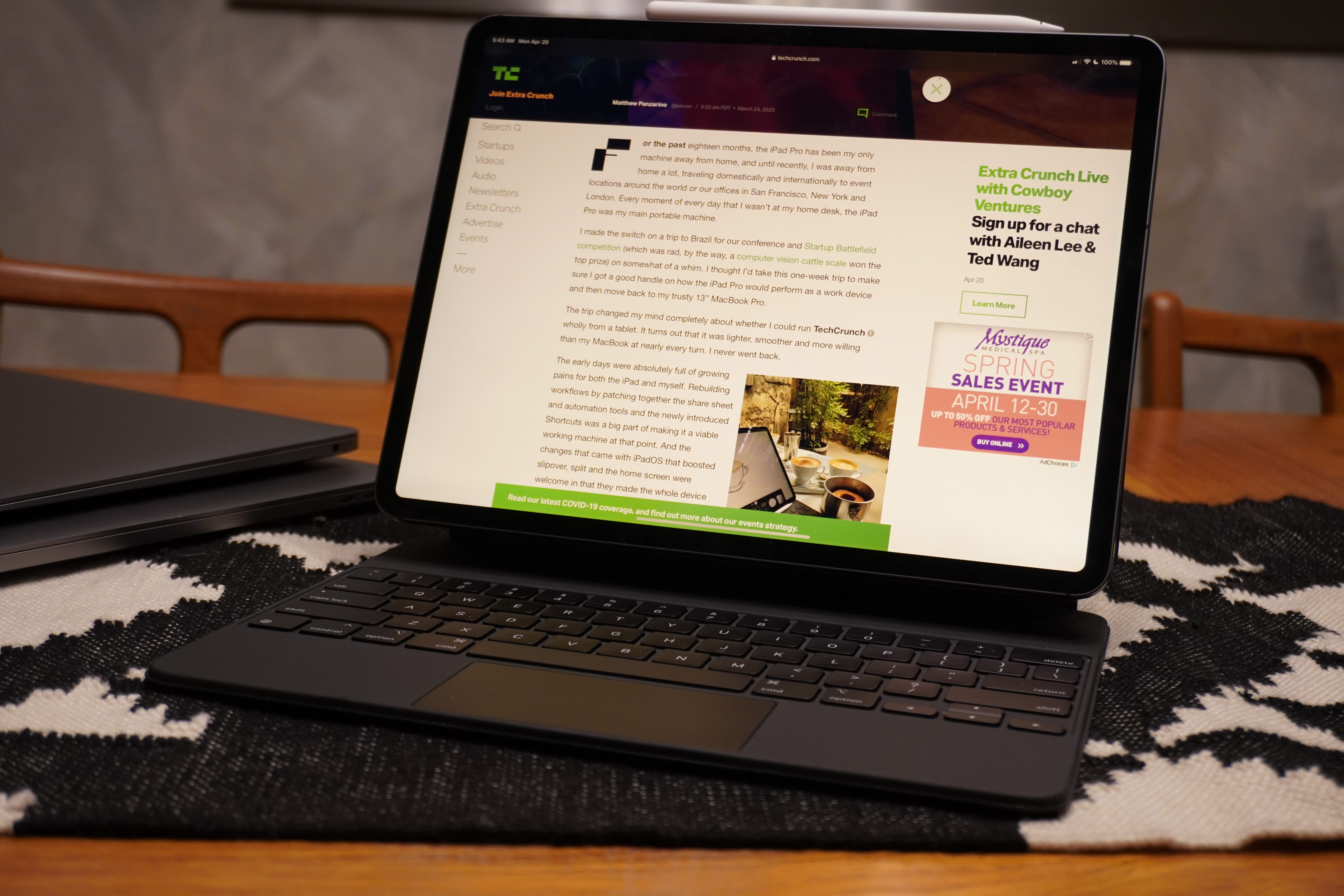
Apple’s Magic Keyboard Review: Laptop class typing comes to iPad Pro

Over the past two years, I’ve typed nearly every word I’ve written while traveling on the iPad Pro’s Smart Keyboard Folio. For more on why you can see my iPad Pro review here.

For the purposes of this look at the new Magic Keyboard, though, you should probably just know two things:

  1. It was reliable, incredibly durable and never once failed me.
  2. It kind of stunk in every other way.

The Keyboard Folio’s plastic coated surface made it impervious to spills, but it also made the keys much less responsive. It rendered them unable to give your fingers the feedback necessary to confirm that a key had been struck, leading me to adopt a technique where I just hit every key with maximum strength at all times.

The new Magic Keyboard is as different from that device as the new MacBook Pro keyboards are from the low profile ones that dominated headlines over the last couple of years. It’s a huge jump forward in usability for the iPad Pro — and for last year’s model too.

I am very relieved I don’t have to slam my fingers onto the plastic keyboard anymore, because over long and fast typing sessions I could feel a numbness that would begin to radiate from the tips of my fingers a bit. An enervation of sorts. It wasn’t precisely painful but it was noticeable.

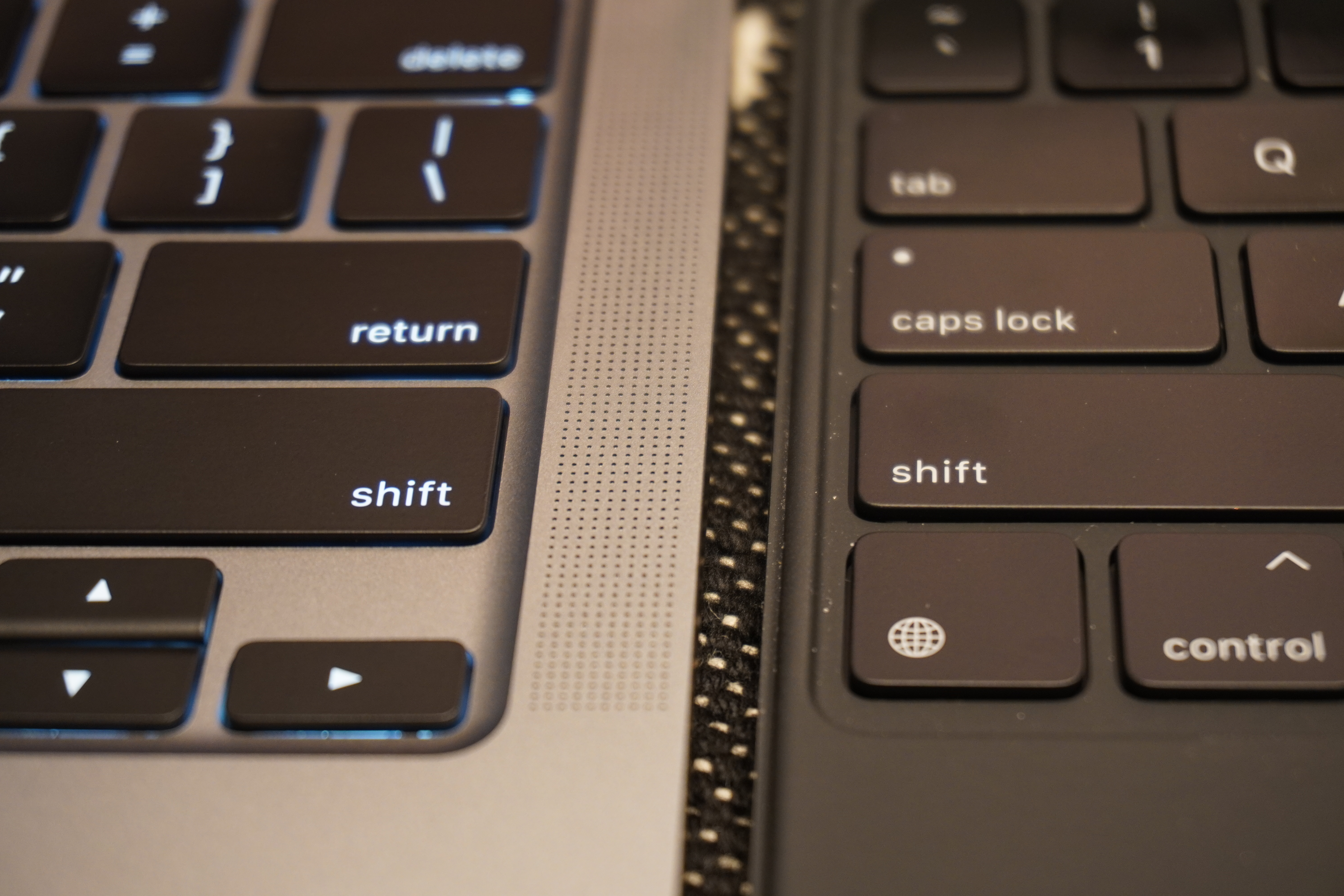
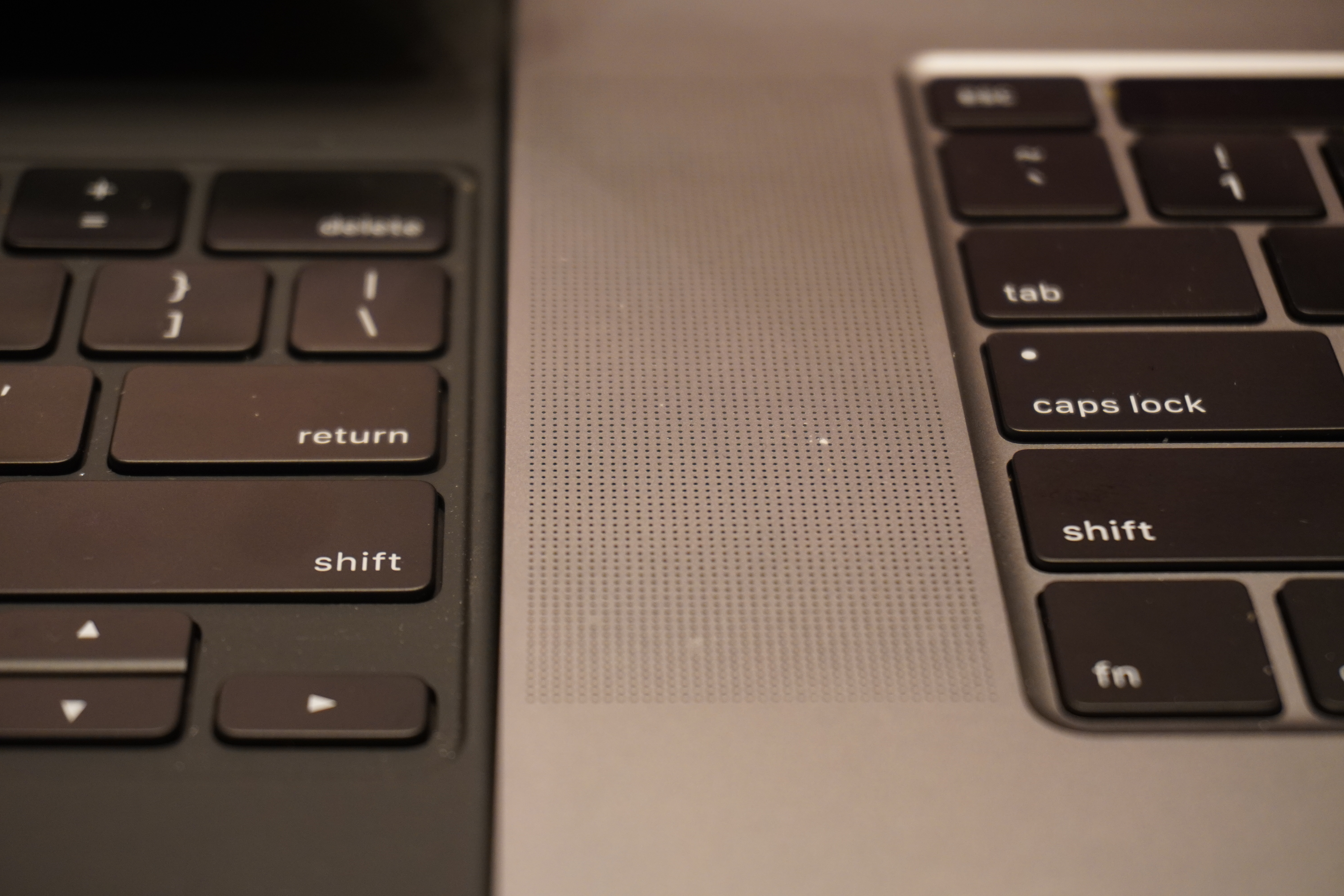
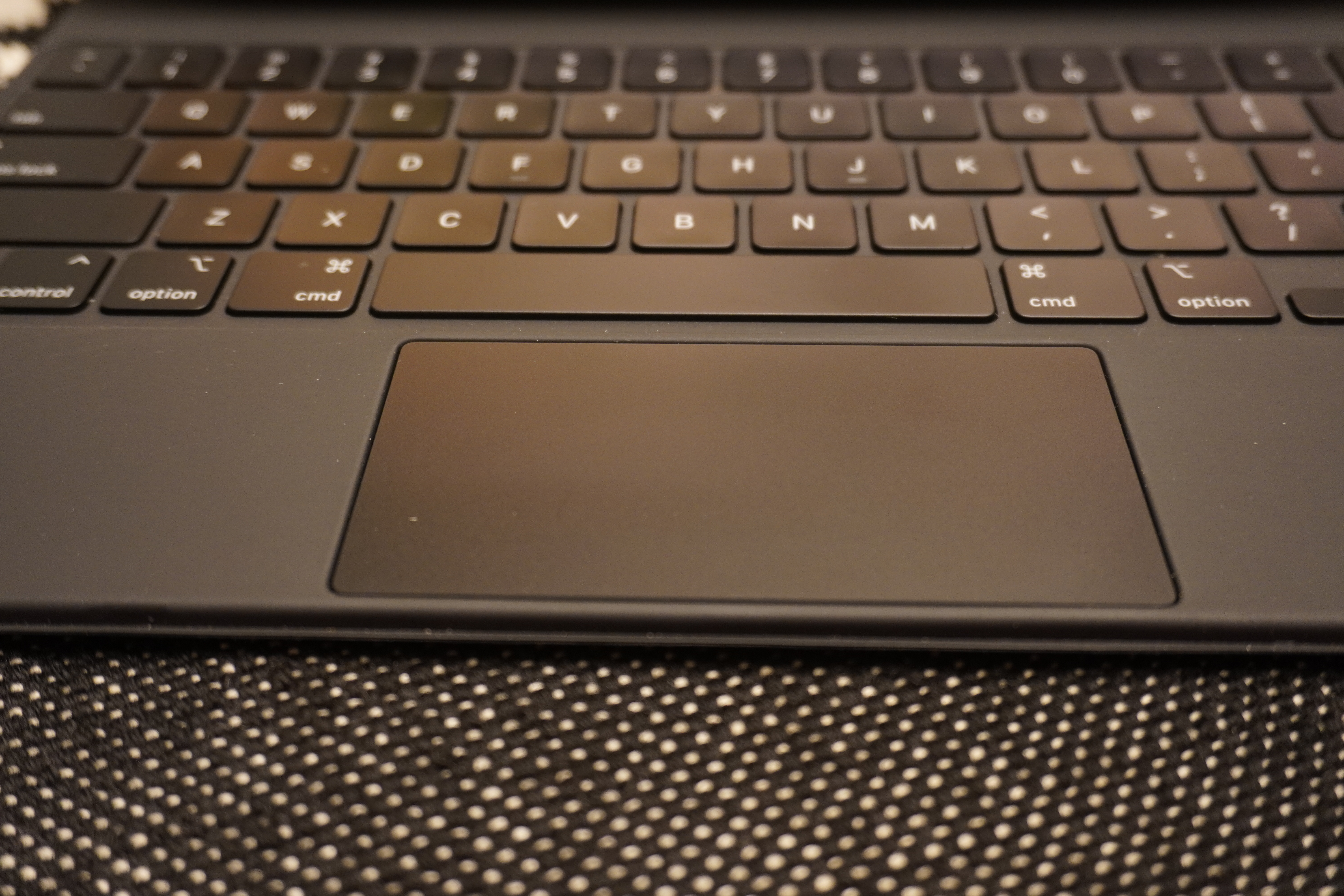
The Magic Keyboard offers a lovely, backlit deck that holds its own against the 16” MacBook Pro and the new MacBook Air for best portable keyboards. The key travel is excellent — in between the two laptops in my opinion — and the feel is tight, responsive and precise. This is a first class typing experience, full stop.

I’ve been testing the three keyboards alongside one another for the past few days and I can’t stress enough how stable the keys are. Even the MacBook Air allows a tiny bit of key shift if you touch your finger to it and gently circle it — though the MacBook Pro is better. There’s such a small amount of that here that it’s almost imperceptible.

It’s a tad spongier than the 16” MBP but more firm than the MacBook Air, which has a bit more return and travel. In my opinion, this keyboard is ‘louder’ (due to the plastic casing being more resonant than the aluminum), than the 16” MBP, but about the same as the MacBook Air. The throw feels similar to the 16” though, with the Air being slightly deeper but ‘sloppier’.

So a hybrid between those two keyboards as far as feel goes, but a clear descendant of the work that was done to turn those offerings around.

Construction

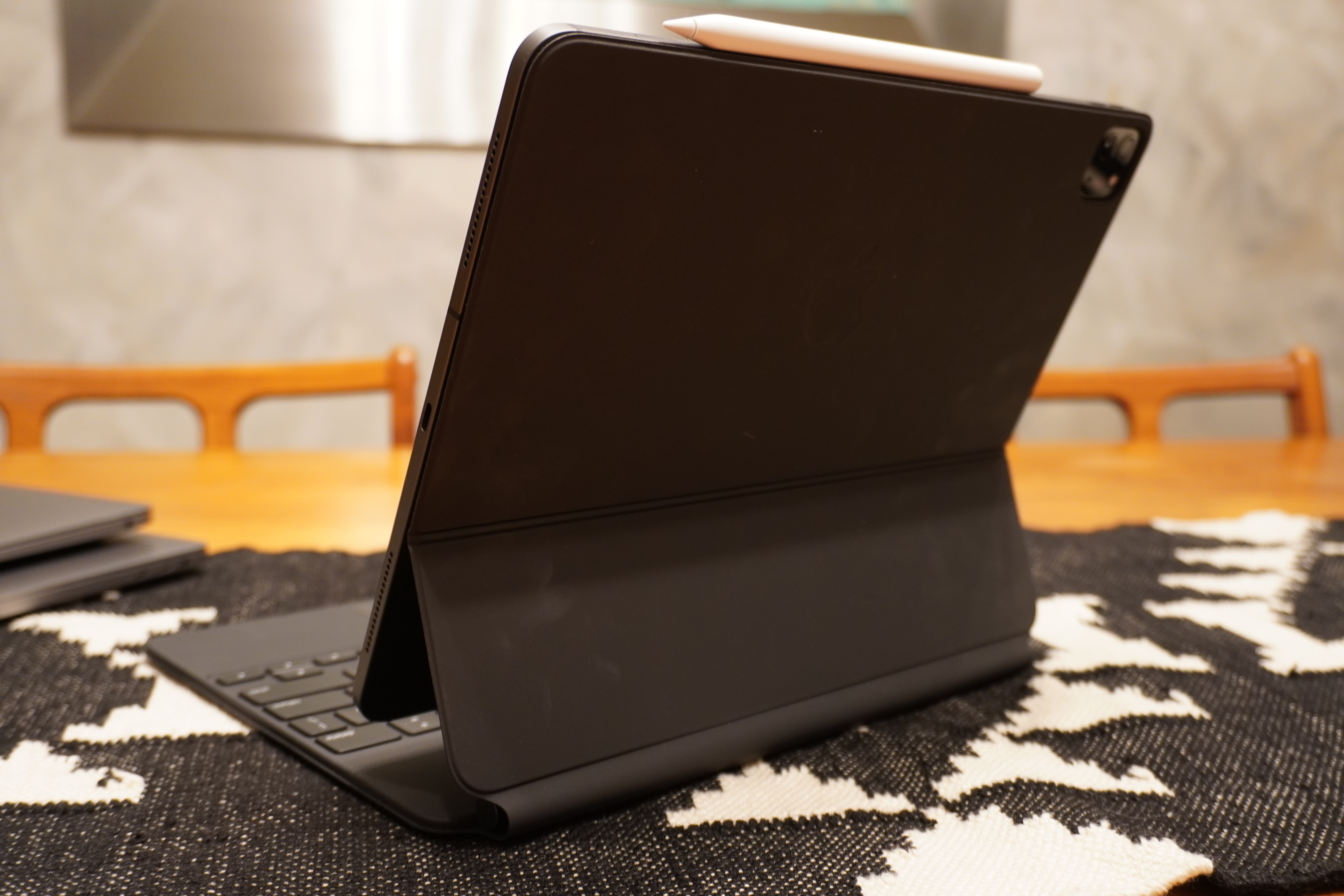
Among my biggest concerns was that Apple would get overly clever with the hinge design, making the the typing an exercise in wobble. Happy to say here that they took the clear path here and made it as sturdy as possible, even if that was at the cost of variability.

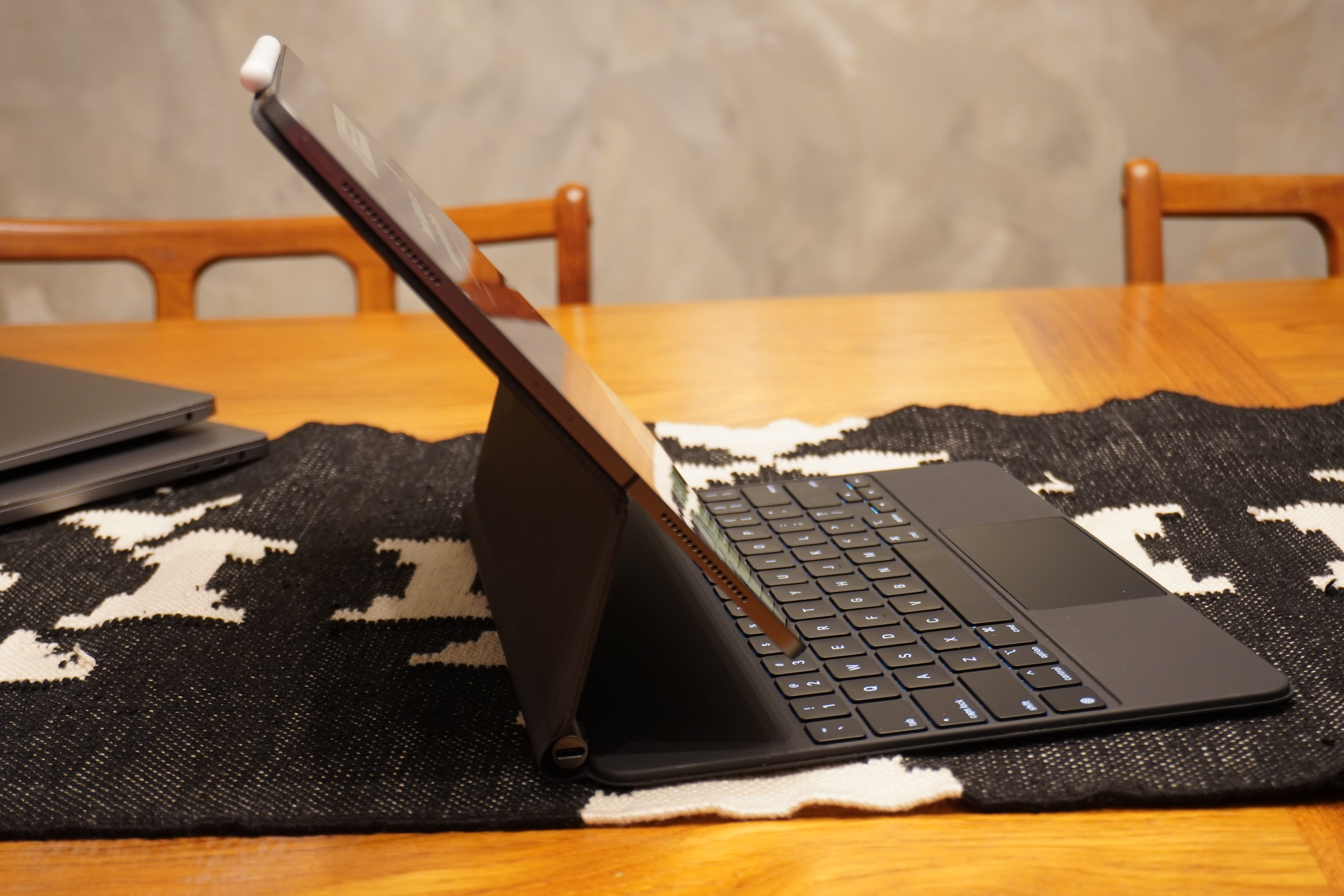
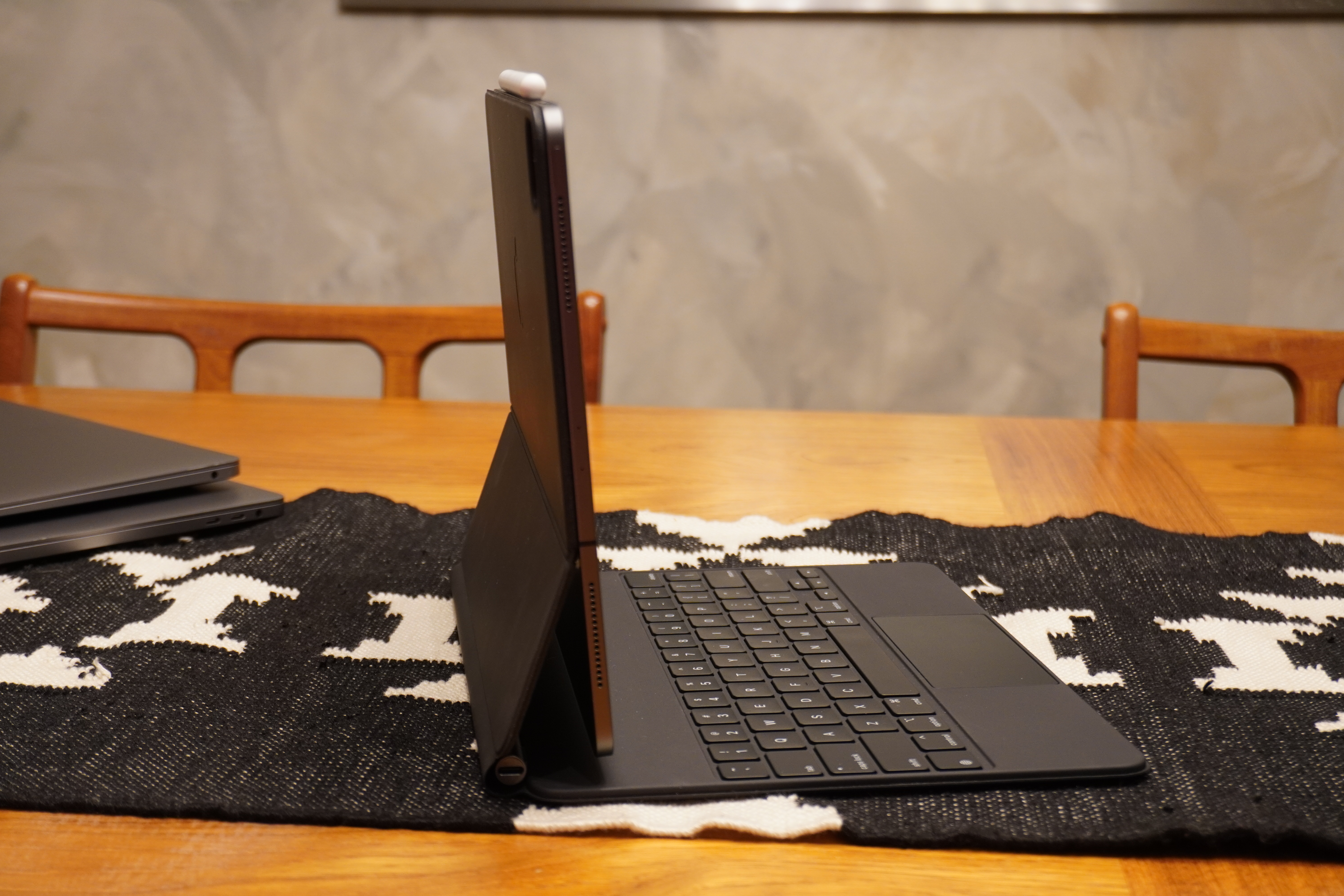
The hinge is a simple limit stop design that opens far less than you’d expect and then allows a second hinge to engage to open in an arc between the 80 and 130 degrees. The 90 degree and fully open positions basically mimic the angles that were offered by the grooves of the Keyboard Folio — but now you can choose any in-between position that feels natural to you.

Apple has obviously put this hard stop fold out limit in place to maintain balance on tables and laps, and its clever use of counter opposing forces with the second hinge combines to limit tipping and to make typing on a lap finally a completely viable thing to do. The fact that you don’t have to hammer the keyboard to type also makes this a better proposition.

For typing, these positions should be just fine for the vast majority of users. And the solid (very high friction) hinge means that the whole thing is very sturdy feeling, even with more moving parts. I have been quite comfortable grabbing the whole assembly of the 12.9” iPad Pro plus Magic Keyboard by the deck of the keyboard and carrying it around, much in the way I’d carry a laptop. No worries about accidental floppiness or detachment.

At the same time, the new design that floats the iPad in the air allows you to quickly pop it off with little effort by either your left or right hand. This makes the Magic Keyboard take on the use case of a desktop based dock, something that never felt right with the Keyboard Folio.

The touchpad physically moves here, and is not a haptic pad, but it is clickable across its entire surface. It’s also a laptop-class trackpad, proving that Apple’s engineering teams still have a better idea about how to make a trackpad that works crisply and as expected than any other hardware team out there.

I do love the soft touch coating of the case itself, but I believe it will wear in a similar fashion to these kinds of surfaces on other devices. It will likely develop shiny spots on either side of the trackpad on the hand rest areas.

The responsive half arrow keys are extremely welcome.

Some other details, quirks and upper limits

The camera placement situation is much improved here, as you’re less likely to hold the left side of the iPad to keep it stable. The lift of the keyboard (at times about an inch and a bit) means that the eye line, while still not ideal, is improved for zoom calls and the like. Less double chin up the nose action. Apple should still move the iPad Pro’s camera on future versions.

The keyboard’s backlight brightness is decent and adjustable in the settings pane once it’s attached to iPad Pro. The unit did use more battery in my tests, though I haven’t had it long enough to assign any numbers to it. I did notice during a recent Facetime call that the battery was draining faster than it could charge, but that is so far anecdotal and I haven’t had the time to reproduce it in testing.

This is not the case that artists have been waiting for. This case does not rotate around backwards like the keyboard folio, meaning that you’re going to be popping it off the case if you’re going to draw on it at all. In some ways the ease of removal feels like an Apple concession. ‘Hey, we couldn’t fit all this in and a way to position it at a drawing angle, so we made it really easy to get it loose.’ It works, but I hope that more magic happens between now and the next iteration to find a way to serve both typing and drawing in one protected configuration.

A little quirk: when it’s tilted super far back to the full stop I sometimes nick the bottom edge of the iPad with my fingers when hitting numbers — could be my typing form or bigger hands but I thought it worth mentioning.

It’s a bit heavy. At 700g for the 12.9” keyboard, it more than doubles the weight of the whole package. The larger iPad Pro and keyboard is basically the weight of a MacBook Air. Get the 11” if weight is a concern. This keyboard makes the iPad 12.9″ package feel very chunky. The

The fact that this keyboard works on the older iPad Pro (the camera just floats inside the cutout) means that this is a fantastic upgrade for existing users. It really makes the device feel like it got a huge upgrade without having to buy a new core unit, which fits with Apple’s modular approach to iPad Pro and also stands out as pretty rare in a world where the coolest new features are often hardware related and new device limited.

At $300 and $350 for each size of Magic Keyboard, the price is something you must think about up front. Given that it is now easily the best keyboard available for these devices I think you need to consider it a part of the package price of the device. If you can’t swing that, consider another option — it’s that good.

I’d love more angles of use here and I’m hoping that they include more — that said! If you work seriously with the iPad and that work is based on typing, the Magic Keyboard is essentially mandatory. It’s the dream keyboard for all of us who found ourselves crossing the Rubicon into iPad as primary computer over the past couple of years. It’s not without its caveats, but it is a refreshingly straightforward and well executed accessory that makes even older iPads feel like better laptops than laptops.


from Apple – TechCrunch https://ift.tt/34RlPsP

Saturday, 18 April 2020

This Week in Apps: Layoffs at VSCO, Google Play’s new guidelines, TikTok rolls out parental controls

Welcome back to This Week in Apps, the Extra Crunch series that recaps the latest OS news, the applications they support and the money that flows through it all.

The app industry is as hot as ever, with a record 204 billion downloads in 2019 and $120 billion in consumer spending in 2019, according to App Annie’s “State of Mobile” annual report. People are now spending 3 hours and 40 minutes per day using apps, rivaling TV. Apps aren’t just a way to pass idle hours — they’re a big business. In 2019, mobile-first companies had a combined $544 billion valuation, 6.5x higher than those without a mobile focus.

In this Extra Crunch series, we help you keep up with the latest news from the world of apps, delivered on a weekly basis.

This week we’re continuing to look at how the coronavirus outbreak is impacting the world of mobile applications, including a dig into Houseparty’s big surge, layoffs at VSCO, Google’s launch of a “Teacher Reviewed” tag, Bumble’s virtual dating, plus changes to Instagram in support of small business and live streaming, among other things. Also this week, Google changed its Play Store guidelines, TikTok launched parental controls, a report suggested Apple may be expanding its Search Ads and more.

Coronavirus Special Coverage

Instagram adds features for supporting small businesses during pandemic


from Apple – TechCrunch https://ift.tt/2Vk4zsS

What is contact tracing?

One of the best tools we have to slow the spread of the coronavirus is, as you have no doubt heard by now, contact tracing. But what exactly is contact tracing, who does it and how, and do you need to worry about it?

In short, contact tracing helps prevent the spread of a virus by proactively finding people at higher risk than others due to potential exposure, notifying them if possible, and quarantining them if necessary. It’s a proven technique, and smartphones could help make it even more effective — but only if privacy and other concerns can be overcome.

Contact tracing, from memory to RAM

Contact tracing has been done in some form or another as long as the medical establishment has understood the nature of contagious diseases. When a person is diagnosed with an infectious disease, they are asked whom they have been in contact with over the previous weeks, both in order to determine who may have been infected by them and perhaps where they themselves were infected.

Until very recently, however, the process has relied heavily on the recall of people who are in a highly stressful situation and, until prompted, were probably not paying special attention to their movements and interactions.

This results in a list of contacts that is far from complete, though still very helpful. If those people can be contacted and their contacts likewise traced, a network of potential infections can be built up without a single swab or blood drop, and lives can be saved or important resources better allocated.

You might think that has all changed now what with modern technology and all, but in fact contact tracing being done at hospitals right now is almost all still of the memory-based kind — the same we might have used a hundred years ago.

It certainly seems as if the enormous digital surveillance apparatus that has been assembled around us over the last decade should be able to accomplish this kind of contact tracing easily, but in fact it’s surprisingly useless for anything but tracking what you are likely to click on or buy.

While it would be nice to be able to piece together a contagious person’s week from a hundred cameras spread throughout the city and background location data collected by social media, the potential for abuse of such a system should make us thankful it is not so easy as that. In other, less dire circumstances the ability to track the exact movements and interactions of a person from their digital record would be considered creepy at best, and perhaps even criminal.

But it’s one thing when an unscrupulous data aggregator uses your movements and interests to target you with ads without your knowledge or consent — and quite another when people choose to use the forbidden capabilities of everyday technology in an informed and limited way to turn the tide of a global pandemic. And that’s what modern digital contact tracing is intended to do.

Bluetooth beacons

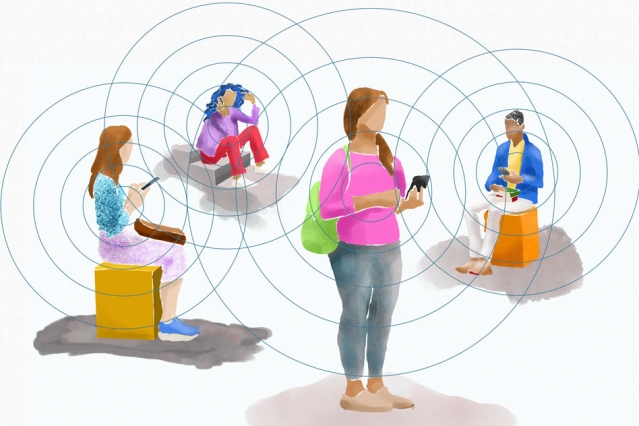
All modern mobile phones use wireless radios to exchange data with cell towers, Wi-Fi routers, and each other. On their own, these transmissions aren’t a very good way to tell where someone is or who they’re near — a Wi-Fi signal can travel 100 to 200 feet reliably, and a cell signal can go miles. Bluetooth, on the other hand, has a short range by design, less than 30 feet for good reception and with a swiftly attenuating signal that makes it unlikely to catch a stray contact from much further out than that.

We all know Bluetooth as the way our wireless earbuds receive music from our phones, and that’s a big part of its job. But Bluetooth, by design, is constantly reaching out and touching other Bluetooth-enabled devices — it’s how your car knows you’ve gotten into it, or how your phone detects a smart home device nearby.

Bluetooth chips also make brief contact without your knowledge with other phones and devices you pass nearby, and if they aren’t recognized, they delete each other from their respective memories as soon as possible. But what if they didn’t?

The type of contact tracing being tested and deployed around the world now uses Bluetooth signals very similar to the ones your phone already transmits and receives constantly. The difference is it just doesn’t automatically forget the other devices it comes into contact with.

Assuming the system is working correctly, what would happen when a person presents at the hospital with COVID-19 is basically just a digitally enhanced version of manual contact tracing. Instead of querying the person’s fallible memory, they query the phone’s much more reliable one, which has dutifully recorded all the other phones it has recently been close enough to connect to. (Anonymously, as we’ll see.)

Those devices — and it’s important to note that it’s devices, not people — would be alerted within seconds that they had recently been in contact with someone who has now been diagnosed with COVID-19. The notification they receive will contain information on what the affected person can do next: Download an app or call a number for screening, for instance, or find a nearby location for testing.

The ease, quickness, and comprehensiveness of this contact tracing method make it an excellent opportunity to help stem the spread of the virus. So why aren’t we all using it already?

Successes and potential worries

In fact digital contact tracing using the above method (or something very like it) has already been implemented with millions of users, apparently to good effect, in east Asia, which of course was hit by the virus earlier than the U.S. and Europe.

In Singapore the TraceTogether app was promoted by the government as the official means for contact tracing. South Korea saw the voluntary adoption of a handful of apps that tracked people known to be diagnosed. Taiwan was able to compare data from its highly centralized healthcare system to a contact tracing system it began work on during the SARS outbreak years ago. And mainland China has implemented a variety of tracking procedures through mega-popular services like WeChat and Alipay.

While it would be premature to make conclusions on the efficacy of these programs while they’re still underway, it seems at least anecdotally to have improved the response and potentially limited the spread of the virus.

But east Asia is a very different place from the U.S.; we can’t just take Taiwan’s playbook and apply it here (or in Europe, or Africa, etc.), for myriad reasons. There are also valid questions of privacy, security, and other matters that need to be answered before people, who for good reason are skeptical of the intentions of both the government and the private sector, will submit to this kind of tracking.

Right now there are a handful of efforts being made in the U.S., the largest profile by far being the collaboration between arch-rivals Apple and Google, which have proposed a cross-platform contact tracing method that can be added to phones at the operating system.

The system they have suggested uses Bluetooth as described above, but importantly does not tie it to a person’s identity in any way. A phone would have a temporary ID number of its own, and as it made contact with other devices, it exchanges numbers. These lists of ID numbers are collected and stored locally, not synced with the cloud or anything. And the numbers also change frequently so no single one can be connected to your device or location.

If and only if a person is determined to be infected with the virus, a hospital (not the person) is authorized to activate the contact tracing app, which will send a notification to all the ID numbers stored in the person’s phone. The notification will say that they were recently near a person now diagnosed with COVID-19 — again, these are only ID numbers generated by a phone and are not connected with any personal information. As discussed earlier, the people notified can then take whatever action seems warranted.

MIT has developed a system that works in a very similar way, and which some states are reportedly beginning to promote among their residents.

Naturally even this straightforward, decentralized, and seemingly secure system has its flaws; this article at the Markup gives a good overview, and I’ve summarized them below:

  • It’s opt-in. This is a plus and a minus, of course, but means that many people may choose not to take part, limiting how comprehensive the list of recent contacts really is.
  • It’s vulnerable to malicious interference. Bluetooth isn’t particularly secure, which means there are several ways this method could be taken advantage of, should there be any attacker depraved enough to do so. Bluetooth signals could be harvested and imitated, for instance, or a phone driven through the city to “expose” it to thousands of others.
  • It could lead to false positives or negatives. In order to maintain privacy, the notifications sent to others would contain a minimum of information, leading them to wonder when and how they might have been exposed. There will be no details like “you stood next to this person in line 4 days ago for about 5 minutes” or “you jogged past this person on Broadway.” This lack of detail may lead to people panicking and running to the ER for no reason, or ignoring the alert altogether.
  • It’s pretty anonymous, but nothing is truly anonymous. Although the systems seem to work with a bare minimum of data, that data could still be used for nefarious purposes if someone got their hands on it. De-anonymizing large sets of data is practically an entire domain of study in data science now and it’s possible that these records, however anonymous they appear, could be cross-referenced with other data to out infected persons or otherwise invade one’s privacy.
  • It’s not clear what happens to the data. Will this data be given to health authorities later? Will it be sold to advertisers? Will researcher be able to access it, and how will they be vetted? Questions like these could very well be answered satisfactorily, but right now it’s a bit of a mystery.

Contact tracing is an important part of the effort to curb the spread of the coronavirus, and whatever method or platform is decided on in your area — it may be different state to state or even between cities — it is important that as many people as possible take part in order to make it as effective as possible.

There are risks, yes, but the risks are relatively minor and the benefits would appear to outweigh them by orders of magnitude. When the time comes to opt in, it is out of consideration for the community at large that one should make the decision to do so.


from Apple – TechCrunch https://ift.tt/2xHmJM5

Friday, 17 April 2020

Europe’s PEPP-PT COVID-19 contacts tracing standard push could be squaring up for a fight with Apple and Google

A coalition of EU scientists and technologists that’s developing what’s billed as a “privacy-preserving” standard for Bluetooth-based proximity tracking, as a proxy for COVID-19 infection risk, wants Apple and Google to make changes to an API they’re developing for the same overarching purpose.

The Pan-European Privacy-Preserving Proximity Tracing (PEPP-PT) uncloaked on April 1, calling for developers of contacts tracing apps to get behind a standardized approach to processing smartphone users’ data to co-ordinate digital interventions across borders and shrink the risk of overly intrusive location-tracking tools gaining momentum as a result of the pandemic.

PEPP-PT said today it has seven governments signed up to apply its approach to national apps, with a claimed pipeline of a further 40 in discussions about joining.

“We now have a lot of governments interacting,” said PEPP-PT’s Hans-Christian Boos, speaking during a webinar for journalists. “Some governments are publicly declaring that their local applications will be built on top of the principles of PEPP-PT and also the various protocols supplied inside this initiative.

“We know of seven countries that have already committed to do this — and we’re currently in conversation with 40 countries that are in various states of onboarding.”

Boos said a list of the governments would be shared with journalists, though at the time of writing we haven’t seen it. But we’ve asked PEPP-PT’s PR firm for the info and will update this report when we get it.

“The pan-European approach has worked,” he added. “Governments have decided at a speed previously unknown. But with 40 more countries in the queue of onboarding we definitely have outgrown just the European focus — and to us this shows that privacy as a model and as a discussion point… is a statement and it is something that we can export because we’re credible on it.”

Paolo de Rosa, the CTO at the Ministry of Innovation Technology and Digital Transformation for the Italian government, was also on the webinar — and confirmed its national app will be built on top of PEPP-PT.

“We will have an app soon and obviously it will be based on this model,” he said, offering no further details.

PEPP-PT’s core ‘privacy-preserving’ claim rests on the use of system architectures that do not require location data to be collected. Rather devices that come near each other would share pseudonymized IDs — which could later be used to send notifications to an individual if the system calculates an infection risk has occurred. An infected individual’s contacts would be uploaded at the point of diagnosis — allowing notifications to be sent to other devices they had come into contact with.

Boos, a spokesman for and coordinator of PEPP-PT, told TechCrunch earlier this month the project will support both centralized and decentralized approaches. The former meaning IDs are uploaded to a trusted server, such as one controlled by a health authority; the latter meaning IDs are held locally on devices, where the infection risk is also calculated — a backend server is only in the loop to relay info to devices.

It’s just such a decentralized contacts tracing system that Apple and Google are collaborating on supporting — fast-following PEPP-PT last week by announcing a plan for cross-platform COVID-19 contacts tracing via a forthcoming API and then a system-wide (opt-in) for Bluetooth-based proximity tracking.

That intervention, by the only two smartphone platforms that matter when the ambition is mainstream app adoption, is a major development — putting momentum in the Western world behind decentralized contacts tracing for responding digitally to the coronavirus crisis, certainly at the platform level.

In a resolution passed today the European parliament also called for a decentralized approach to COVID-19 proximity tracking. MEPs are pushing for the Commission and Member States to be “fully transparent on the functioning of contact tracing apps, so that people can verify both the underlying protocol for security and privacy, and check the code itself to see whether the application functions as the authorities are claiming”. (The Commission has previously signalled a preference for decentralization too.)

However backers of PEPP-PT, which include at least seven governments (and the claim of many more), aren’t giving up on the option of a “privacy-preserving” centralized option — which some in their camp are dubbing ‘pseudo-decentralized’ — with Boos claiming today that discussions are ongoing with Apple and Google about making changes to their approach.

As it stands, contacts tracing apps that don’t use a decentralized infrastructure won’t be able to carry out Bluetooth tracking in the background on Android or iOS — as the platforms limit how general apps can access Bluetooth. This means users of such apps would have to have the app open and active all the time for proximity tracking to function, with associated (negative) impacts on battery life and device usability.

There are also (intentional) restrictions on how contracts tracing data could be centralized, as a result of the relay server model being deployed in the joint Apple-Google model.

“We very much appreciate that Google and Apple are stepping up to making the operating system layer available — or putting what should be the OS actually there, which is the Bluetooth measurement and the handling of crypto and the background running of such tasks which have to keep running resiliently all the time — if you look at their protocols and if you look at whom they are provided by, the two dominant players in the mobile ecosystem, then I think that from a government perspective especially, or from lots of government perspectives, there is many open points to discuss,” said Boos today.

“From a PEPP-PT perspective there’s a few points to discuss because we want choice and implementing choice in terms of model — decentralized or centralized on top of their protocol creates actually the worst of both worlds — so there are many points to discuss. But contrary to the behavior that many of us who work with tech companies are used to Google and Apple are very open in these discussions and there’s no point in getting up in arms yet because these discussions are ongoing and it looks like agreement can be reached with them.”

It wasn’t clear what specific changes PEPP-PT wants from Apple and Google — we asked for more detail during the webinar but didn’t get a response. But the group and its government backers may be hoping to dilute the tech giants’ stance to make it easier to create centralized graphs of Bluetooth contacts to feed national coronavirus responses.

As it stands, Apple and Google’s API is designed to block contact matching on a server — though there might still be ways for governments (and others) to partially workaround the restrictions and centralize some data.

We reached out to Apple and Google with questions about the claimed discussions with PEPP-PT. At the time of writing neither had responded.

As well as Italy, the German and French governments are among those that have indicated they’re backing PEPP-PT for national apps — which suggests powerful EU Member States could be squaring up for a fight with the tech giants, along the lines of Apple vs the FBI, if pressure to tweak the API fails.

Another key strand to this story is that PEPP-PT continues to face strident criticism from privacy and security experts in its own backyard — including after it removed a reference to a decentralized protocol for COVID-19 contacts tracing that’s being developed by another European coalition, comprised of privacy and security experts, called DP-3T.

Coindesk reported on the silent edit to PEPP-PT’s website yesterday.

Backers of DP-3T have also repeatedly queried why PEPP-PT hasn’t published code or protocols for review to-date — and even gone so far as to dub the effort a ‘trojan horse’.

ETH Zürich’s Dr. Kenneth Paterson, who is both a part of the PEPP-PT effort and a designer of DP-3T, couldn’t shed any light on the exact changes the coalition is hoping to extract from ‘Gapple’ when we asked.

“They’ve still not said exactly how their system would work, so I can’t say what they would need [in terms of changes to Apple and Google’s system],” he told us in an email exchange.

Today Boos couched the removal of the reference to DP-3T on PEPP-PT’s website as a mistake — which he blamed on “bad communication”. He also claimed the coalition is still interested in including the former’s decentralized protocol within its bundle of standardized technologies. So the already sometimes fuzzy lines between the camps continue to be redrawn. (It’s also interesting to note that press emails to Boos are now being triaged by Hering Schuppener; a communications firm that sells publicity services including crisis PR.)

“We’re really sorry for that,” Boos said of the DP-3T excision. “Actually we just wanted to put the various options on the same level that are out there. There are still all these options and we very much appreciate the work that colleagues and others are doing.

“You know there is a hot discussion in the crypto community about this and we actually encourage this discussion because it’s always good to improve on protocols. What we must not lose sight of is… that we’re not talking about crypto here, we’re talking about pandemic management and as long as an underlying transport layer can ensure privacy that’s good enough because governments can choose whatever they want.”

Boos also said PEPP-PT would finally be publishing some technical documents this afternoon — opting to release information some three weeks after its public unveiling and on a Friday evening (a 7-page ‘high level overview’ has since been put on their Github here — but still a far cry from code for review) — while making a simultaneous plea for journalists to focus on the ‘bigger picture’ of fighting the coronavirus rather than keep obsessing over technical details. 

During today’s webinar some of the scientists backing PEPP-PT talked about how they’re testing the efficacy of Bluetooth as a proxy for tracking infection risk.

“The algorithm that we’ve been working on looks at the cumulative amount of time that individuals spend in proximity with each other,” said Christophe Fraser, professor at the Nuffield Department of Medicine and Senior Group Leader in Pathogen Dynamics at the Big Data Institute, University of Oxford, offering a general primer on using Bluetooth proximity data for tracking viral transmission.

“The aim is to predict the probability of transmission from the phone proximity data. So the ideal system reduces the requested quarantine to those who are the most at risk of being infected and doesn’t give the notification — even though some proximity event was recorded — to those people who’re not at risk of being infected.”

“Obviously that’s going to be an imperfect process,” he went on. “But the key point is that in this innovative approach that we should be able to audit the extent to which that information and those notifications are correct — so we need to actually be seeing, of the people who have been sent the notification how many of them actually were infected. And of those people who were identified as contacts, how many weren’t.

“Auditing can be done in many different ways for each system but that step is crucial.”

Evaluating the effectiveness of the digital interventions will be vital, per Fraser — whose presentation could have been interpreted as making a case for public health authorities to have fuller access to contacts graphs. But it’s important to note that DP-3T’s decentralized protocol makes clear provision for app users to opt-in to voluntarily share data with epidemiologists and research groups to enable them to reconstruct the interaction graph among infected and at risk users (aka to get access to a proximity graph).

“It’s really important that if you’re going to do an intervention that is going to affect millions of people — in terms of these requests to [quarantine] — that that information be the best possible science or the best possible representation of the evidence at the point at which you give the notification,” added Fraser. “And therefore as we progress forwards that evidence — our understanding of the transmission of the virus — is going to improve. And in fact auditing of the app can allow that to improve, and therefore it seems essential that that information be fed back.”

None of the PEPP-PT aligned apps that are currently being used for testing or reference are interfacing with national health authority systems, per Boos — though he cited a test in Italy that’s been plugged into a company’s health system to run tests.

“We have supplied the application builders with the backend, we have supplied them with sample code, we have supplied them with protocols, we have supplied them with the science of measurement, and so on and so forth. We have a working application that simply has no integration into a country’s health system — on Android and on iOS,” he noted.

On its website PEPP-PT lists a number of corporate “members” as backing the effort — including the likes of Vodafone — alongside several research institutions including Germany’s Fraunhofer Heinrich Hertz Institute for telecoms (HHI) which has been reported as leading the effort.

The HHI’s executive director, Thomas Wiegand, was also on today’s call. Notably, his name initially appeared on the authorship list for the DP-3T’s White Paper. However on April 10 he was removed from the README and authorship list, per its Github document history. No explanation for the change was given.

During today’s press conference Wiegand made an intervention that seems unlikely to endear him to the wider crypto and digital rights community — describing the debate around which cryptography system to use for COVID-19 contacts tracing as a ‘side show’ and expressing concern that what he called Europe’s “open public discussion” might “destroy our ability to get ourselves as Europeans out of this”.

“I just wanted to make everyone aware of the difficulty of this problem,” he also said. “Cryptography is only one of 12 building blocks in the system. So I really would like to have everybody go back and reconsider what problem we are in here. We have to win against this virus… or we have another lockdown or we have a lot of big problems. I would like to have everybody to consider that and to think about it because we have a chance if we get our act together and really win against the virus.”

The press conference had an even more inauspicious start after the Zoom call was disrupted by racist spam in the chat field. Right before that Boos had kicked off the call saying he had heard from “some more technically savvy people that we should not be using Zoom because it’s insecure — and for an initiative that wants security and privacy it’s the wrong tool”.

“Unfortunately we found out that many of our international colleagues only had this on their corporate PCs so over time either Zoom has to improve — or we need to get better installations out there. It’s certainly not our intention to leak the data on this Zoom,” he added.



from Apple – TechCrunch https://ift.tt/3agrPwi

Apple Music’s web interface exits beta

Apple has done a good job closing the gap between Spotify and its own music streaming service. But the former still maintains some advantages, a list that until recently included a robust web interface. As a Spotify user myself, I find myself frequently using the browser interface on different devices.

Apple’s been working on its own version of course, but for the past six months, it’s only been available as a beta. The interface dropped that tag today, officially going live sans-beta URL. As noted by MacRumors, the interface looks nearly identical to the desktop app, but bringing it to browsers allows for a lot more cross-platform flexibility.

Once logged in with an Apple ID, your music library should be visible. The news also comes Apple prepares for tonight’s One World: Together at Home concert, cohosted by three late night comedians and featuring everyone from Paul McCartney and Elton John to Lady Gaga and Lizzo.


from Apple – TechCrunch https://ift.tt/3aje8g2