Wednesday, 29 April 2020

TikTok tops 2 billion downloads

TikTok, the widely popular video sharing app developed by one of the world’s most valued startup (ByteDance), continues to grow rapidly despite suspicion from the U.S. as more people look for ways to keep themselves entertained amid the coronavirus pandemic.

The global app and its Chinese version, called Douyin, have amassed over 2 billion downloads on Google Play Store and Apple’s App Store, mobile insight firm SensorTower said Wednesday.

TikTok is the first app after Facebook’s marquee app, WhatsApp, Instagram, and Messenger to break past the 2 billion downloads figure since January 1 of 2014, a SensorTower official told TechCrunch. (SensorTower began its app analysis on that date.)

A number of apps from Google, the developer of Android, including Gmail and YouTube have amassed over 5 billion downloads, but they ship pre-installed on most Android smartphones and tables.

TikTok’s 2 billion download milestone, a key metric to assuage an app’s growth, comes five months after it surpassed 1.5 billion downloads.

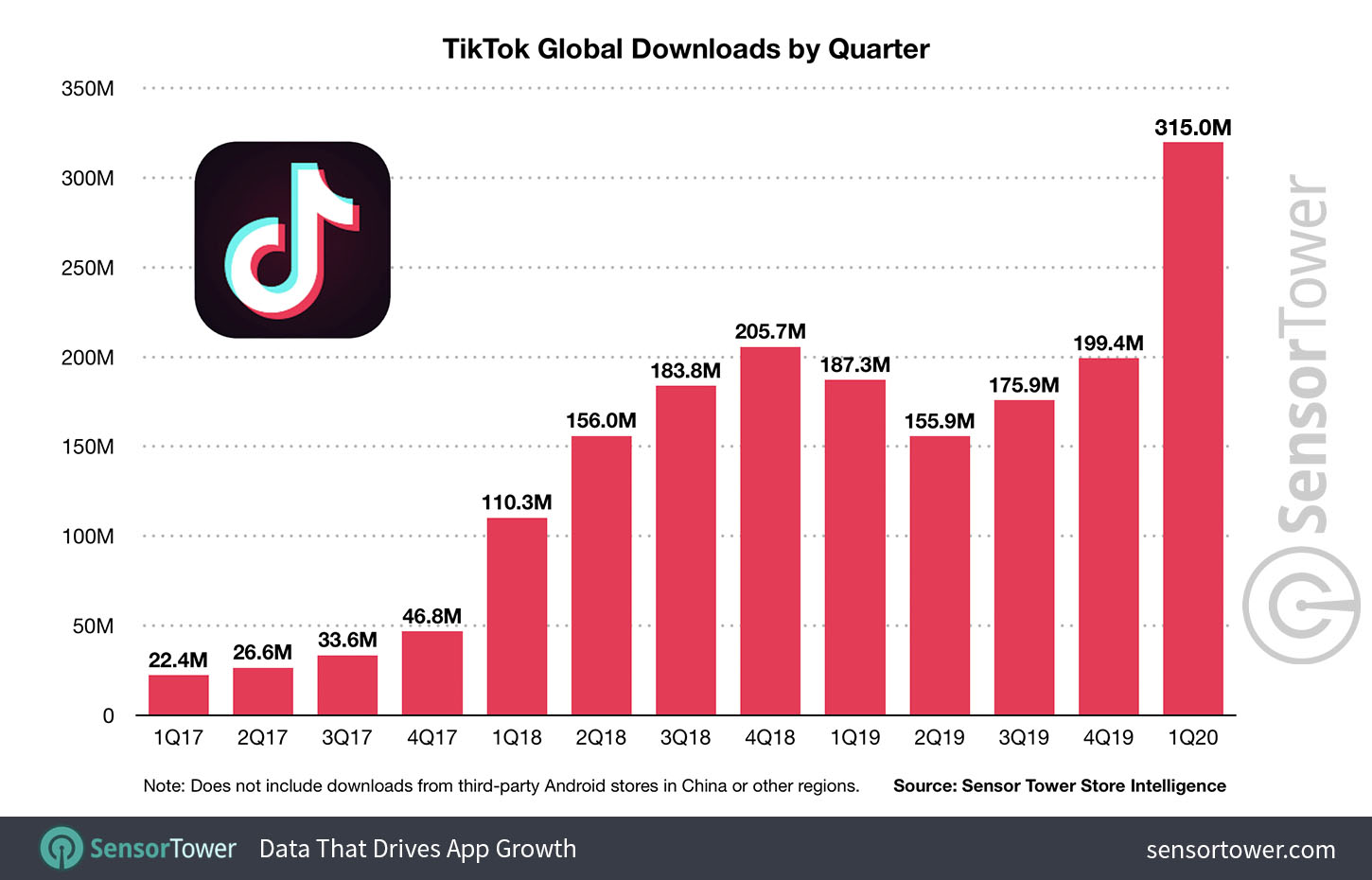
In the quarter that ended on March 31, TikTok was downloaded 315 million times, surpassing its previous best of 205.7 million downloads in Q4 2018. Facebook’s WhatsApp, the second most popular app by volume of downloads, amassed nearly 250 million downloads in Q1 this year, SensorTower told TechCrunch.

As the app gains popularity, it is also clocking more revenue. Users have spent about $456.7 million on TikTok to date, up from $175 million five months ago. Much of these spends — about 72.3% — has happened in China. Users in the United States have spent about $86.5 million on the app, making the nation the second most important market for TikTok from revenue standpoint.

Craig Chapple, a strategist at SensorTower, said that not all the downloads are organic as TikTok, which launched outside of China in 2017, has engaged in a “large user acquisition campaign.” But he attributed some of the surge in downloads to the COVID-19 outbreak that has driven more people than ever to look for new apps.

India, TikTok’s largest international market, accounts for the app’s 30.3% downloads, according to SensorTower. The app has been downloaded 611 million times in the world’s second largest internet market.

From a platform’s stand point, 75.5% of all of TikTok’s downloads have occurred through Google Play Store. But the vast majority of spendings have come from users on Apple’s ecosystem ($435.3 million of $456 million).


from Apple – TechCrunch https://ift.tt/3d2pWoq

Apple will make it easier to unlock your iPhone while wearing a face mask

Face ID was a great idea — until large swathes of the world were forced to wear face masks, rendering it largely useless.

Apple has apparently heard our pain.

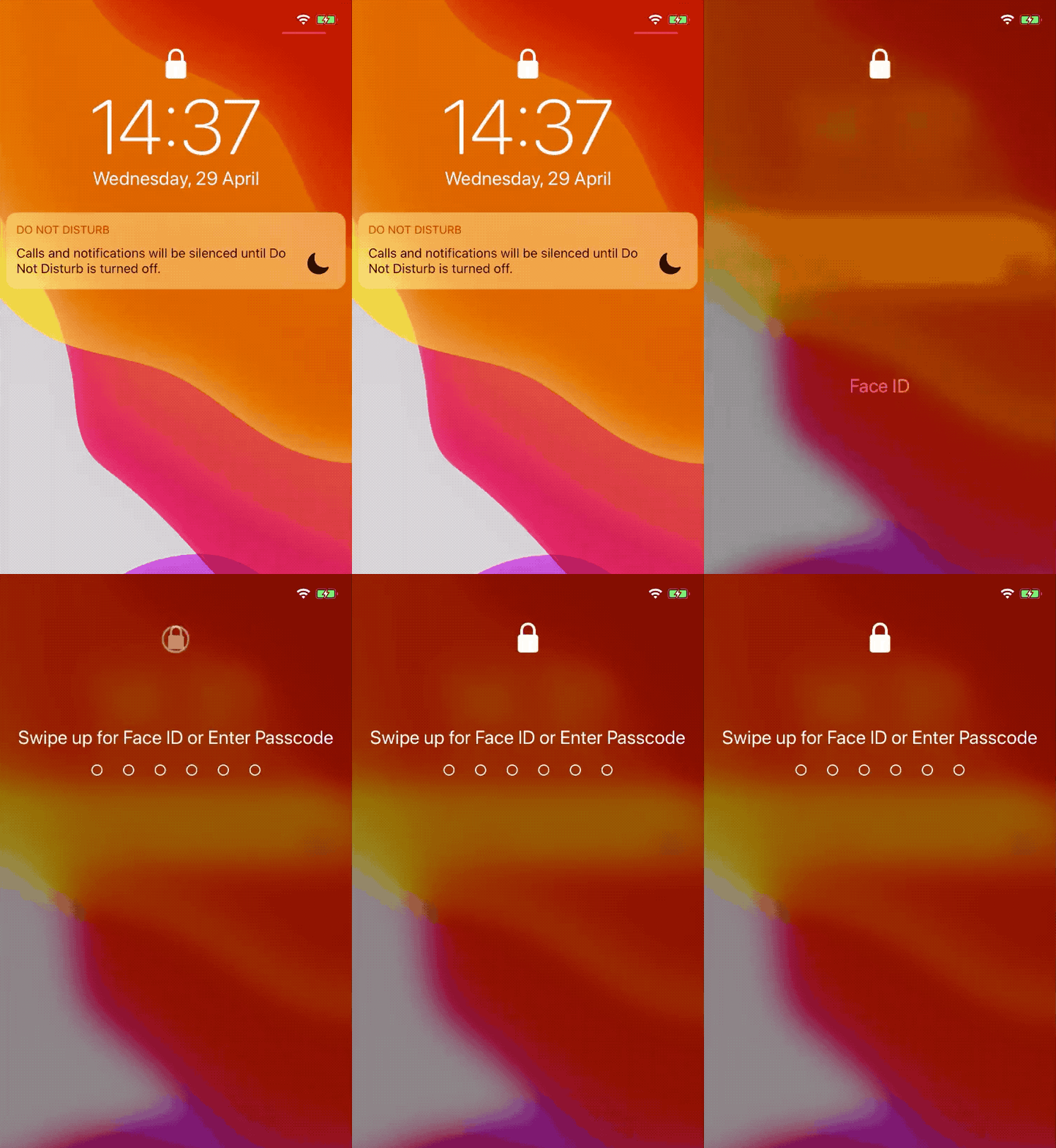
Users are reporting a subtle new feature in the latest developer version of iOS 13.5 that will make it easier to unlock your iPhone without having to take off your protective face mask.

Videos shared on Twitter by Robert Petersen and Guilherme Rambo show that Apple devices with Face ID will jump to the backup passcode-entry screen if it detects a mask. That’s not only helpful if you’re unlocking your phone dozens of times a day — which we all do — but it’s also helping to keep people safe by not forcing users to take off their masks, potentially exposing themselves to the virus.

Apple’s new Face ID unlock feature in iOS 13.5 beta (Source: Guilherme Rambo)

It’s not known if this feature will land in the final version of the software update. But one feature that will be included for sure is a new contact tracing API, built by Apple and Google in partnership, which lets national health authorities build apps that can help users privately and anonymously find out if they’ve been exposed to someone with coronavirus.

iOS 13.5 is expected to land in the coming weeks.


from Apple – TechCrunch https://ift.tt/3cXO1wF

Apple and Google release first seed of COVID-19 exposure notification API for contact tracing app developers

Apple and Google have released the very first version of their exposure notification API, which they previously called the contact tracing API. This is a developer-focused release, and is a seed of the API in development with the primary intent of collecting feedback from developers who will be using the API to create new contract tracing and notification apps on behalf of public health agencies.

Last week, Apple CEO Tim Cook told EU Commissioner Thierry Breton that the API would be arriving shortly, and this version is indeed now available – albeit to a specific and limited group that includes select developers working on behalf of public health authorities globally, according to the companies. This is a test release that’s intended to provide the opportunity for development and feedback in advance of the API’s public release in mid-May, at which time developers will be able to use the software feature on devices with publicly available apps released through the iOS and Google software stores, respectively.

Apple and Google say they will be providing additional details this coming Friday about the API and its release, including sample code to show how it operates in practice. Both are intent on providing updates to the documentation as they become available, and in adding access to new developers throughout testing, though this will be gated because the companies are limiting access to this API to authorized public health authorities only.

Already, Apple and Google have made available documents that describe the specification in detail on its respective developer websites, and it provided an update with improvements to the tech’s functioning, including in terms of its protection of user privacy, and the ease with which developers can deploy it within their apps, as discussed during a press call last week.

This update includes an added ability for health authorities to define and calcite an exposure risk level for individuals based on their own criteria, since that varies organization to organization. This will be variable based on approximate distance of an individual to a confirmed exposed COVID-19 patient, as well as the duration of that exposure. Developers can customize notification messaging based on their defined exposure levels to ensure alerts correspond correctly to calculated risk.

Apple and Google first announced the combined API and eventual system-level contact tracing feature on April 10, and intend to release the first version of the API publicly in mid-May, with the system-level integration to follow in the coming months. The tech is designed to be privacy-preserving, ensuring that contact IDs are rotating and randomized, and never tied to an individual’s specific identifying information.


from Android – TechCrunch https://ift.tt/3bMFlt6
via IFTTT

Apple and Google release first seed of COVID-19 exposure notification API for contact tracing app developers

Apple and Google have released the very first version of their exposure notification API, which they previously called the contact tracing API. This is a developer-focused release, and is a seed of the API in development with the primary intent of collecting feedback from developers who will be using the API to create new contract tracing and notification apps on behalf of public health agencies.

Last week, Apple CEO Tim Cook told EU Commissioner Thierry Breton that the API would be arriving shortly, and this version is indeed now available – albeit to a specific and limited group that includes select developers working on behalf of public health authorities globally, according to the companies. This is a test release that’s intended to provide the opportunity for development and feedback in advance of the API’s public release in mid-May, at which time developers will be able to use the software feature on devices with publicly available apps released through the iOS and Google software stores, respectively.

Apple and Google say they will be providing additional details this coming Friday about the API and its release, including sample code to show how it operates in practice. Both are intent on providing updates to the documentation as they become available, and in adding access to new developers throughout testing, though this will be gated because the companies are limiting access to this API to authorized public health authorities only.

Already, Apple and Google have made available documents that describe the specification in detail on its respective developer websites, and it provided an update with improvements to the tech’s functioning, including in terms of its protection of user privacy, and the ease with which developers can deploy it within their apps, as discussed during a press call last week.

This update includes an added ability for health authorities to define and calcite an exposure risk level for individuals based on their own criteria, since that varies organization to organization. This will be variable based on approximate distance of an individual to a confirmed exposed COVID-19 patient, as well as the duration of that exposure. Developers can customize notification messaging based on their defined exposure levels to ensure alerts correspond correctly to calculated risk.

Apple and Google first announced the combined API and eventual system-level contact tracing feature on April 10, and intend to release the first version of the API publicly in mid-May, with the system-level integration to follow in the coming months. The tech is designed to be privacy-preserving, ensuring that contact IDs are rotating and randomized, and never tied to an individual’s specific identifying information.


from Apple – TechCrunch https://ift.tt/3bMFlt6

When regulation presents a (rare) opportunity

Every time we realize something new about the coronavirus, it’s always worse than we thought: maybe we don’t develop immunity to it; maybe six feet of social distancing isn’t far enough; maybe the spread won’t wane in warmer weather.

Every time we realize something new about the economy, it’s equally bleak: maybe we can’t safely reopen for months (Georgia and South Carolina notwithstanding), maybe unemployment will top Great Depression levels, maybe travel won’t resume till mid-2021, maybe most of the businesses who have shuttered their doors will never return.

But like everything in life, within all of the bad, there’s usually some good too. And for businesses who have to deal with regulation, this may be an unusually good time to get what you need.

The federal government does not have to balance its budget, which is why multi-trillion dollar legislation like the CARES Act is possible. But cities and states have to produce a budget every fiscal year that at least looks balanced on paper. In good times, that leads to lots of new spending. But in bad times, it requires a painful series of cuts, tax and fee increases and tough decisions that are normally avoided by politicians at all costs. All of that creates opportunity for startups.

Local government will desperately need new sources of revenue. Figuring out what a politician is going to do isn’t that difficult: identify the choice with the least political downside and that’s almost always the answer. That’s why controversial policy issues like legalizing mobile sports betting or recreational marijuana often stall in state legislatures when the budget is flush (disclosure, we’re investors in FanDuel). But now, lawmakers face a very different situation: to balance the budget, they will either need to enact deep spending cuts, raise fees and taxes, or find new sources of revenue. All of a sudden, legalizing gambling and drugs doesn’t seem so risky, politically or substantively.

Any company that can offer material new tax revenues can now see their product or service legalized and permitted in a fraction of the time it would normally take. Companies who can offer direct savings to government can now secure contracts and win procurements at a rapidly faster clip. A broke government is a friendly government. This is the moment to be aggressive.
It was less than a year ago when Amazon tried to build its second headquarters in New York City.

Despite strong support from Governor Andrew Cuomo and tepid support from Mayor Bill de Blasio, the project was widely derided as an unfair corporate boondoggle and Amazon was swiftly run out of town. In good economic times, voters have the luxury of focusing on issues that aren’t critical to their own day-to-day survival and politicians have the luxury of saying no to new jobs and tax revenue to try to score points with the base.

Not anymore. Startups in blue cities and states up and down both coasts have vastly more political leverage than they’ve had in years. Issues like privacy, worker classification reform and fears of AI are all about to take a back seat to pocketbook issues like jobs, crime and access to health care. Startups who can promise to retain jobs can now drive meaningful changes on policy, regulation, permitting, zoning, licensing and everything else they need to operate.

Startups that can offer solutions to living in a pandemic (digital payments, D2C, telemedicine, teleconferencing, tele-anything) will become shiny new toys that lawmakers want to be seen with. Delivery drones, autonomous cars, at home medical testing and other concepts that seem a little edgy will now become ideas that lawmakers have to seriously consider – if a new technology could potentially save lives during a pandemic, you really don’t want to be the politician who killed the idea.

Proposals to screw with startups won’t automatically become the top priority for the San Francisco Board of Supervisors. Facebook even now has a much stronger argument to lobby for Libra (no one in this climate wants to use cash if they can help it). The power dynamic just flipped on its head. But that only works if you understand it and take advantage of it.

In the continual debate over whether tech startups should ask government for permission or beg for forgiveness over the last few years, the zeitgeist has shifted significantly towards asking for permission. The tech-lash against Facebook, Google, Amazon, Apple and Twitter created regulatory headaches for virtually every tech company, even some early stage startups.

All of that just changed. Regulators and lawmakers now have far bigger things to worry about than whether an electric scooter needs a particular type of permit. And if saying no to new ideas from new companies means turning away desperately needed jobs and tax revenue, for all of the same reasons that it was politically salient for lawmakers to reclassify all California sharing economy workers as full time employees or reject Amazon’s overtures or limit the spread of homesharing, the opposite is now true.

Now you get points for creating jobs and avoiding spending cuts. Now you’re far more reticent to tell a constituent that they can’t make a few extra bucks by renting out a room (assuming anyone ever travels again). The label of job killer will start to become politically toxic, even in the most progressive wards, districts and neighborhoods in the bluest cities on each coast. The dynamic is clearly shifting back to begging for forgiveness (don’t be stupid and do things that are clearly illegal but interpreting gray areas of regulation as friendly is now a lot easier).

Unlike the financial crisis in 2008, businesses are not the culprit here. Tech companies are actually even some of the heroes of fighting the coronavirus. But most important, being punitive towards startups is no longer a clear political winner, even in the most liberal cities and states. Even if it seems counterintuitive, now is exactly the time for startups to aggressively seek policy change and regulatory relief.

Politics is about leverage. Startups now have it. They should take advantage of it before things change again.


from Apple – TechCrunch https://ift.tt/3d363O3

Fairphone teams up with /e/OS on a box-fresh ‘deGoogled’ handset

The makers of the world’s most ethical smartphone, the Fairphone 3, have teamed up for a version of the device with even less big tech on board.

The Netherlands-based device maker has partnered with France’s /e/OS to offer a ‘de-Googled’ version of its latest handset, running an Android AOSP fork out of the box that’s itself built atop a fork of CyanogenMod (remember them?) — called LineageOS (via Engadget).

“The deGoogled Fairphone 3 is most likely the first privacy conscious and sustainable phone,” runs the blurb on /e/OS’ website. “It combines a phone that cares for people and planet and an OS and apps that care for your privacy.”

A pithy explainer of its “privacy by design ecosystem” — and the point of “Android without Google” — further notes: “We have removed many pieces of code that send your personal data to remote servers without your consent. We don’t scan your data in your phone or in your cloud space, and we don’t track your location hundred times a day or collect what you’re doing with your apps.”

When the Fairphone 3 launched last September it came with Android 9 preloaded. But the company touted a post-launch update that would make it easy for buyers to wipe Google services off their slate and install the Android Open Source Project, which it recommended for advanced users.

The new /e/OS flavor offers a third OS option.

Per Engadget, Fairphone said it polled members of its community asking which alternative OS to offer and /e/OS got more votes than a number of others. The company also highlighted /e/OS’ privacy by design as a factor in the choice, lauding how it shuts down “unwanted data flows”, meaning users have more control over what their phone is doing.

The e/OS flavor of the Fairphone 3 ships from May 6, priced at just under €480 — a €30 premium on the Googley flavor of Android you get on the standard Fairphone 3.

Existing owners of Fairphone’s third gen handset can manually install /e/OS gratis via an installer on its website.

When the Fairphone 3 launched last year the company told us only around 5% of Fairphone users opt to go full open source — which suggests the /e/OS Fairphone 3 will be a niche choice for even these discerning buyers.


from Android – TechCrunch https://ift.tt/35hoH2e
via IFTTT

UK privacy and security experts warn over coronavirus app mission creep

A number of UK computer security and privacy experts have signed an open letter raising transparency and mission creep concerns about the national approach to develop a coronavirus contacts tracing app.

The letter, signed by 177 academics, follows a similar letter earlier this month signed by around 300 academics from across the world, who urged caution over the use of such tech tools and called for governments that choose to deploy digital contacts tracing to use privacy-preserving techniques and systems.

We urge that the health benefits of a digital solution be analysed in depth by specialists from all relevant academic disciplines, and sufficiently proven to be of value to justify the dangers involved,” the UK academics write now, directing their attention at NHSX, the digital arm of the National Health Service which has been working on building a digital contacts tracing app since early March. 

It has been reported that NHSX is discussing an approach which records centrally the de-anonymised ID of someone who is infected and also the IDs of all those with whom the infected person has been in contact. This facility would enable (via mission creep) a form of surveillance.”

Yesterday the NHSX’s CEO, Matthew Gould, was giving evidence to the UK parliament’s Science and Technology committee. He defended the approach it’s taking — claiming the forthcoming app uses only “a measure of centralization”, and arguing that it’s a “false dichotomy” to say decentralized is privacy secure and centralized isn’t.

He went on to describe a couple of scenarios he suggested show why centralizing the data is necessary in the NHSX’s view. But in the letter the UK academics cast doubt on the validity of the central claim, writing that “we have seen conflicting advice from different groups about how much data the public health teams need“.

We hold that the usual data protection principles should apply: collect the minimum data necessary to achieve the objective of the application,” they continue. “We hold it is vital that if you are to build the necessary trust in the application the level of data being collected is justified publicly by the public health teams demonstrating why this is truly necessary rather than simply the easiest way, or a ‘nice to have’, given the dangers involved and invasive nature of the technology.”

Europe has seen fierce debate in recent weeks over the choice of app architecture for government-backed coronavirus contacts tracing apps — with different coalitions forming to back decentralized and centralized approaches and some governments pressuring Apple over backing the opposing horse with a cross-platform API for national coronavirus contacts tracing apps it’s developing with Android-maker Google.

Most of the national apps in the works in the region are being designed to use Bluetooth proximity as a proxy for calculating infection risk — with smartphone users’ devices swapping pseudonymized identifiers when near each other. However privacy experts are concerned that centralized stores of IDs risk creating systems of state surveillance as the data could be re-identified by the authority controlling the server.

Alternative decentralized systems have been proposed, using a p2p system with IDs stored locally. Infection risk is also calculated on device, with a relay server used only to push notifications out to devices — meaning social graph data is not systematically exposed.

Although this structure does require the IDs of people who have been confirmed infected to be broadcast to other devices — meaning there’s a potential for interception and re-identification attacks at a local level.

At this stage it’s fair to say that the momentum in Europe is behind decentralized approaches for the national contacts tracing apps. Notably Germany’s government switched from previously backing a centralized approach to decentralized earlier this week, joining a number of others (including Estonia, Spain and Switzerland) — which leaves France and the UK the highest profile backers of centralized systems for now.

France is also seeing expert debate over the issue. Earlier this week a number of French academics signed a letter raising concerns about both centralized and decentralized architectures — arguing that “there should be important evidence in order to justify the risks incurred” of using any such tracking tools.

In the UK, key concerns being attached to the NHSX app are not only the risk of social graph data being centralized and reidentified by the state — but also scope/function creep.

Gould said yesterday that the app will iterate, adding that future versions could ask people to voluntarily give up more data such as their location. And while the NHSX has said use of the app will be voluntary, if multiple functions get baked in that could raise questions over the quality of the consent and whether mission creep is being used as a lever to enforce public uptake.

Another concern is that a public facing branch of the domestic spy agency, GCHQ, has also been involved in advising on the app architecture. And yesterday Gould dodged the committee’s direct questions on whether the National Cyber Security Centre (NCSC) had been involved in the decision to select a centralized architecture.

There may be more concerns on that front, too. Today the HSJ reports that health secretary Matt Hancock recently granted new powers to the UK’s intelligence agencies which mean they can require the NHS to disclose any information that relates to “the security” of the health service’s networks and information systems during the pandemic.

Such links to database-loving spooks are unlikely to quell privacy fears.

There is also concern about how involved the UK’s data watchdog has been in the detail of the app’s design process. Last week the ICO’s executive director, Simon McDougall, was reported to have told a public forum he had not seen plans for the app, although the agency put out a statement on April 24 saying it was working with NHSX “to help them ensure a high level of transparency and governance”.

Yesterday Gould also told the committee the NHSX would publish data protection impact assessments (DPIAs) for each iteration of the app, though none has yet been published.

He also said the software would be “technically” ready to launch in a few weeks’ time — but could not confirm when the code would be published for external review.

In their letter, the UK academics call on NHSX to publish a DPIA for the app “immediately”, rather than dropping it right before deployment, to allow for public debate about the implications of its use and in order that that public scrutiny can take place of the claimed security and privacy safeguards.

The academics are also calling for the unit to publicly commit to no database or databases being created that would allow de-anonymization of users of the system (other than those self reporting as infected), and which could therefore allow the data to be used for constructing users’ social graphs.

They also urge the NHSX to set out details on how the app will be phased out after the pandemic has passed — in order “to prevent mission creep”.

Asked for a commitment on the database point, an NHSX spokesman told us that’s a question for the UK’s Department of Health and Social Care and/or the NCSC — which won’t salve any privacy concerns around the governments’ wider plans for app users’ data.

We also asked when the NHSX will be publishing a DPIA for the app. At the time of writing we were still waiting for a response.



from Android – TechCrunch https://ift.tt/2SkZuyu
via IFTTT