Wednesday, 13 May 2020

Google’s Android ad ID targeted in strategic GDPR tracking complaint

Now here’s an interesting GDPR complaint: Is Google illegally tracking Android users in Europe via a unique, device-assigned advertising ID?

First, what is the Android advertising ID? Per Google’s description to developers building apps for its smartphone platform it’s — [emphasis added by us]

The advertising ID is a unique, user-resettable ID for advertising, provided by Google Play services. It gives users better controls and provides developers with a simple, standard system to continue to monetize their apps. It enables users to reset their identifier or opt out of personalized ads (formerly known as interest-based ads) within Google Play apps.

Not so fast, says noyb — a European not-for-profit privacy advocacy group that campaigns to get regulators to enforce existing rules around how people’s data can be used — the problem with offering a tracking ID that can only be reset is that there’s no way for an Android user to not be tracked.

Simply put, resetting a tracker is not the same thing as being able to not be tracked at all.

noyb has now filed a formal complaint against Google under Europe’s General Data Protection Regulation (GDPR), accusing it of tracking Android users via the ad ID without legally valid consent.

As we’ve said many, many, many times before, GDPR applies a particular standard if you’re relying on consent — as Google appears to be here, since Android users are asked to consent to its terms on device set up, yet must agree to a resettable but not disable-able advertising ID.

Yet, under the EU data protection framework, for consent to be legally valid it must be informed, purpose limited and freely given.

Freely given means there must be a choice (which must also be free).

Thus the question arises, if an Android user can’t say no to an ad ID tracker — they can merely keep resetting it (with no user control over any previously gathered data) — where’s their free choice to not be tracked by Google?

“In essence, you buy a new Android phone, but by adding a tracking ID they ship you a tracking device,” said Stefano Rossetti, privacy lawyer at noyb.eu, in a statement on the complaint.

noyb’s contention is that Google’s ‘choice’ is “between tracking or more tracking” — which isn’t, therefore, a genuine choice to not be tracked at all.

Google claims that users can control the processing of their data, but when put to the test Android does not allow deleting the tracking ID,” it writes. “It only allows users to generate a new tracking ID to replace the existing one. This neither deletes the data that was collected before, nor stops tracking going forward.”

“It is grotesque,” continued Rossetti. “Google claims that if you want them to stop tracking you, you have to agree to new tracking. It is like cancelling a contract only under the condition that you sign a new one. Google’s system seems to structurally deny the exercise of users’ rights.”

We reached out to Google for comment on noyb’s complaint. At the time of writing the company had not responded but we’ll update this report if it provides any remarks.

The tech giant is under active GDPR investigation related to a number of other issues — including its location tracking of users; and its use of personal data for online advertising.

The latest formal complaint over its Android ad ID has been lodged with Austria’s data protection authority on behalf of an Austrian citizen. (GDPR contains provisions that allow for third parties to file complaints on behalf of individuals.)

noyb says the complaint is partially based on a recent report by the Norwegian Consumer Council — which analyzed how popular apps are rampantly sharing user data with the behavioral ad industry.

In terms of process, it notes that the Austrian DPA may involve other European data watchdogs in the case.

This is under a ‘one-stop-shop’ mechanism in the GDPR whereby interested watchdogs liaise on cross-border investigations, with one typically taking a lead investigator role (likely to be the Irish Data Protection Commission in any complaint against Google).

Under Europe’s GDPR, data regulators have major penalty powers — with fines that can scale as high as 4% of global annual turnover, which in Google’s case could amount to up to €5BN. And the ability to order data processing is suspended or stopped. (An outcome that would likely be far more expensive to a tech giant like Google.)

However there has been a dearth of major fines since the regulation began being applied, almost two years ago (exception: France’s data watchdog hit Google with a $57M fine last year). So pressure is continuing to pile up over enforcement — especially on Ireland’s Data Protection Commission which handles many cross-border complaints but has yet to issue any decisions in a raft of cross-border cases involving a number of tech giants.


from Android – TechCrunch https://ift.tt/3dGqUan
via IFTTT

Emteria, maker of industrial version of Android, raises cash from HTG and Runa Capital

Emteria, is a startup that emerged out of the limitations of the official Android Open Source Project. AOSP just isn’t good enough to be used in industrial applications which means if industry wants to use it, the platform must be extended and customized. Some industries still use outdated platforms like Windows CE to power things like ticket machines, for instance.

Emteria developed emteria.OS, an adapted Android operating system for industrial settings. As a result of its work, the startup has now raised €1.5 million in funding from the German state-backed High-Tech Gründerfonds and Runa Capital, based out of San Francisco.

While Android is the most popular OS with 2.5 billion active Android devices, pure-play Android isn’t suited to an industrial environment, where you can’t access Google Play Services, vendors’ centralized updates and have to limit the user-accessible functionality.

Emteria.OS can be used to power ticket scanning devices, cashier desks, ticketing machines, smart home controllers, video conferencing and alarming systems – or whatever a customer has in mind. They also get personalized branding, security updates, and ongoing support from the emteria team. emteria.OS is now used by over 75,000 сustomers.

Dr. Igor Kalkov, founder and CEO of emteria said: “The B2B market has so far failed to maximize the Android platform even though it has reached a market share of more than 70% for mobile operating systems. In the B2B environment, this development leaves much to be desired. Our vision is to free industrial devices from their individualized software, just like the mobile revolution.”

He said currently, software service providers often offer development contracts, but generate source code which the customer can’t do anything with, outside of the contract. Development contracts are also expensive and result in 100 companies cooking 100 different Android distributions.

Daniela Bach, Investment Manager at HTGF, said: “We are very convinced of this technology’s potential in the field of industrial operating systems.”

Dmitry Galperin, Partner at Runa Capital, added: “The team has reached great success among the Raspberry Pi community by developing an important layer for device configuration and management not available from the open-source Android. We believe that emteria will continue to attract more IoT developers.”


from Android – TechCrunch https://ift.tt/2WOCfP2
via IFTTT

Tuesday, 12 May 2020

YouTube Music adds a transfer option ahead of Google Play Music’s shutdown this year

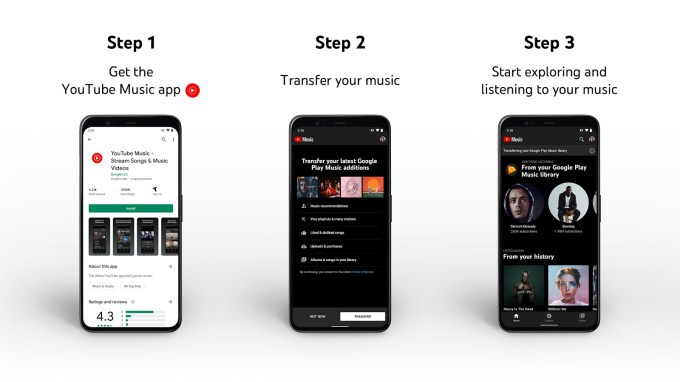
Google is making it easier for Google Play Music users to make the switch to the company’s now preferred music app, YouTube Music, ahead of its plans to shut down Google Play Music later this year. Starting today, Google Play Music users will be able to move their libraries, personal taste preferences and playlists to the newer YouTube Music service by way of a new “transfer” option available in the app.

The company has been steadily working to make YouTube Music its default music service, in order to eventually replace Google Play Music. Last year, for example, Google shut down the Google Play Artist Hub and began preinstalling YouTube Music on Android smartphones. It said at the time those moves were part of its broader strategy to merge the two services.

Now we have a deadline of sorts for Google Play Music’s end-of-life — sometime later this year, according to Google’s announcement.

One challenge in this transition was the ability for Google Play users to retain their personalization preferences, library and playlists from Google Play Music, when moving to the new service. Most users did not relish the idea of starting from scratch after building up years of history on Google Play Music.

That’s where today’s new “transfer” option comes in.

On YouTube Music, users will be able to now click on a “transfer” button on iOS and Android to start the transfer of their uploads, purchases, added songs and albums, personal and subscribed playlists, likes and dislikes, curated stations and personal taste preferences.

Following the transfer, users will immediately see an updated YouTube Music home screen reflecting the impact of this new data on their personalized recommendations. YouTube Music will also email users when the transfer is complete and their music has been fully added to the in-app “Library” tab.

Current customers will be alerted to the transfer option via an email that includes more detailed instructions.

Google also addressed Google Play Music user feedback by rolling out new features to YouTube Music aimed at making its newer service more compatible (in terms of feature set) with the older one.

It recently added increased playlist length (from 1,000 to 5,000 songs), support for uploads (up to 100,000 tracks — which is 50,000 more compared with Google Play Music), offline listening, lyrics and an Explore tab for discovering new music, playlists and genres.

In addition, podcast listeners are able to visit a webpage (http://podcasts.google.com/transfer) to transfer their subscriptions and episode progress to Google Podcasts with a single click. The Google Podcasts app, like YouTube Music, will serve as Google’s default podcast listening experience, similar to how Apple’s Podcasts is its own dedicated app for audio programs.

YouTube Music has yet to rival Spotify or Apple in terms of paying music subscribers. Earlier this year, the company said YouTube Music and YouTube Premium combined to have more than 20 million paid subscribers, but it didn’t break out how many users converted to paid customers to access the music subscription offering. Meanwhile, Apple announced last year its Apple Music service topped 60 million subscribers; Spotify as of Q1 2020 now has 130 million paid subscribers.

In part, YouTube Music’s struggles are due to the fact that Google is operating two separate music services, splitting its customer base. When Google Play Music fully shuts down, that could change.

YouTube Music is being offered at the same $9.99 per month subscription price as Google Play Music, which includes on-demand streaming, background listening, offline access and an ad-free experience. For $11.99 per month, users can extend that experience to YouTube by way of YouTube Premium.

Google didn’t provide an exact date for the shutdown of Google Play Music.

“For now, users will continue to have access to both services,” the company said. “We want to ensure everyone has time to transfer their content and get used to YouTube Music, so we’ll provide plenty of notice ahead of users no longer having access to Google Play Music later this year.”


from Android – TechCrunch https://ift.tt/2Aq0ewt
via IFTTT

China’s smartphone shipments are reportedly up for April, following COVID-19-fueled decline

Smartphone shipments are reportedly beginning to see signs of life in China, after a sizable dip from the COVID-19 pandemic. New numbers from China Academy of Information and Communications Technology (a government-connected agency) point to a 17% rise in shipments for April, pointing to some recovery for the market.

The figure, from the China state-supported group, is virtually a mirror reflection of the 18% dip Canalys reported for Q1. COVID-19 was the primary culprit for those figures, through a combination of decreased spending among China’s phone-buying public and sizable supply chain constraints, as many Asian nations were on lockdown to slow the spread.

Both Huawei and Apple benefited from the rebound, though Reuters notes that the firm opted not to include an OS breakdown for the first time in a while, making it more difficult to parse market share.

Smartphone shipments have suffered across the board, along with countless other industries. A rebound for China’s market could be a bellwether for positive numbers for the industry moving forward — especially given the country’s close ties to the global supply chain. In spite of being the first country hit, China’s official figures for COVID-19 deaths have remained low, compared to countries in Europe and North America.

That’s likely due in part to some draconian measures used to stop the spread. Other countries (the U.S. in particular) may not be so likely to rebound from the pandemic, leading to a more protracted impact on the global market. 


from Apple – TechCrunch https://ift.tt/2Z3E3Gi

India’s contact tracing app tops 100 million users in 41 days

As most countries across the globe scramble to build an app to trace the spread of coronavirus, India’s solution is growing at an unprecedented scale — despite being dogged by privacy concerns.

New Delhi’s contact tracing app, called Aarogya Setu, has reached 100 million users in 41 days since its release. A representative at think-tank Niti Aayog told TechCrunch that this 100 million figure represents unique users — and not just those who had merely downloaded the app.

The app, available on Android and iOS, allows people to self-assess whether they have caught the infectious disease by answering a set of questions. It then uses this information to alert users if they have come in contact with someone who might be infected. (It’s also available for feature phone users through an IVR system.)

Aarogya Setu, which means healthcare bridge in Hindi, also delivers updates on India’s testing efforts to fight the coronavirus pandemic and tips to stay safe.

But the app has also raised concerns from privacy advocates and security researchers. The app stores location data of users when they sign up and logs detail of those who have reported facing symptoms of the disease. New Delhi has dubbed this as a feature — even as this centralization approach is in stark contrast with how smartphone vendors Apple and Google are tackling this.

Aarogya Setu is also not open source, which means that independent researchers can’t audit the code and find any flaws in it.

Ajay Prakash Sawhney, secretary in the ministry of electronics and information technology, said in an interview with Indian daily Business Standard that the government has not made the source code of Aarogya Setu public because it feared many will point flaws in it and overburden the staff overseeing the app’s development.

“If I open up my source code, and say, some 50,000 people start criticizing it, raising issues every day, we will have to spend too much time reacting to those. We might do that for all in due course, but right now we are planning to open it up to some of the top cybersecurity experts in the country,” he said.

There are some other concerns, too. Singapore is relying on its contact tracing app, called TraceTogether, for disease control but not using it to enforce lockdowns. Aarogya Setu, in contrast, retains the flexibility to do just that, or to ensure compliance of legal orders and so on, according to New Delhi-based digital rights advocacy group Internet Freedom Foundation.

Additionally, Aarogya Setu, which was launched as a voluntary app, is now mandatory for those who wish to travel with Indian railways. In Noida, at the outskirts of New Delhi, those found without the app installed on their phone could be fined or sent to jail, the local authority said earlier this month.

“Aarogya Setu is an important step in our fight against COVID-19. By leveraging technology, it provides important information. As more and more people use it, its effectiveness will increase. I urge all to download it,” a quote attributed to Indian Prime Minister Narendra Modi appears on the homepage of the app.

The confirmed coronavirus caseload in India, which ordered one of the world’s most stringent lockdowns in late March, has risen steadily in recent weeks. More than 71,600 confirmed infections have been reported to date, with about 2,320 confirmed dead.

In a televised address on Tuesday, Modi unveiled a $266 billion stimulus package to help the nation’s stalled economy recover.

More to follow…


from Apple – TechCrunch https://ift.tt/2WOsNLx

YouTube Music adds a transfer option ahead of Google Play Music’s shutdown this year

Google is making it easier for Google Play Music users to make the switch to the company’s now preferred music app, YouTube Music, ahead of its plans to shut down Google Play Music later this year. Starting today, Google Play Music users will be able to move their libraries, personal taste preferences and playlists to the newer YouTube Music service by way of a new “transfer” option available in the app.

The company has been steadily working to make YouTube Music its default music service, in order to eventually replace Google Play Music. Last year, for example, Google shut down the Google Play Artist Hub and began preinstalling YouTube Music on Android smartphones. It said at the time those moves were part of its broader strategy to merge the two services.

Now we have a deadline of sorts for Google Play Music’s end-of-life — sometime later this year, according to Google’s announcement.

One challenge in this transition was the ability for Google Play users to retain their personalization preferences, library and playlists from Google Play Music, when moving to the new service. Most users did not relish the idea of starting from scratch after building up years of history on Google Play Music.

That’s where today’s new “transfer” option comes in.

On YouTube Music, users will be able to now click on a “transfer” button on iOS and Android to start the transfer of their uploads, purchases, added songs and albums, personal and subscribed playlists, likes and dislikes, curated stations and personal taste preferences.

Following the transfer, users will immediately see an updated YouTube Music home screen reflecting the impact of this new data on their personalized recommendations. YouTube Music will also email users when the transfer is complete and their music has been fully added to the in-app “Library” tab.

Current customers will be alerted to the transfer option via an email that includes more detailed instructions.

Google also addressed Google Play Music user feedback by rolling out new features to YouTube Music aimed at making its newer service more compatible (in terms of feature set) with the older one.

It recently added increased playlist length (from 1,000 to 5,000 songs), support for uploads (up to 100,000 tracks — which is 50,000 more compared with Google Play Music), offline listening, lyrics and an Explore tab for discovering new music, playlists and genres.

In addition, podcast listeners are able to visit a webpage (http://podcasts.google.com/transfer) to transfer their subscriptions and episode progress to Google Podcasts with a single click. The Google Podcasts app, like YouTube Music, will serve as Google’s default podcast listening experience, similar to how Apple’s Podcasts is its own dedicated app for audio programs.

YouTube Music has yet to rival Spotify or Apple in terms of paying music subscribers. Earlier this year, the company said YouTube Music and YouTube Premium combined to have more than 20 million paid subscribers, but it didn’t break out how many users converted to paid customers to access the music subscription offering. Meanwhile, Apple announced last year its Apple Music service topped 60 million subscribers; Spotify as of Q1 2020 now has 130 million paid subscribers.

In part, YouTube Music’s struggles are due to the fact that Google is operating two separate music services, splitting its customer base. When Google Play Music fully shuts down, that could change.

YouTube Music is being offered at the same $9.99 per month subscription price as Google Play Music, which includes on-demand streaming, background listening, offline access and an ad-free experience. For $11.99 per month, users can extend that experience to YouTube by way of YouTube Premium.

Google didn’t provide an exact date for the shutdown of Google Play Music.

“For now, users will continue to have access to both services,” the company said. “We want to ensure everyone has time to transfer their content and get used to YouTube Music, so we’ll provide plenty of notice ahead of users no longer having access to Google Play Music later this year.”


from Apple – TechCrunch https://ift.tt/2Aq0ewt

India’s contact tracing app tops 100 million users in 41 days

As most countries across the globe scramble to build an app to trace the spread of coronavirus, India’s solution is growing at an unprecedented scale — despite being dogged by privacy concerns.

New Delhi’s contact tracing app, called Aarogya Setu, has reached 100 million users in 41 days since its release. A representative at think-tank Niti Aayog told TechCrunch that this 100 million figure represents unique users — and not just those who had downloaded the app.

The app, available on Android, iOS, allows people to self-assess whether they have caught the infectious disease by answering a set of questions. It then uses this information to alert users if they have come in contact with someone who might be infected. (It’s also available for feature phone users through an IVR system.)

Aarogya Setu, which means healthcare bridge in Hindi, also delivers updates on India’s testing efforts to fight the coronavirus pandemic and tips to stay safe.

But the app has also raised concerns from privacy advocates and security researchers. The app stores location data of users when they sign up and logs detail of those who have reported facing symptoms of the disease. New Delhi has dubbed this as a feature — even as this centralization approach is in stark contrast with how smartphone vendors Apple and Google are tackling this.

Aarogya Setu is also not open source, which means that independent researchers can’t audit the code and find any flaws in it.

Ajay Prakash Sawhney, secretary in the ministry of electronics and information technology, said in an interview with Indian daily Business Standard that the government has not made the source code of Aarogya Setu public because he feared many will point flaws in it and overburden the staff overseeing the app’s development.

“If I open up my source code, and say, some 50,000 people start criticizing it, raising issues every day, we will have to spend too much time reacting to those. We might do that for all in due course, but right now we are planning to open it up to some of the top cybersecurity experts in the country,” he said.

There are some other concerns, too. Singapore is relying on its contact tracing app, called TraceTogether, for disease control but not using it to enforce lockdowns. Aarogya Setu, in contrast, retains the flexibility to do just that, or to ensure comply legal orders and so on, according to New Delhi-based digital rights advocacy group Internet Freedom Foundation.

Additionally, Aarogya Setu, which was launched as a voluntary app, is now mandatory for those who wish to travel with Indian railways. In Noida, at the outskirts of New Delhi, those found without the app installed on their phone could be fined or sent to jail, the local authority said earlier this month.

“Aarogya Setu is an important step in our fight against COVID-19. By leveraging technology, it provides important information. As more and more people use it, its effectiveness will increase. I urge all to download it,” a quote attributed to Indian Prime Minister Narendra Modi appears on the homepage of the app.

More to follow…


from Android – TechCrunch https://ift.tt/2WOsNLx
via IFTTT