Monday, 17 June 2019

5G reportedly coming to premium iPhones in 2020, all models in 2021

The latest report from renowned Apple leaker Ming-Chi Kuo already has an eye on 2020 and beyond. The news lines up with other reports around future iPhones, noting that the high-end versions of the handset are set to get 5G in the second half of next year. By 2021, all models are set to be on-board with the next-gen wireless standard.

The report is inline with recent rumors that have the company holding off on 5G until 2020. That puts Apple somewhat behind the curve of a number of Android manufacturers who have been racing to get the technology to market. Of course, those companies (including Samsung, LG and even OnePlus) may be putting the cart before the horse, with wireless carriers providing extremely limited access to the tech through the end of 2019.

Apple’s push into 5G is believed to be a primary driver behind the company’s recent decision to make nice with Qualcomm, though Kuo believes that the company is shooting for 2022/2023 to begin manufacturing its own wireless chips. That would help Apple further divorce itself on reliance from third party component makers, which seems to have been the plan all along.

The report has Apple continuing to release three models of iPhone later next year. The list includes a 5.4 inch and 6.7 inch OLED models, making the smaller iPhone even smaller and the larger even larger. The XR successor, meanwhile, would maintain a 6.1 inch display, getting upgraded to OLED next year, while only offering up an LTE modem — a move that could muddy the waters a bit for consumers.


from Apple – TechCrunch https://tcrn.ch/2KPRxi2

Thursday, 13 June 2019

Tesla’s in-car touchscreens are getting YouTube support

Tesla has consistently been adding software to its in-car touchscreen infotainment displays — including sometimes things that probably leave a lot of people scratching their heads. During a special Q&A today at annual gaming event E3 in LA, Tesla CEO Elon Musk revealed that Tesla’s in-car display will support YouTube someday soon.

This isn’t the first time the Tesla CEO has suggested YouTube might one day have a home in the company’s cars: In response to a fan’s question on Twitter last August he noted that version 10 of the company’s in-car software would provide support for third-party video streaming. The company debuted its Software Version 9.0 last year.

Musk specifically said YouTube would be coming to cars during the E3 event today, at which he revealed that Bethesda’s Fallout 3 would be coming to the infotainment displays, and unveiled a demo video of Android game Beach Buggy Racer running on a display in a Tesla Model 3.

On a recent podcast, the Tesla CEO also said the company would consider opening the platform more broadly to third-party developers for both apps and games. The company has done a lot on its own to add software “Easter Eggs” to the dash display, but turning it into a true platform is a much more ambitious vision.

On its face, adding to a car attention-heavy apps like streaming video services definitely seems counterintuitive, but to be fair to Tesla, a large number of drivers today use their phones for in-car navigation and those can also all technically display YouTube at any time. It does seem like a case of Musk’s mind racing ahead to a day when his cars are fully autonomous, something he recently reiterated he expects to happen within the next couple of years.


from Android – TechCrunch https://tcrn.ch/2X5Z7vz
via IFTTT

Apple soups up Logic Pro X ahead of Mac Pro launch

When it announced the long-awaited Mac Pro relaunch onstage at WWDC last week, Apple settled on creative pro software as the best way to illustrate the desktop’s power. Along with Final Cut, Logic was one of the centerpieces of that introduction.

Today the company issued the update to Logic Pro X illustrated onstage. Version 10.4.5 of the pro-level music production software supports up to 56 processing threads, and up to 1,000 audio tracks and software instrument tracks.

That can be augmented with 1,000 auxiliary channel strips and 1,000 external MIDI tracks. The company says the new version is capable of handling five times as many real-time plug-ins on the software as the last version of the Mac Pro.

There a handful of other smaller updates, as well. Per Apple:

  • The loop browser can filter by loop type and allows drag and drop of multiple loops into your project simultaneously.
  • The redesigned DeEsser 2 plug-in provides more options to reduce sibilance on audio tracks.
  • MIDI beat clocks can be sent to individual ports, each with unique settings like timing offset and plug-in delay compensation.

Version 10.4.5 is out today for $200 or as a free update to existing users. The new Mac Pro, meanwhile, isn’t set to be released until the fall.


from Apple – TechCrunch https://tcrn.ch/2F8zos9

Wednesday, 12 June 2019

Facebook collected device data on 187,000 users using banned snooping app

Facebook obtained personal and sensitive device data on about 187,000 users of its now-defunct Research app, which Apple banned earlier this year after the app violated its rules.

The social media giant said in a letter to Sen. Richard Blumenthal’s office — which TechCrunch obtained — that it collected data on 31,000 users in the U.S., including 4,300 teenagers. The rest of the collected data came from users in India.

Earlier this year, a TechCrunch investigation found both Facebook and Google were abusing their Apple-issued enterprise developer certificates, designed to only allow employees to run iPhone and iPad apps used only inside the company. The investigation found the companies were building and providing apps for consumers outside Apple’s App Store, in violation of Apple’s rules. The apps paid users in return for collecting data on how participants used their devices and understand app habits by gaining access to all of the network data in and out of their device.

Apple banned the apps by revoking Facebook’s enterprise developer certificate — and later Google’s enterprise certificate. In doing so, the revocation knocked both companies’ fleet of internal iPhone or iPad app offline that relied on the same certificates.

But in response to lawmakers’ questions, Apple said it didn’t know how many devices installed Facebook’s rule-violating app.

“We know that the provisioning profile for the Facebook Research app was created on April 19, 2017, but this does not necessarily correlate to the date that Facebook distributed the provisioning profile to end users,” said Timothy Powderly, Apple’s director of federal affairs, in his letter.

Facebook said the app dated back to 2016.

TechCrunch also obtained the letters sent by Apple and Google to lawmakers in early March, but were never made public.

These “research” apps relied on willing participants to download the app from outside the app store and use the Apple-issued developer certificates to install the apps. Then, the apps would install a root network certificate, allowing the app to collect all the data out of the device — like web browsing histories, encrypted messages, and mobile app activity — potentially also including data from their friends — for competitive analysis.
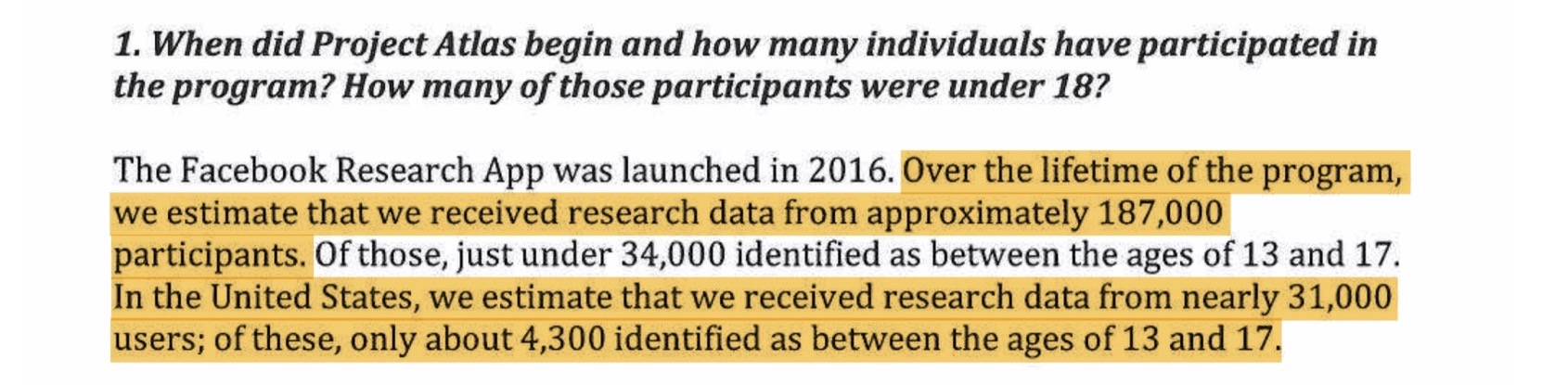
A response by Facebook about the number of users involved in Project Atlas. (Image: TechCrunch)

In Facebook’s case, the research app — dubbed Project Atlas — was a repackaged version of its Onavo VPN app, which Facebook was forced to remove from Apple’s App Store last year for gathering too much device data.

Just this week, Facebook relaunched its research app as Study, only available on Google Play and for users who have been approved through Facebook’s research partner, Applause. Facebook said it would be more transparent about how it collects user data.

Facebook’s vice-president of public policy Kevin Martin defended the company’s use of enterprise certificates, saying it “was a relatively well-known industry practice.” When asked, a Facebook spokesperson didn’t quantify this further. Later, TechCrunch found dozens of apps that used enterprise certificates to evade the app store.

Facebook previously said it “specifically ignores information shared via financial or health apps.” In its letter to lawmakers, Facebook stuck to its guns, saying its data collection was focused on “analytics,” but confirmed “in some isolated circumstances the app received some limited non-targeted content.”

“We did not review all of the data to determine whether it contained health or financial data,” said a Facebook spokesperson. “We have deleted all user-level market insights data that was collected from the Facebook Research app, which would include any health or financial data that may have existed.”

But Facebook didn’t say what kind of data, only that the app didn’t decrypt “the vast majority” of data sent by a device.

Facebook describing the type of data it collected — including “limited, non-targeted content.” (Image: TechCrunch)

Google’s letter, penned by public policy vice-president Karan Bhatia, did not provide a number of devices or users, saying only that its app was a “small scale” program. When reached, a Google spokesperson did not comment by our deadline.

Google also said it found “no other apps that were distributed to consumer end users,” but confirmed several other apps used by the company’s partners and contractors, which no longer rely on enterprise certificates.
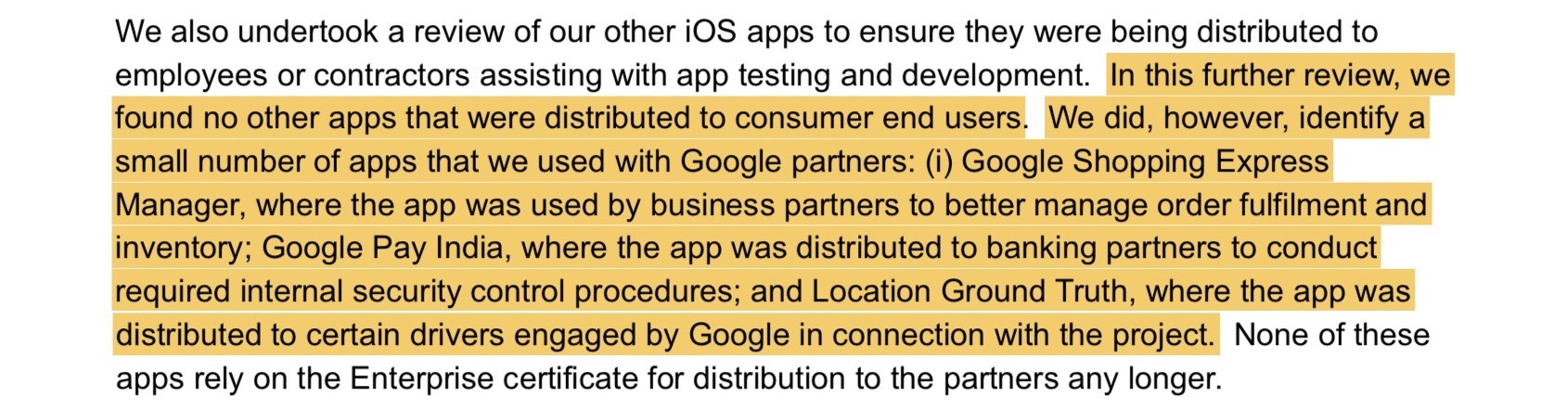
Google explaining which of its apps were improperly using Apple-issued enterprise certificates. (Image: TechCrunch)

Apple told TechCrunch that both Facebook and Google “are in compliance” with its rules as of the time of publication. At its annual developer conference last week, the company said it now “reserves the right to review and approve or reject any internal use application.”

Facebook’s willingness to collect this data from teenagers — despite constant scrutiny from press and regulators — demonstrates how valuable the company sees market research on its competitors. With its restarted paid research program but with greater transparency, the company continues to leverage its data collection to keep ahead of its rivals.

Facebook and Google came off worse in the enterprise app abuse scandal, but critics said in revoking enterprise certificates Apple retains too much control over what content customers have on their devices.

The Justice Department and the Federal Trade Commission are said to be examining the big four tech giants — Apple, Amazon, Facebook, and Google-owner Alphabet — for potentially falling foul of U.S. antitrust laws.


from iPhone – TechCrunch https://tcrn.ch/2WH8z9e

NFC gets a lot more powerful in iOS 13

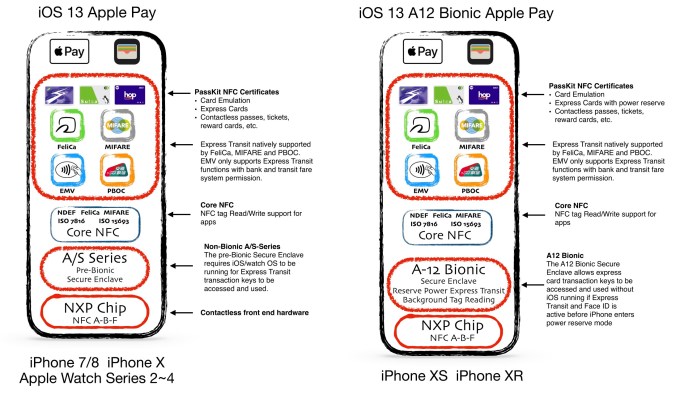
NFC — the technology that helps to power Apple Pay as well other clever features for iOS apps like Launch Center Pro’s tappable stickers – is getting a big upgrade with the launch of iOS 13, due out this fall. Instead of only allowing iPhone apps to read NFC tags — apps will be able to write directly to blank tags, as well as interact with tags through native protocols. This opens up a range of new application possibilities, Apple told attendees at its Worldwide Developer Conference last week, including the ability to create apps that read passports, contactless smart cards, and interact with NFC-enabled hardware.

We’ve already seen the potential for NFC that goes beyond just an easier way to check out at point-of-sale in a traditional retail environment, as with Apple Pay.

For example, both Apple and Google recently announced support for Apple Pay- and Google Pay-enabled contactless payments for the NYC Subway. Portland offers something similar, as do several other international cities.

With the updates to the core NFC framework, however, the iPhone’s NFC capabilities will get even more powerful.

With iOS 13 (on iPhone 7 and up), users will be able to read a range of contactless smartcards and tags, including NFC-enabled passports and other government IDs.

There are already solutions in the works that will take advantage of this new feature.

For example, both Engadget Japan and Nikkei have reported the Japanese government will add support for NFC tag reading to Japan’s national ID (Individual Number Card) when iOS 13 launches later this year.

The news was confirmed by the Japanese government, via a tweet from an advisor to the government’s CIO:

In addition, the U.K. government’s NFC passport reader app, ReadID, will now work on the iPhone as a result of the iOS 13 updates.

“This announcement means that ReadID will also work on iPhones, using the embedded internal NFC capability,” the company said in a blog post.

“Needless to say we are very excited about this. We’re convinced this will have a major impact on the online use cases such as mobile onboarding for banks, especially for countries with a high iPhone penetration,” the announcement read.

Beyond ID-scanning, iOS apps will be able to write to NFC tags (i.e. NDEF writing), and even lock the tag so it can’t be written to again, if the developer chooses.

And now, the core NFC framework will support tag reading and writing across various formats, including not only NFCNDEFTag (for NDEF tags, as offered today), but also Mifare, FeliCa, ISO 7816 (e.g. for passports), and ISO 15693.

That means NFC will work in more places with more type of tags than what’s available today.

Above Image Credit: Ata Distance, which covers Apple Pay and contactless news 

Apple had unveiled some of its plans around NFC by pre-announcing support for NFC stickers and tags that can trigger Apple Pay payments at the Transact conference in Las Vegas, just ahead of WWDC.

Bird (scooters), Bonobos (retailer), and PayByPhone (parking meters) said they would soon support this feature which enables NFC transactions without a terminal or special app from the vendor.

This is enabled by way of new support for Value Added Service (VAS) tags, which also support loyalty sign-ups with merchants. On this front, Apple said that Dairy Queen, Dave & Buster’s, and Caribou Coffee will later this year use NFC tags that make it easier for their customers to sign up for their loyalty programs.

Panera Bread, Yogurtland, and Jimmy John’s Gourmet Sandwiches will also pilot instant enrollment.

At Apple’s WWDC, the company demonstrated NFC’s expanded abilities in a real-world scenario.

As an example of NFC in action on an iOS 13 device, the company showed off how a merchant could use NFC tags that displayed a product description after the customer scanned it, as well as how another NFC tag could offer the customer a coupon for their purchase, when scanned.

Launch Center Pro developer, David Barnard who had been selling NFC tags that were pre-encoded and locked so they couldn’t work with other apps beyond his own, is now unloading older inventory in preparation for iOS 13. The developer tweeted that his app will soon be able to write to blank NFC stickers, which you can buy in bulk on Amazon.

In addition, the upgrade to Apple’s Siri Shortcuts app means users could kick off an action or even a multi-step workflow just by scanning an NFC tag.

Developers have wanted more NFC capabilities for some time, and Apple has delivered. Consumers may not understand the underlying technology or know what it’s called. However, they will get the “tap to interact” functionality thanks to broad Apple Pay adoption which taught them the behavior.


from Apple – TechCrunch https://tcrn.ch/31obO49

Only 48 hours left for early-bird tickets to TC Sessions: Mobility 2019

If you’re wild about anything and everything related to mobility and transportation, you do not want to miss the TC Sessions: Mobility 2019 conference in San Jose, Calif. on July 10.

If you’re also wild about saving money, then synchronize your Apple watches — there are 48 hours left to score the early-bird price and save $100. That train leaves the station on Friday, June 14 at 11:59 p.m. (PT), so book your pass now.

More than 1,000 of the industries’ top technologists, founders, investors, engineers and researchers will be there to explore the current and future states of transformational technologies — flying taxis, delivery drones, dockless scooters, autonomous vehicles and more.

World-class speakers and TechCrunch editors will look at both the exciting benefits and the formidable challenges that will ultimately and profoundly affect billions of people around the world. Here’s a taste of what’s coming (you can also check out the full agenda):

  • Bringing Ethics to Self-Driving Cars: Voyage’s Oliver Cameron and Uber’s Clark Haynes will discuss ethical decision-making in autonomous vehicles and detail how robot cars are designed to prioritize some objects over others.
  • Will Venture Capital Drive the Future of Mobility? Michael Granoff (Maniv Mobility), Ted Serbinski (Techstars) and Sarah Smith (Bain Capital) will debate the uncertain future of mobility tech and whether VC dollars are enough to push the industry forward.
  • Rebuilding the Motor City: Ken Washington, Ford’s CTO and vice president of research and advanced engineering, will discuss how the historic automaker is rapidly changing its culture and processes while it prepares for an electric future.
  • The Last Mile: Challenges and Opportunities for Startups: Regina Clewlow, Populus founder and CEO, and Stonly Baptiste, Urban Us co-founder break down what it means to be a last-mile innovation business — the money needed to succeed, how data and technology will change the way people move from Point A to Point B and the hurdles that stand in the way.

TC Sessions: Mobility 2019 takes place on July 10, and you have only 48 hours left to get wild, be an early-bird and save $100. Get your ticket today.

Is your company interested in sponsoring or exhibiting at TC Sessions: Mobility? Contact our sponsorship sales team by filling out this form.


from Apple – TechCrunch https://tcrn.ch/2KKtr89

What do subscription services and streaming mean for the future of gaming?

The future of gaming is streaming. If that wasn’t painfully obvious to you a week ago, it certainly ought to be now. Google got ahead of E3 late last week by finally shedding light on Stadia, a streaming service that promises a hardware agnostic gaming future.

It’s still very early days, of course. We got a demo of the platform right around the time of its original announcement. But it was a controlled one — about all we can hope for at the moment. There are still plenty of moving parts to contend with here, including, perhaps most consequentially, broadband caps.

But this much is certainly clear: Google’s not the only company committed to the idea of remote game streaming. Microsoft didn’t devote a lot of time to Project xCloud on stage the other day — on fact, the pass with which the company blew threw that announcement was almost news in and of itself.

It did, however, promise an October arrival for the service — beating out Stadia by a full month. The other big piece of the announcement was the ability for Xbox One owners to use their console as a streaming source for their own remote game play. Though how that works and what, precisely, the advantage remains to be seen. What is clear, however, is that Microsoft is hanging its hat on the Xbox as a point of distinction from Google’s offering.

It’s clear too, of course, that Microsoft is still invested in console hardware as a key driver of its gaming future. Just after rushing through all of that Project xCloud noise, it took the wraps off of Project Scarlett, its next-gen console. We know it will feature 8K content, some crazy fast frame rates and a new Halo title. Oh, and there’s an optical drive, too, because Microsoft’s not quite ready to give up on physical media just yet.


from Apple – TechCrunch https://tcrn.ch/2IaUCHw