Wednesday, 28 August 2019

Apple is turning Siri audio clip review off by default and bringing it in house

The top line news is that Apple is making changes to the way that Siri audio review, or ‘grading’ works across all of its devices. First, it is making audio review an explicitly opt-in process in an upcoming software update. This will be applicable for every current and future user of Siri.

Second, only Apple employees, not contractors, will review any of this opt-in audio in an effort to bring any process that uses private data closer to the company’s core processes.

Apple has released a blog post outlining some Siri privacy details that may not have been common knowledge as they were previously described in security white papers.

Apple apologizes for the issue.

“As a result of our review, we realize we haven’t been fully living up to our high ideals, and for that we apologize. As we previously announced, we halted the Siri grading program. We plan to resume later this fall when software updates are released to our users — but only after making the following changes…”

It then outlines three changes being made to the way Siri grading works.

  • First, by default, we will no longer retain audio recordings of Siri interactions. We will continue to use computer-generated transcripts to help Siri improve.
  • Second, users will be able to opt in to help Siri improve by learning from the audio samples of their requests. We hope that many people will choose to help Siri get better, knowing that Apple respects their data and has strong privacy controls in place. Those who choose to participate will be able to opt out at any time.
  • Third, when customers opt in, only Apple employees will be allowed to listen to audio samples of the Siri interactions. Our team will work to delete any recording which is determined to be an inadvertent trigger of Siri.

Apple is not implementing any of these changes, nor is it lifting the suspension on the Siri grading process that it halted until the software update becomes available for its operating systems that will allow users to opt in. Once people update to the new versions of its OS, they will have the chance to say yes to the grading process that uses audio recordings to help verify requests that users make of Siri. This effectively means that every user of Siri will be opted out of this process once the update goes live and is installed.

Apple says that it will continue using anonymized computer generated written transcripts of your request to feed its machine learning engines with data, in a fashion similar to other voice assistants. These transcripts may be subject to Apple employee review.

Amazon and Google had previous revelations that their assistants were being helped along by human review of audio, and they have begun putting opt-ins in place as well.

Apple is making changes to the grading process itself as well, noting that, for example, “the names of the devices and rooms you setup in the Home app will only be accessible by the reviewer if the request being graded involves controlling devices in the home.”

A story in The Guardian in early August outlined how Siri audio samples were sent to contractors Apple had hired to evaluate the quality of responses and transcription that Siri produced for its machine learning engines to work on. The practice is not unprecedented, but it certainly was not made as clear as it should have been in Apple’s privacy policies that humans were involved in the process. There was also the matter that contractors, rather than employees, were being used to evaluate these samples. One contractor described as containing sensitive and private information that, in some cases, may have been able to be tied to a user, even with Apple’s anonymizing processes in place.

In response, Apple halted the grading process worldwide while it reviewed the process. This post and updates to its process are the result of that review.

Apple says that around 0.2% of all Siri requests got this audio treatment in the first place, but given that there are 15B requests per month, the quick maths tell us that though it is statistically insignificant, the raw numbers could be quite high.

The move away from contractors was signaled by Apple releasing employees in Europe, as noted by Alex Hearn earlier on Wednesday.

Apple is also publishing an FAQ on how Siri’s privacy controls fit in with its grading process, you can read that in full here.

The blog post from Apple and the FAQ provide some details to consumers about how Apple handles the grading process, how it is minimizing the data given to data reviewers in the grading process and how Siri privacy is preserved.

Apple’s work with Siri from the beginning has focused enormously on on-device processing whenever possible. This has led a lot of experts to say that Apple was trading raw capability for privacy by eschewing the data-center heavy processes of assistants from companies like Amazon or Google in favor of keeping a ‘personal cloud’ of data on device. Sadly, the lack of transparency on human review processes and the use of contractors undercut all of this foundational work Apple has been doing from the beginning. So it’s good that Apple is cranking all the way back to past industry standard on its privacy policies regarding grading and improvement. That is where it needs to be.

The fact is that no other assistant product is nearly as privacy focused as Siri — as I said above, some would say to the point of hampering its ability to advance as quickly. Hopefully this episode leads to better transparency on the part of Apple when humans get involved in processes that are presumed to be fully automated.

Most people assume that ‘AI’ or ‘machine learning’ mean computers only, but the sad fact is that most of those processes are intensely human driven still because AI (which doesn’t really exist) and ML are still pretty crap. Humans will be involved in making them seem smarter for a very long time yet.


from Apple – TechCrunch https://ift.tt/346eZid

Fitbit’s CEO discusses the company’s subscription future

At a small event in Manhattan this week, Fitbit laid out its future for the press. Tellingly, the event was far more focus on the company’s software play, with the big hardware announcement feeling almost rushed at the end.

Along with an increased focus on health care providers and enterprise, much of its revenue strategy will be tied up in Fitbit Premium, a $10 a month subscription service. The offering marks a major shift for a company whose identity has been so closely tied to hardware for its first decade of existence.

The announcement comes a year and a half after the release of Versa. The smartwatch has helped the company begin to right the ship after several quarters’ worth of financial struggle. And while last quarter found Fitbit’s valuation stumbling a bit on the heels of a disappointing performance by the Versa Lite, the company says it continues to be committed to its core hardware offering.

Following the announcement of Fitbit Premium and the Versa 2 smartwatch, we sat down with CEO and co-founder James Park to discuss the company’s path and what the future holds for Fitbit.

The state of Fitbit

Brian Heater: The flow of today’s briefing was different. In previous years, the company’s always led with hardware.

James Park: You noticed that it was pretty conscious, and I think it’s just to reinforce the fact that what we’re working on is not just about hardware anymore. But it’s equally important that the services component is an important part of our strategy, and also an important part of an overall solution, again, people healthier.


from Apple – TechCrunch https://ift.tt/30HAaVx

Tuesday, 27 August 2019

Apple releases first beta of iOS 13.1, indicating iOS 13 is nearly done

Surprise, Apple didn’t release yet another beta version of iOS 13. The company released the first developer beta of iOS and iPadOS 13.1 instead.

This is a curious move as Apple doesn’t usually share beta versions of .1 updates before the release of major updates. What’s even more surprising is that Apple released new beta versions for watchOS 6.0 and tvOS 13.0 today.

Chances are that iOS 13.0 is pretty much done by this point. Usually, Apple releases major versions of iOS a few days after announcing the new iPhone — the press event will likely take place at some point in early September. The company might release iOS 13.0 a bit earlier than expected this year.

Apple removed some minor features in iOS 13 in early beta versions of iOS 13. As MacRumors spotted, many of those features are now back in the beta version of iOS 13.1. Those features include Shortcuts automations and the ability to share your ETA in Apple Maps.

It’s clear that Apple is trying to make iOS 13.0 as stable as possible, even if it means releasing some features a bit later this fall.


from Apple – TechCrunch https://ift.tt/2PxELJ9

Emojivision app turns your iPhone’s camera into a real-time emoji painting machine

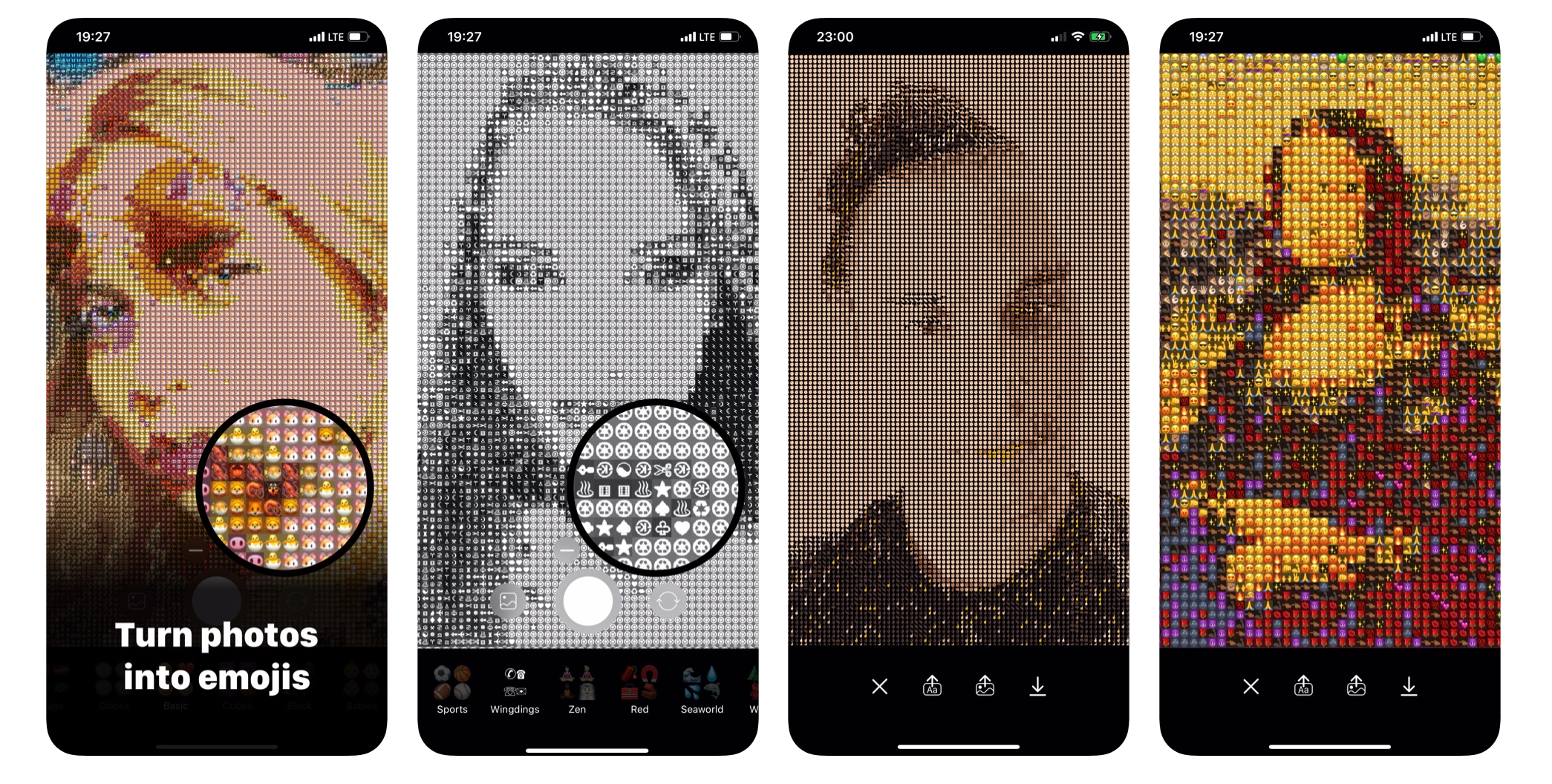
Your iPhone is capable of some impressive feats of computational photography, and a new app created by developer Gabriel O’Flaherty-Chan shows one way all that power can be put to creative use. Emojivision lets you see the world as if it were made up entirely of emojis.

The free app (which induces an in-app purchase for $2.79 that unlocks more emoji packs) works by breaking down your iPhone’s camera sensor input to its color palette fundamentals, finding its nearest neighbor from a subset of emojis (organized thematically within the app) and then rebuilding the image with a filter that overlays the image, and that can run at 60fps so you’d be hard-pressed to spot any lag between it and a real-time feed.

Screen Shot 2019 08 27 at 12.33.38 PM

You can use the app to take selfies, interpret photos from your phone’s photo gallery, or just mess around with resolution to see how finely detailed, or how abstractly and yet obviously emoji-based you can get. This isn’t the app to go to if you’re looking for a hyper-realistic or clear visual interpretation of your face, but it is a fun thing to show your friends – and an impressive bit of software engineering, too.

O’Flaherty-Chan has create some noteworthy mobile software projects in the past – including when he managed to hack a fully playable version of Pokémon Yellow onto an Apple Watch. He’s currently working on building a gigantic real-time strategy game set within a procedurally-generated universe – like a ‘No Man’s Sky’ but with a focus on the RTS elements that should make for a very compelling and evolving approach to gathering resources and expanding your empire.


from Apple – TechCrunch https://ift.tt/2LbIUwJ

Emojivision app turns your iPhone’s camera into a real-time emoji painting machine

Your iPhone is capable of some impressive feats of computational photography, and a new app created by developer Gabriel O’Flaherty-Chan shows one way all that power can be put to creative use. Emojivision lets you see the world as if it were made up entirely of emojis.

The free app (which induces an in-app purchase for $2.79 that unlocks more emoji packs) works by breaking down your iPhone’s camera sensor input to its color palette fundamentals, finding its nearest neighbor from a subset of emojis (organized thematically within the app) and then rebuilding the image with a filter that overlays the image, and that can run at 60fps so you’d be hard-pressed to spot any lag between it and a real-time feed.

Screen Shot 2019 08 27 at 12.33.38 PM

You can use the app to take selfies, interpret photos from your phone’s photo gallery, or just mess around with resolution to see how finely detailed, or how abstractly and yet obviously emoji-based you can get. This isn’t the app to go to if you’re looking for a hyper-realistic or clear visual interpretation of your face, but it is a fun thing to show your friends – and an impressive bit of software engineering, too.

O’Flaherty-Chan has create some noteworthy mobile software projects in the past – including when he managed to hack a fully playable version of Pokémon Yellow onto an Apple Watch. He’s currently working on building a gigantic real-time strategy game set within a procedurally-generated universe – like a ‘No Man’s Sky’ but with a focus on the RTS elements that should make for a very compelling and evolving approach to gathering resources and expanding your empire.


from iPhone – TechCrunch https://ift.tt/2LbIUwJ

Google Maps adds biking and ridesharing options to transit directions for multi-mode commutes

Google is introducing combo navigation directions that pair ridesharing and biking options with transit guidance. Starting today, when you search from directions using Google Maps and select the ‘transit’ tap, you’ll see ridesharing options included when the nearest station is a bit further than most people might expect to go on foot. Similarly, you’ll also see routes with bike suggestions for certain legs, all listed alongside routes that stick to just transit alone for a full range of options.

The new hybrid navigation options will include useful info life the cost of rideshare segments, as well as wait times and traffic conditions. You’ll be able to specify your preferred rideshare provider from this available through Google Maps in your area, and also pick which rideshare method you prefer (ie., pool or economy).

[gallery ids="1874327,1874326"]

Bikers will get route directions specific to the best paths and roads for bikes to takes, and in both cases, all of the available info will be fed into providing an overall ETA, so you can make an informed decision about which route and method of transportation to take depending on when you need to be where you’re going.

Google says that the combined transit/ridesharing navigation will start rolling out today on both Android and iOS, and that iOS users will start seeing the biking options today, with Android to follow in the coming weeks.


from Android – TechCrunch https://ift.tt/2ZkSnfc
via IFTTT

Mario Kart Tour arrives on iOS and Android on September 25

Nintendo’s next mobile game, Mario Kart Tour, will be available on iOS and Android devices starting on September 25. The official Twitter account for the game revealed the launch date, and shared the pre-registration link where users of both platforms can sign up to get the game when it launches.

The mobile instalment of Nintendo’s incredibly popular cart racing franchise was originally announced last year, and at that time had a planned launch window of sometime before the end of March 2019. Nintendo later updated that date to sometime during this summer, in order to “improve [the] quality of the application and expand the content offerings after launch,” according to a statement in one of the game-maker’s earnings reports.

September 25 is actually technically after the end of summer, the last day of which is officially on September 23, but it’s pretty close. Nintendo also released Dr. Mario World earlier this year, so it’s been a busy year for the company in terms of launching mobile adaptations of its popular franchises.

Mario Kart Tour had a closed beta in the U.S. and Japan, which was Android-only, earlier this year. Details from the beta include a look at the rather expansive roster, as well as a lot of in-game purchase mechanics that might frustrate fans of the main series.


from Android – TechCrunch https://ift.tt/2HsvknQ
via IFTTT