Saturday, 21 December 2019

This Week in Apps: the year and decade in review, gaming acquisitions and a Facebook OS

Welcome back to This Week in Apps, the Extra Crunch series that recaps the latest OS news, the applications they support and the money that flows through it all.

The app industry is as hot as ever, with 194 billion downloads last year and more than $100 billion in consumer spending. People spend 90% of their mobile time in apps and more time using their mobile devices than watching TV. Apps aren’t just a way to waste idle hours — they’re big business, one that often seems to change overnight.

In this Extra Crunch series, we help you to keep up with the latest news from the world of apps, delivered on a weekly basis.

Headlines

The top apps of the year… and the decade

App Annie this week released its list of the year’s top apps. And this time around, it also included the top apps of the past 10 years in its analysis. Outside of games, Facebook dominated the decade, the firm reported. It ran the four most-downloaded apps of the decade, including Facebook (#1), Messenger (#2), WhatsApp (#3), and Instagram (#4). Other communication and social media apps were also among the most popular over the past 10 years, claiming seven out of the 10 top spots, including Snapchat (#5), Skype (#6) and Twitter (#10). Social video platforms TikTok and YouTube also placed on the list at #7 and #9, respectively. And yes, it’s pretty notable that TikTok — an app that only launched outside of China in 2017 — is one of the most-downloaded apps of the past decade. Meanwhile, even though dating app Tinder was the most profitable app this year, Netflix was the No. 1 app by all-time consumer spend over the past decade.

2019 app downloads and consumer spending

Related to its round-up of the top apps, App Annie also offered some preliminary data on downloads and consumer spending in 2019. Its current figures don’t include calculations from third-party app stores in China, (like those referenced above), which App Annie tends to provide in its annual State of Mobile report. Instead, App Annie reports we’re on track to see 120 billion apps from Apple’s App Store and Google Play by the end of 2019, a 5% increase from 2018. Consumer spending was also up 15% year-over-year to reach $90 billion, it says. Expect a full analysis to come in Q1 2020.

Facebook still sat at the top of the charts for 2019. The company’s Messenger app was the most downloaded non-game app of 2019, followed by Facebook’s main app, then WhatsApp. Tinder switched places with Netflix for the No. 1 spot on this chart — last year, it was the other way around. (For more details, TechCrunch’s full review is here.)

2019 in Mobile Gaming

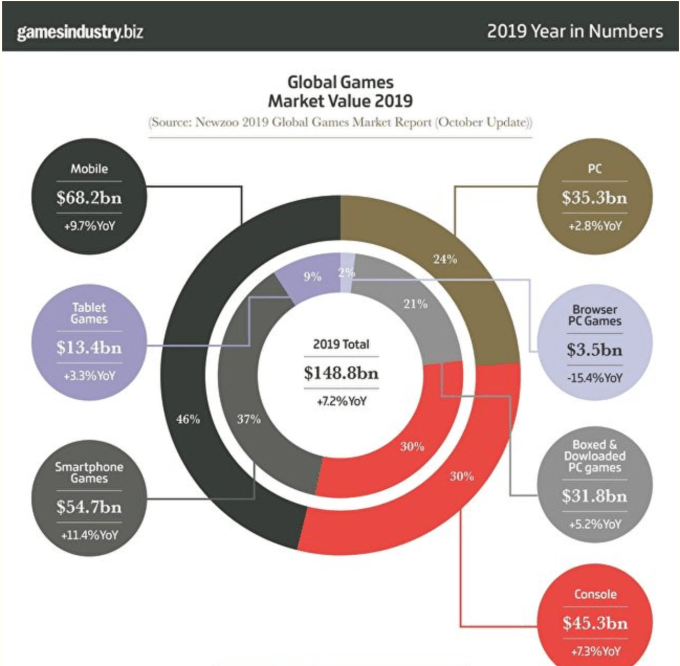
According to a year-end report by GamesIndustry.biz, mobile gaming grew 9.7% year-over-year in 2019 to reach a market value of $68.2 billion. The gaming market as a whole was worth $148.8 billion, the report said. Smartphone games were the biggest piece of this figure, at $54.7 billion, compared with $13.4 billion for tablet games. That means smartphone games are still bigger than PC, browser PC games, boxed and downloaded PC games, and console games.
Big moves in cloud gaming

To beef up its new cloud gaming service Stadia, Google this week bought game development firm Typhoon Studios, who were set to release their cross-platform title and first game, Journey to the Savage Planet. Google had said it wants to build out a few different first-party studios to release content on Stadia, which is where this acquisition fits in. Meanwhile, Facebook this week acquired the cloud gaming startup, PlayGiga, which had been working with telcos to create streaming game technology for 5G.

Stadia has a big mobile component, as its controller can play games on compatible mobile devices like Pixel phones. Gaming has been a big part of Facebook’s mobile efforts, as not only a platform where games can be played, but also a place to watch live game streams, similar to Twitch. But the big gaming trend of the past year (which will continue into 2020) is cross-platform gaming — thanks to games like Fortnite, Roblox and PUBG Mobile, as well as devices like Nintendo Switch, gamers expect to continue playing no matter what screen they happen to be using at the time.

Apple Developer app expands support for China

Apple launched a dedicated mobile app for its developer community in November, with the arrival of the Apple Developer app, which was an upgraded and rebranded version of Apple’s existing WWDC app. The app lets developers access resources like technical and design articles, as well as read news, watch developer videos, and enroll in the Apple Developer program. Now that the program is open to China through the app, Apple announced this week.

From the app, developers in China can start and complete their Apple Developer membership and pay with a local payment method on their iPhone or iPad. They can also renew their membership, to keep their account active. Apple has been heavily investing in growing its international developer community by launching developer academies and accelerators in key regions, among other initiatives. Over the past year, Apple grew its developer community in China by 17%, the company earlier said.

So much for nostalgia, Rewound gets yanked from the App Store
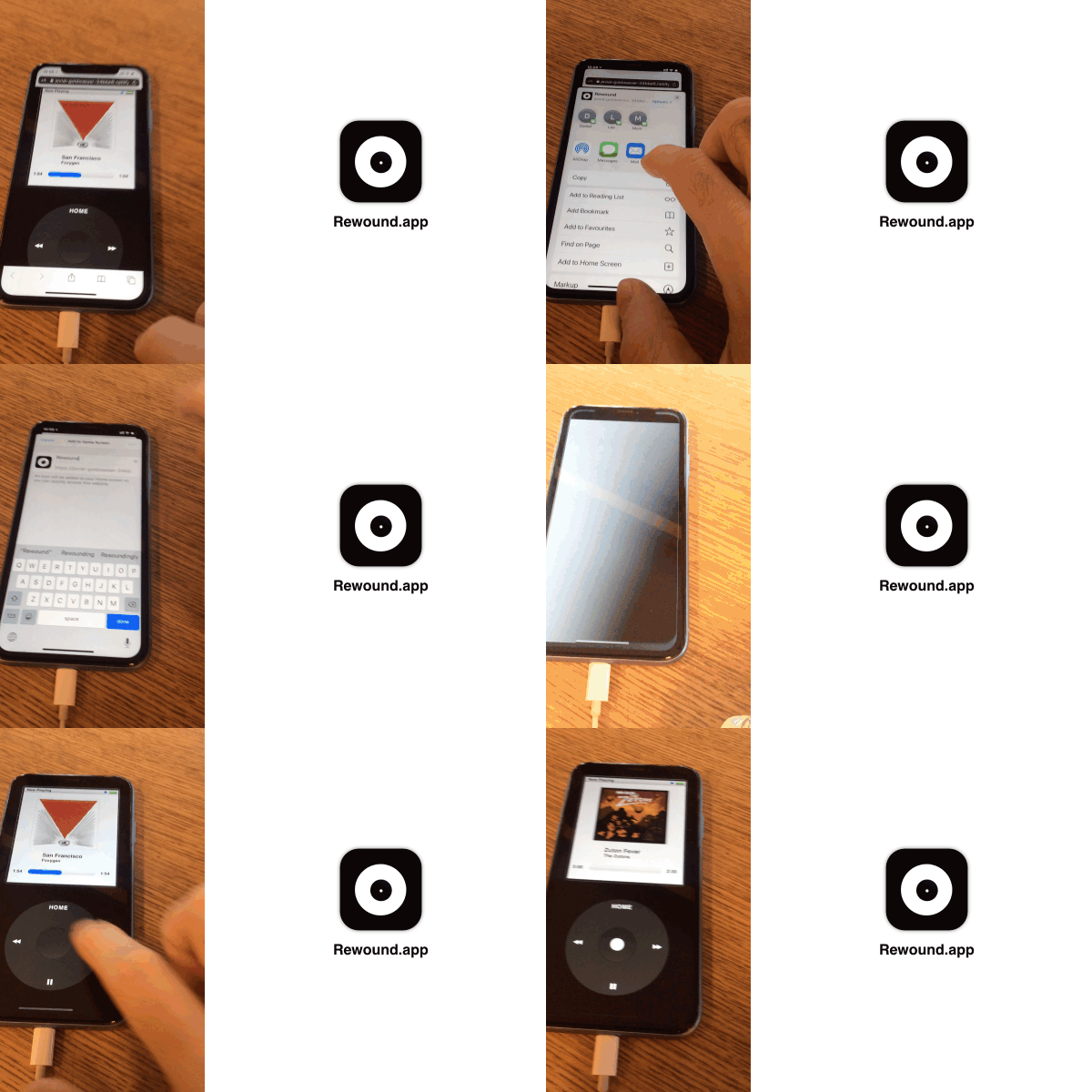
We hope you downloaded this fun app when we told you to in last week’s column! Because now it’s gone.

Rewound, briefly, was a clever music player app that turns your iPhone into a 2000’s era iPod, complete with click wheel nav. The developer was able to sneak the app into the App Store by not including the actual iPod UI, which infringes on Apple’s own product design. Instead, the UI pieces were hosted off-site — on Twitter accounts, for example. Users could find them and download them after they installed the app. Technically, that means the App Store app itself wasn’t infringing, but Apple still kicked it out. The developer also charged a fee to access the Apple Music features, which may have been another reason for its removal.

It’s no surprise Apple took this step, but the developer seems confused as to how the app could be approved then pulled later on, even though it hadn’t changed. That’s actually par for the course for Apple’s subjective, editorial decisions over its App Store, however. Now Rewound, which has 170K+ users after only a few days, will focus on a web app and Android version.

Facebook is building its own OS so it can ditch Android


from Android – TechCrunch https://ift.tt/2sMQicz
via IFTTT

Friday, 20 December 2019

Apple reportedly working on satellite technology for direct wireless iPhone data transmission

Apple is said to be working on satellite technology, having hired a number of aerospace engineers to form team along with satellite and antenna designers, according to a new report from Bloomberg. The report notes that this is an early-stage secret project that could still be scrapped, but that the purpose of the team and its work is to potentially develop communications satellite technology that can send and receive data directly to user devices, including the iPhone, in a bid to make it possible to connect Apple devices without the need of a third-party network.

Bloomberg says that Apple won’t necessarily be building its own satellite hardware – it could instead be developing just th re transmission devices or ground-based equipment to make use of data transmissions for orbital communications equipment. The tech could be used for actually delivering data directly to Apple devices, or it could just connect them to each other independent of a cellphone carrier data network. It could also be used to provide more accurate location services for better maps and guidance, the report says.

Apple is said to have hired both executives and engineers from the aerospace and satellite industry, including Skybox Imaging alumni Michael Trela and John Fenwick who are leading the team. These two formerly headed up Google’s satellite and spacecraft divines. New hired include former Aerospace Corporation executive Ashley Moore Williams, as well as key personnel from the wireless networking and content delivery network industries.

The idea of providing a data network from space direct to devices seems preposterous on its face – most data communications satellites require communication with ground stations that then relay information with end-point devices. But it’s not an unheard of concept, and in fact we wrote earlier this year about Ubiquitlink, a company that’s focused on building a new kinds of low-Earth orbit communications satellite constellation that can communicate directly with phones.

Ubiquitlink’s initial goals spell out what a supplemental direct satellite communication network could provide on top of regular iPhone carrier service: The startup company hopes to essentially provide global roaming with a connection level that probably isn’t anywhere near as fast as you’d get from a ground-based network, but is usable for communication at least – and not dependent on local infrastructure. It could also act as a redundant fallback that ensures no matter what your main network status, you’ll always be able to do less data-intensive operations, like texting and calling.

While there’s obviously a lot of unknowns remaining in what Apple is working on or what it will eventually amount to, if anything, it’s very interesting to consider the possibility that it could offer a level of always-on connectivity that’s bundled with iPhones and available even when your primary network is not, that offers persistent access to features like iMessage, voice calls and navigation – leaving streaming and other data-intensive applications to your standard carrier rate plan.


from iPhone – TechCrunch https://ift.tt/2tEnx27

Apple reportedly working on satellite technology for direct wireless iPhone data transmission

Apple is said to be working on satellite technology, having hired a number of aerospace engineers to form team along with satellite and antenna designers, according to a new report from Bloomberg. The report notes that this is an early-stage secret project that could still be scrapped, but that the purpose of the team and its work is to potentially develop communications satellite technology that can send and receive data directly to user devices, including the iPhone, in a bid to make it possible to connect Apple devices without the need of a third-party network.

Bloomberg says that Apple won’t necessarily be building its own satellite hardware – it could instead be developing just th re transmission devices or ground-based equipment to make use of data transmissions for orbital communications equipment. The tech could be used for actually delivering data directly to Apple devices, or it could just connect them to each other independent of a cellphone carrier data network. It could also be used to provide more accurate location services for better maps and guidance, the report says.

Apple is said to have hired both executives and engineers from the aerospace and satellite industry, including Skybox Imaging alumni Michael Trela and John Fenwick who are leading the team. These two formerly headed up Google’s satellite and spacecraft divines. New hired include former Aerospace Corporation executive Ashley Moore Williams, as well as key personnel from the wireless networking and content delivery network industries.

The idea of providing a data network from space direct to devices seems preposterous on its face – most data communications satellites require communication with ground stations that then relay information with end-point devices. But it’s not an unheard of concept, and in fact we wrote earlier this year about Ubiquitlink, a company that’s focused on building a new kinds of low-Earth orbit communications satellite constellation that can communicate directly with phones.

Ubiquitlink’s initial goals spell out what a supplemental direct satellite communication network could provide on top of regular iPhone carrier service: The startup company hopes to essentially provide global roaming with a connection level that probably isn’t anywhere near as fast as you’d get from a ground-based network, but is usable for communication at least – and not dependent on local infrastructure. It could also act as a redundant fallback that ensures no matter what your main network status, you’ll always be able to do less data-intensive operations, like texting and calling.

While there’s obviously a lot of unknowns remaining in what Apple is working on or what it will eventually amount to, if anything, it’s very interesting to consider the possibility that it could offer a level of always-on connectivity that’s bundled with iPhones and available even when your primary network is not, that offers persistent access to features like iMessage, voice calls and navigation – leaving streaming and other data-intensive applications to your standard carrier rate plan.


from Apple – TechCrunch https://ift.tt/2tEnx27

Thursday, 19 December 2019

Anybody can now make HomeKit accessories

Apple has released an open-source version of the HomeKit Accessory Development Kit. You can now fork it on GitHub and play around with it to integrate smart home devices in the Home app and beyond.

Today’s news is related to the Connected Home over IP effort, an industry-wide effort to build an open-source standard for the internet of things. Essentially, Apple, Amazon, Google, the Zigbee Alliance and smart home manufacturers want to work together so that accessories work everywhere.

HomeKit is lagging behind, although Apple arrived early in the connected home space. A ton of accessories now work with Amazon Alexa and Google Assistant, but you can control very few accessories with Siri, as HomeKit adoption has been slow.

By open-sourcing HomeKit, Apple hopes that more smart home manufacturers will try to integrate HomeKit in their prototypes. Everything has been released under the Apache 2.0 license.

As Next INpact noticed, if you want to release a HomeKit-compatible accessory, you still have to work with Apple to get a certification. And of course, manufacturers that work with Apple directly could potentially access unreleased features before they’re unveiled at WWDC.

Developers have already reverse-engineered HomeKit to add HomeKit compatibility to more devices with the Homebridge project. Now let’s see if it leads to more cool projects to make it easier to control your connected objects from your iPhone, iPad and other Apple devices.


from Apple – TechCrunch https://ift.tt/2Z3sHQQ

Facebook is building an operating system so it can ditch Android

Facebook doesn’t want its hardware like Oculus and Portal to be at the mercy of Google because they rely on its Android operating system. That’s why Facebook has tasked a co-author of Microsoft’s Windows NT named Mark Lucovsky with building the social network an operating system from scratch, according the The Information’s Alex Heath.

“We really want to make sure the next generation has space for us” says Facebook’s VP of hardware Andrew ‘Boz’ Bosworth. “We don’t think we can trust the marketplace or competitors to ensure that’s the case. And so we’re gonna do it ourselves.”

By moving to its own OS, Facebook could have more freedom to bake social interaction — and hopefully privacy — deeper into its devices. It could also prevent a disagreement between Google and Facebook from derailing the roadmaps of Oculus, Portal, or future gadgets. We’ve asked Facebook for more details on its homegrown operating system.

One added bonus of moving to a Facebook-owned operating system? It could make it tougher to force Facebook to spin out some of its acquisitions, especially if Facebook goes with Instagram branding for its future augmented reality glasses.

Facebook Portal Lineup

Facebook has always been sore about not owning an operating system and having to depend on the courtesy of some of its biggest rivals. Those include Apple, who’s CEO Tim Cook has repeatedly thrown jabs at Facebook and its chief Mark Zuckerberg over privacy and data collection. In a previous hedge against the power of the mobile operating systems, Facebook worked on a secret project codenamed Oxygen circa 2013 that would help it distribute Android apps from outside the Google Play store if necessary, Vox’s Kurt Wagner reported.

Now Facebook is ramping up its hardware efforts with a new office for the team in Burlingame, 15 miles north of the company’s headquarters. The 70,000-square-foot space is designed to house roughly 4,000 employees.

Interested in potentially controlling more of the hardware stack, Facebook held acquisition talks with $4.5 billion market cap semiconductor company Cirrus Logic, which makes audio chips for Apple and more, The Information reports. That deal never happened, and it’s unclear how far the talks went given tech giants constantly keep their M&A teams open to discussions. But it shows how serious Facebook is taking hardware, even if Portal and Oculus sales have been slow to date.

That could start to change next year, though, as flagship virtual reality experiences hit the market. I got a press preview of the upcoming Medal Of Honor first-person shooter that will launch on the Oculus Quest in 2020. An hour of playing the World War 2 game flew by, and it was one of the first VR games that felt like you could enjoy it week after week rather than being just a tech demo. Medal Of Honor could prove to be the killer app that convinces gamers they have to get a Quest.

Facebook has also been working on hardware experiences for the enterprise. Facebook Workplace video calls can now run on Portal, with its smart camera auto-zooming to keep everyone in the board room in frame or focus on the action. The Information reports Facebook is also prototyping a VR videoconferencing system that Boz has been testing with his team.

The hardware initiatives meanwhile feed back into Facebook’s core ad business. It’s now using some data about what people do on their Oculus or Portal to target them with ads. From playing certain games to accessing kid-focused experiences to virtually teleporting to vacation destinations, there’s plenty of lucrative data for Facebook to potentially mine.

Facebook even wants to know what’s on our mind before we act on it. The Information reports that Facebook’s brain-computer interface hardware for controlling interfaces by employing sensors to recognize a word a user is thinking has been shrunk down. It’s gone from the size of a refridgerator to something hand-held but still far from ready for integration into a phone.

Selling Oculus headsets, Portal screens, and mind-readers might never generate the billions in profits Facebook earns from its efficient ads business. But they could ensure the social network isn’t locked out of the next waves of computing. Whether those are fully immersive like virtual reality, convenient complements to our phones like smart displays, or minimally-invasive sensors, Facebook wants them to be social. If it can bring your friends along to your new gadgets, Facebook will find some way to squeeze out revenue while keeing these devices from making us more isolated and less human.


from Android – TechCrunch https://ift.tt/34Cu5Lh
via IFTTT

Wednesday, 18 December 2019

UK’s competition regulator asks for views on breaking up Google

The UK’s competition regulator has raised concerns about the market power of digital ad platform giants Google and Facebook in an interim report published today, opening up a consultation on a range of potential inventions — from breaking up platform giants, to limiting their ability to set self-serving defaults, and enforcing data sharing and/or feature interoperability to help rivals compete.

Breaking up Google by forcing it to separate its ad server arm from the rest of the business is one of a number of possible interventions it’s eyeing, along with enforcing choice screens for search engines and browsers that use non-monetary criteria to allocate slots — vs Google’s plan for a pay-to-play offering for EU Android users (which rivals argue does not offer relief for the antitrust abuse the European Commission sanctioned last year).

The UK regulator is also considering whether to require Facebook to interoperate specific features of its current network so they can be accessed by competitors — as a fix for what it describes as “strong network effects” which work against “new entrant and challenger social media platforms”.

The Competition and Markets Authority (CMA) launched the market study in July — a couple of weeks after the UK’s data watchdog published its own damning report setting out major privacy and other concerns around programmatic advertising.

It is due to issue a final report next summer — which will set out conclusions and recommendations for interventions — and is now consulting on suggestions in its interim report, inviting contributions before February 12.

Since beginning the study the CMA says it has received several requests to open a full-blown market investigation, which means it has a statutory duty to consult on making such a reference.

Based on initial findings from the study it says there are “reasonable grounds” for suspecting serious impediments to competition in the online platforms and digital advertising market.

The report specifically flags three areas where it suspects harm — namely:

  • the open display advertising market — with a focus on “the conflicts of interest Google faces at several parts of its vertically integrated chain of intermediaries”;
  • general search and search advertising — with a focus on “Google’s market power and the barriers to expansion faced by rival search engines”;
  • social media and display advertising — with a focus on “Facebook’s market power and the lack of interoperability between Facebook and rival services”;

Other concerns raised in the report include problems flowing from a lack of transparency in the digital advertising market; and the difficulty or lack of choice for consumers to opt out of behavioral advertising.

However the regulator is not making a market investigation reference at this stage — a step which would open access to the order making powers which could be used to enforce the sorts of interventions discussed in the report. Instead, the CMA says it is favors making recommendations to government to feed into a planned “comprehensive regulatory framework” to govern the behaviour of online platforms.

Earlier this year the UK government set out a wide-ranging proposal to regulate a range of online harms. Although it remains to be seen how much of that program prime minister Boris Johnson’s newly elected Conservative government will now push ahead with.

“Although it is a finely balanced judgement, we remain of the view that a comprehensive suite of recommendations to government is currently the best way forward and are therefore consulting on not making a market investigation reference at this stage,” the CMA writes, saying it feels it has further investigation work to do and also does not wish to “cut across” the government’s plans around regulating platforms.

“The concerns we have identified regarding online platforms such as Google and Facebook are a truly global antitrust challenge facing governments and regulators. Therefore, in relation to some of the potential interventions we may consider in a market investigation, and in particular any significant structural remedies such as those involving ownership separation, we need to be pragmatic about what changes could efficiently be pursued unilaterally by the UK,” it adds, saying it will “continue to work as closely as we can with our international counterparts to develop a coordinated position on these issues in the second half of the study”.

Antitrust regulators in a number of countries have been turning their attention on platform giants in recent years — including Australia and the US.

The new European Commission has also talked tough on platform power, suggesting it will further dial up scrutiny of tech giants and seek to accelerate its own interventions where it finds competitive harms.

Responding to the CMA report in a statement, Ronan Harris, VP, Google UK and Ireland, told us:

The digital advertising industry helps British businesses of all sizes find customers in the UK and across the world, and supports the websites that people know and love with revenue and reach. We’ve built easy-to-use controls that enable people to manage their data in Google’s services — such as the ability to turn off personalised advertising and to automatically delete their search history.  We’ll continue to work constructively with the CMA and the government on these important areas so that everyone can make the most of the web.

A Facebook spokesperson also sent us this statement:

We are fully committed to engaging in the consultation process around the CMA’s preliminary report, and continuing to deliver the benefits of technology and relevant advertising to the millions of people and small businesses in the UK who use our services.

We agree with the CMA that people should have control over their data and transparency around how it is used. In fact, for every ad we show, we give people the option to find out why they are seeing that ad and an option to turn off ads from that advertiser entirely.  We also provide industry-leading tools to help people control their data, like “Off Facebook Activity”, and to transfer it to other services through our Data Transfer tools.  We look forward to further engagement with the CMA on these topics.


from Android – TechCrunch https://ift.tt/2M8U9Y7
via IFTTT

Amazon, Apple, Google and Zigbee join forces for an open smart home standard

The biggest names in the connected home category are reaching across the aisle to create an open source standard. Marquee names Amazon, Apple, Google and the Zigbee Alliance are leading the charge here.

There are a number of key partners on the board, as well, including IKEA, Legrand, NXP Semiconductors, Resideo, Samsung SmartThings, Schneider Electric, Signify (nee Philips Lighting), Silicon Labs, Somfy and Wulian.

The goals certainly seem solid from the outset. The Connected Home over IP project seeks to create a connectivity standard designed the increase compatibility across companies and devices. The landscape is pretty scattered at the moment, with each player digging pretty heavily into their own standard and forcing many smaller third-party players to pick sides.

There will no doubt continue to be a degree of that, but more devices can speak to one another, that would certainly appear to be a net positive for the consumer. The aim is to make it easier for hardware makers to build devices that work with Alexa, Assistant, Siri and the like.

“The project is built around a shared belief that smart home devices should be secure, reliable, and seamless to use,” according to the joint release. “By building upon Internet Protocol (IP), the project aims to enable communication across smart home devices, mobile apps, and cloud services and to define a specific set of IP-based networking technologies for device certification.”

Security and privacy ought to be pretty high up on the list, as well. These topics are of utmost and increasing concern as we surrender more of our square footage to connected products.


from Apple – TechCrunch https://ift.tt/2PyFh7z