Friday, 21 February 2020

PC shipments expected to drop this year because of coronavirus outbreak

The coronavirus outbreak could result in at least a 3.3% drop — and as high as a 9% dip — in the volume of PCs that will ship globally this year, research firm Canalys reported Thursday evening in its revised projections to clients.

PC shipments will be down between 10.1% to 20.6% in Q1 2020, the firm estimated. The impact will remain visible in Q2, when the shipments are expected to drop between 8.9% (best case scenario, per Canalys) and 23.4% (worst case scenario), it said.

In the best case scenario, the outbreak would mean 382 million units will ship in 2020, down 3.4% from 396 million last year.

The worst case makes a deeper dent, stating that about 362 million units will ship this year, down 8.5% from last year.

“In the best-case scenario, production levels are expected to revert to full capacity by April 2020, hence the biggest hit will be to sell-in shipments in the first two quarters, with the market recovering in Q3 and Q4,” the firm said.

“Thus, worldwide PC market shipments are expected to decline 3.4% year on year in 2020, with Q1 2020 down by 10% and Q2 2020 by 9%. PC market supply will normalize by Q3 2020. On a yearly basis, Canalys expects the worldwide PC market will slowly begin its recovery starting in 2021.”

The worst case scenario assumes that production levels will not return to their full capacity by June 2020. “Under the assumptions of this scenario, production and demand levels in China will take even longer to recover and Q2 will suffer a decline on a par with Q1 as a consequence. It will be as late as Q4 2020 until we see a market recovery.”

In either of the scenarios, China, one of the world’s largest PC markets, will be most impacted. In worst case scenarios, “the Chinese market will suffer heavily in 2020 under this scenario, with a 12% year-on-year decline over 2019, and subsequent stabilization taking even longer, with 2021 forecast shipments lagging 6 million behind the best-case scenario. The expected CAGR between 2021 and 2024 in China is 6.3%,” Canalys.

China, the global hub for production and supply chain, moved to contain the impact of coronavirus by first extending the official Lunar New Year holidays, which was followed by stringent travel restrictions to keep citizens safe. “This resulted in a significant drop in offline retail traffic and a dramatic fall in consumer purchases,” Canalys analysts said.

The outbreak has also resulted in supply shortages of components such as PCBs and memory in China and other markets. “Likewise, channel partners have received notifications from key PC vendors over the last two weeks that their PC shipments and replacement parts can be expected to arrive in up to 14 weeks – over three times the usual delivery time – depending on where partners are located,” the firm said.

“Technology vendors and channel partners in the Asia Pacific region face the unexpected challenge of coping with the sudden outbreak of COVID-19 (coronavirus). The crisis was largely unforeseen, even in mid-January. Most leaders this year were anticipating disruption from political instability and natural disasters, not an epidemic,” wrote Sharon Hiu, an analyst at Canalys in a separate report.

The outbreak has impacted several more industries, including smartphones, automobiles, television, smart speakers, and video game consoles.

Foxconn, a key manufacturer for Apple, said on Thursday that its 2020 revenue will be impacted by Wuhan coronavirus. The firm said its factories in India, Vietnam, and Mexico are fully loaded and it is planning to expand overseas.

Earlier this month, Apple said it does not expect to meet revenue guidance for March quarter due to constrained iPhone supply and low demand due to the store closures in China.

The US giant is expected to miss its schedule for mass producing a widely rumored affordable iPhone, while inventories for existing models could remain low until April or longer, Nikkei Asian Review reported on Wednesday.


from Apple – TechCrunch https://ift.tt/2PeivBk

Wednesday, 19 February 2020

How companies are working around Apple’s ban on vaping apps

Apple banned vaping apps in November 2019. Since then, the company has said very little about its decision, leaving many companies upset and confused about its blanket prohibition.

Three months later, companies are working around Apple’s ban. Here’s how they’re doing it.

Apple’s wide-sweeping ban on vaping affected apps from Juul, Pax and many others, including apps that calculate electrical resistance because they can be used to build vape components. It appears to have hit the cannabis industry at a higher rate than tobacco, as few tobacco vapes have a companion application.

The removal was sudden but not unexpected, given the climate at the time. In 2019, the vaping industry suffered a crisis as the Centers for Disease Control stumbled through a health scare caused by illicit products. Industry experts quickly identified a filler additive as the source of the illnesses, but these reports were ignored for months, creating widespread panic. Consumer sentiment promptly settled on the conclusion that all vapes are harmful, even when clear data shows the opposite. Vapes sourced through legal means are proven to be safer alternatives than other consumption methods.

It’s important to note Apple didn’t disable the apps or force the removal from phones. Apps that had already been downloaded continued to work, though they could not be updated.


from Apple – TechCrunch https://ift.tt/328bO8Y

Lack of big tech GDPR decisions looms large in EU watchdog’s annual report

The lead European Union privacy regulator for most of big tech has put out its annual report which shows another major bump in complaints filed under the bloc’s updated data protection framework, underlining the ongoing appetite EU citizens have for applying their rights.

But what the report doesn’t show is any firm enforcement of EU data protection rules vis-a-vis big tech.

The report leans heavily on stats to illustrate the volume of work piling up on desks in Dublin. But it’s light on decisions on highly anticipated cross-border cases involving tech giants including Apple, Facebook, Google, LinkedIn and Twitter.

The General Data Protection Regulation (GDPR) began being applied across the EU in May 2018 — so is fast approaching its second birthday. Yet its file of enforcements where tech giants are concerned remains very light — even for companies with a global reputation for ripping away people’s privacy.

This despite Ireland having a large number of open cross-border investigations into the data practices of platform and adtech giants — some of which originated from complaints filed right at the moment GDPR came into force.

In the report the Irish Data Protection Commission (DPC) notes it opened a further six statutory inquiries in relation to “multinational technology companies’ compliance with the GDPR” — bringing the total number of major probes to 21. So its ‘big case’ file continues to stack up. (It’s added at least two more since then, with a probe of Tinder and another into Google’s location tracking opened just this month.)

The report is a lot less keen to trumpet the fact that decisions on cross-border cases to date remains a big fat zero.

Though, just last week, the DPC made a point of publicly raising “concerns” about Facebook’s approach to assessing the data protection impacts of a forthcoming product in light of GDPR requirements to do so — an intervention that resulted in a delay to the regional launch of Facebook’s Dating product.

This discrepancy (cross-border cases: 21 – Irish DPC decisions: 0), plus rising anger from civil rights groups, privacy experts, consumer protection organizations and ordinary EU citizens over the paucity of flagship enforcement around key privacy complaints is clearly piling pressure on the regulator. (Other examples of big tech GDPR enforcement do exist. Well, France’s CNIL is one.)

In its defence the DPC does have a horrifying case load. As illustrated by other stats its keen to spotlight — such as saying it received a total of 7,215 complaints in 2019; a 75% increase on the total number (4,113) received in 2018. A full 6,904 of which were dealt with under the GDPR (while 311 complaints were filed under the Data Protection Acts 1988 and 2003).

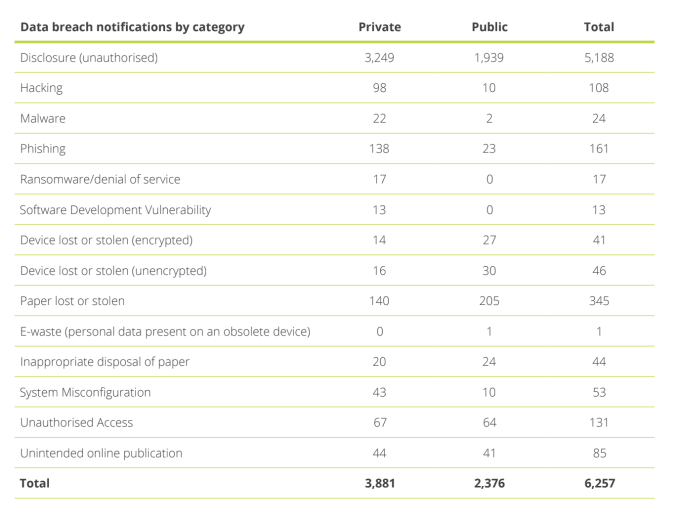
There were also 6,069 data security breaches notified to it, per the report — representing a 71% increase on the total number (3,542) recorded last year.

While a full 457 cross-border processing complaints were received in Dublin via the GDPR’s One-Stop-Shop mechanism. (This is the device the Commission came up with for the ‘lead regulator’ approach that’s baked into GDPR and which has landed Ireland in the regulatory hot seat. tl;dr other data protection agencies are passing Dublin A LOT of paperwork.)

The DPC necessarily has to do back and forth on cross border cases, as it liaises with other interested regulators. All of which, you can imagine, creates a rich opportunity for lawyered up tech giants to inject extra friction into the oversight process — by asking to review and query everything. [Insert the sound of a can being hoofed down the road]

Meanwhile the agency that’s supposed to regulate most of big tech (and plenty else) — which writes in the annual report that it increased its full time staff from 110 to 140 last year — did not get all the funding it asked for from the Irish government.

So it also has the hard cap of its own budget to reckon with (just €15.3M in 2019) vs — for example — Google’s parent Alphabet’s $46.1BN in full year 2019 revenue. So, er, do the math.

Nonetheless the pressure is firmly now on Ireland for major GDPR enforcements to flow.

One year of major enforcement inaction could be filed under ‘bedding in’; but two years in without any major decisions would not be a good look. (It has previously said the first decisions will come early this year — so seems to be hoping to have something to show for GDPR’s 2nd birthday.)

Some of the high profile complaints crying out for regulatory action include behavioral ads serviced via real-time bidding programmatic advertising (which the UK data watchdog has admitted for half a year is rampantly unlawful); cookie consent banners (which remain a Swiss Cheese of non-compliance); and adtech platforms cynically forcing consent from users by requiring they agree to being microtargeted with ads to access the (‘free’) service. (Thing is GDPR stipulates that consent as a legal basis must be freely given and can’t be bundled with other stuff, so… )

Full disclosure: TechCrunch’s parent company, Verizon Media (née Oath), is also under ongoing investigation by the DPC — which is looking at whether it meets GDPR’s transparency requirements under Articles 12-14 of the regulation.

Seeking to put a positive spin on 2019’s total lack of a big tech privacy reckoning, commissioner Helen Dixon writes in the report: “2020 is going to be an important year. We await the judgment of the CJEU in the SCCs data transfer case; the first draft decisions on big tech investigations will be brought by the DPC through the consultation process with other EU data protection authorities, and academics and the media will continue the outstanding work they are doing in shining a spotlight on poor personal data practices.”

In further remarks to the media Dixon said: “At the Data Protection Commission, we have been busy during 2019 issuing guidance to organisations, resolving individuals’ complaints, progressing larger-scale investigations, reviewing data breaches, exercising our corrective powers, cooperating with our EU and global counterparts and engaging in litigation to ensure a definitive approach to the application of the law in certain areas.

“Much more remains to be done in terms of both guiding on proportionate and correct application of this principles-based law and enforcing the law as appropriate. But a good start is half the battle and the DPC is pleased at the foundations that have been laid in 2019. We are already expanding our team of 140 to meet the demands of 2020 and beyond.”

One notable date this year also falls when GDPR turns two — because a Commission review of how the regulation is functioning is looming in May.

That’s one deadline that may help to concentrate minds on issuing decisions.

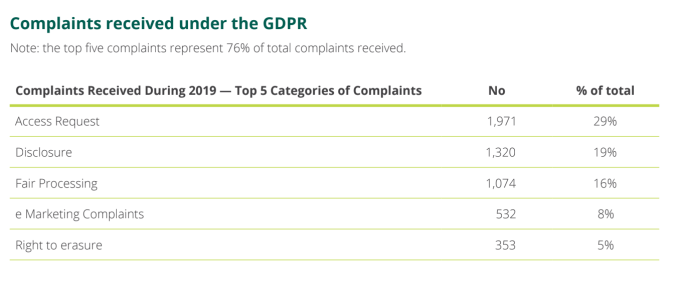
Per the DPC report, the largest category of complaints it received last year fell under ‘access request’ issues — whereby data controllers are failing to give up (all) people’s data when asked — which amounted to 29% of the total; followed by disclosure (19%); fair processing (16%); e-marketing complaints (8%); and right to erasure (5%).

On the security front, the vast bulk of notifications received by the DPC related to unauthorised disclosure of data (aka breaches) — with a total across the private and public sector of 5,188 vs just 108 for hacking (though the second largest category was actually lost or stolen paper, with 345).

There were also 161 notification of phishing; 131 notification of unauthorized access; 24 notifications of malware; and 17 of ransomeware.


from Apple – TechCrunch https://ift.tt/2P6zl4Q

How companies are working around Apple’s ban on vaping apps

Apple banned vaping apps in November 2019. Since then, the company has said very little about its decision, leaving many companies upset and confused about its blanket prohibition.

Three months later, companies are working around Apple’s ban. Here’s how they’re doing it.

Apple’s wide-sweeping ban on vaping affected apps from Juul, Pax and many others, including apps that calculate electrical resistance because they can be used to build vape components. It appears to have hit the cannabis industry at a higher rate than tobacco, as few tobacco vapes have a companion application.

The removal was sudden but not unexpected, given the climate at the time. In 2019, the vaping industry suffered a crisis as the Centers for Disease Control stumbled through a health scare caused by illicit products. Industry experts quickly identified a filler additive as the source of the illnesses, but these reports were ignored for months, creating widespread panic. Consumer sentiment promptly settled on the conclusion that all vapes are harmful, even when clear data shows the opposite. Vapes sourced through legal means are proven to be safer alternatives than other consumption methods.

It’s important to note Apple didn’t disable the apps or force the removal from phones. Apps that had already been downloaded continued to work, though they could not be updated.


from iPhone – TechCrunch https://ift.tt/328bO8Y

How companies are working around Apple’s ban on vaping apps

Apple banned vaping apps in November 2019. Since then, the company has said very little about its decision, leaving many companies upset and confused about its blanket prohibition.

Three months later, companies are working around Apple’s ban. Here’s how they’re doing it.

Apple’s wide-sweeping ban on vaping affected apps from Juul, Pax and many others, including apps that calculate electrical resistance because they can be used to build vape components. It appears to have hit the cannabis industry at a higher rate than tobacco, as few tobacco vapes have a companion application.

The removal was sudden but not unexpected, given the climate at the time. In 2019, the vaping industry suffered a crisis as the Centers for Disease Control stumbled through a health scare caused by illicit products. Industry experts quickly identified a filler additive as the source of the illnesses, but these reports were ignored for months, creating widespread panic. Consumer sentiment promptly settled on the conclusion that all vapes are harmful, even when clear data shows the opposite. Vapes sourced through legal means are proven to be safer alternatives than other consumption methods.

It’s important to note Apple didn’t disable the apps or force the removal from phones. Apps that had already been downloaded continued to work, though they could not be updated.


from Android – TechCrunch https://ift.tt/328bO8Y
via IFTTT

Google launches the first developer preview of Android 11

With the days of desert-themed releases officially behind it, Google today announced the first developer preview of Android 11, which is now available as system images for Google’s own Pixel devices, starting with the Pixel 2.

As of now, there is no way to install the updates over the air. That’s usually something the company makes available at a later stage. These first releases aren’t meant for regular users anyway. Instead, they are a way for developers to test their applications and get a head start on making use of the latest features in the operating system.

With Android 11 we’re keeping our focus on helping users take advantage of the latest innovations, while continuing to keep privacy and security a top priority,” writes Google VP of Engineering Dave Burke. “We’ve added multiple new features to help users manage access to sensitive data and files, and we’ve hardened critical areas of the platform to keep the OS resilient and secure. For developers, Android 11 has a ton of new capabilities for your apps, like enhancements for foldables and 5G, call-screening APIs, new media and camera capabilities, machine learning, and more.”

Unlike some of Google’s previous early previews, this first version of Android 11 does actually bring quite a few new features to the table. As Burke noted, there are some obligatory 5G features like a new bandwidth estimate API, for example, as well as a new API that checks whether a connection is unmetered so apps can play higher-resolution video, for example.

With Android 11, Google is also expanding its Project Mainline lineup of updatable modules from 10 to 22. With this, Google is able to update critical parts of the operating system without having to rely on the device manufacturers to release a full OS update. Users simply install these updates through the Google Play infrastructure.

Users will be happy to see that Android 11 will feature native support for waterfall screens that cover a device’s edges, using a new API that helps developers manage interactions near those edges.

Also new are some features that developers can use to handle conversational experiences, including a dedicated conversation section in the notification shade, as well as a new chat bubbles API and the ability to insert images into replies you want to send from the notifications pane.

Unsurprisingly, Google is adding a number of new privacy and security features to Android 11, too. These include one-time permissions for sensitive types of data, as well as updates to how the OS handles data on external storage, which it first previewed last year.

As for security, Google is expanding its support for biometrics and adding different levels of granularity (strong, weak and device credential), in addition to the usual hardening of the platform you would expect from a new release.

There are plenty of other smaller updates as well, including some that are specifically meant to make running machine learning applications easier, but Google specifically highlights the fact that Android 11 will also bring a couple of new features to the OS that will help IT manage corporate devices with enhanced work profiles.

This first developer preview of Android 11 is launching about a month earlier than previous releases, so Google is giving itself a bit more time to get the OS ready for a wider launch. Currently, the release schedule calls for monthly developer preview releases until April, followed by three betas and a final release in Q3 2020.


from Android – TechCrunch https://ift.tt/2ucX5Nz
via IFTTT

Tortoise co-founder Dmitry Shevelenko is bringing autonomous scooters to TC Sessions: Mobility

TechCrunch Sessions Mobility is gearing up to be a lit event. The one-day event, taking place May 14 in San Jose, has just added Dmitry Shevelenko, co-founder and president of an automatic repositioning startup for micromobility vehicles. Yes, that means we’ll be having autonomous scooters rolling around on stage. #2020

Tortoise, which recently received approval to deploy its tech in San Jose, is looking to become an operating system of sorts for micromobility vehicles. Just how Android is the operating system for a number of mobile phones, Tortoise wants to be the operating system for micromobility vehicles.

Given the volume of micromobility operators in the space today, Tortoise aims to make it easier for these companies to more strategically deploy their respective vehicles and reposition them when needed. Using autonomous technology in tandem with remote human intervention, Tortoise’s software enables operators to remotely relocate their scooters and bikes to places where riders need them, or, where operators need them to be recharged. On an empty sidewalk, Tortoise may employ autonomous technologies while it may rely on humans to remotely control the vehicle on a highly trafficked city block.

Before co-founding Tortoise, Shevelenko served as Uber’s director of business development. While at Uber, Shevelenko helped the company expand into new mobility and led the acquisition of JUMP Bikes. Needless to say, Shevelenko is well-versed to talk about the next opportunities in micromobility.

Other speakers at TC Sessions Mobility include Waymo COO Tekedra Mawakana, Uber Director of Policy, Cities & Transportation Shin-pei Tsay and Argo AI co-founder and CEO Bryan Salesky.

Tickets are on sale right now for $250 (early bird status). After April 9, tickets go up so be sure to get yours before that deadline. If you’re a student, tickets cost just $50.

Early-stage startups in the mobility space can book an exhibitor package for $2000 and get 4 tickets and a demo table. Packages allow you to get in front of some of the biggest names in the industry and meet new customers. Book your tickets here.


from Android – TechCrunch https://ift.tt/2wwFctZ
via IFTTT