Monday, 2 March 2020

Pixel phones updated with new gesture controls, emoji, AR effects & more

One of the benefits of owning a Pixel smartphone is that it improves over time as Pixels are first to receive updates that deliver the latest fixes and improvements. The first round of new features arrived in December, including a filter for robocalls, more photo controls, improved Duo calls, and more. Today Google says Pixel owners are getting a second set of additions, this time including new music controls, new emoji, still more photo and video features, expanded emergency help features, Google Pay improvements, and several others.

Last year, Google introduced a new sort of gesture control called Motion Sense with the introduction of the Pixel 4. The idea is that you can now control your phone without having to touch it. Instead, the smartphone detects the wave of your hands and translates that into software controls.
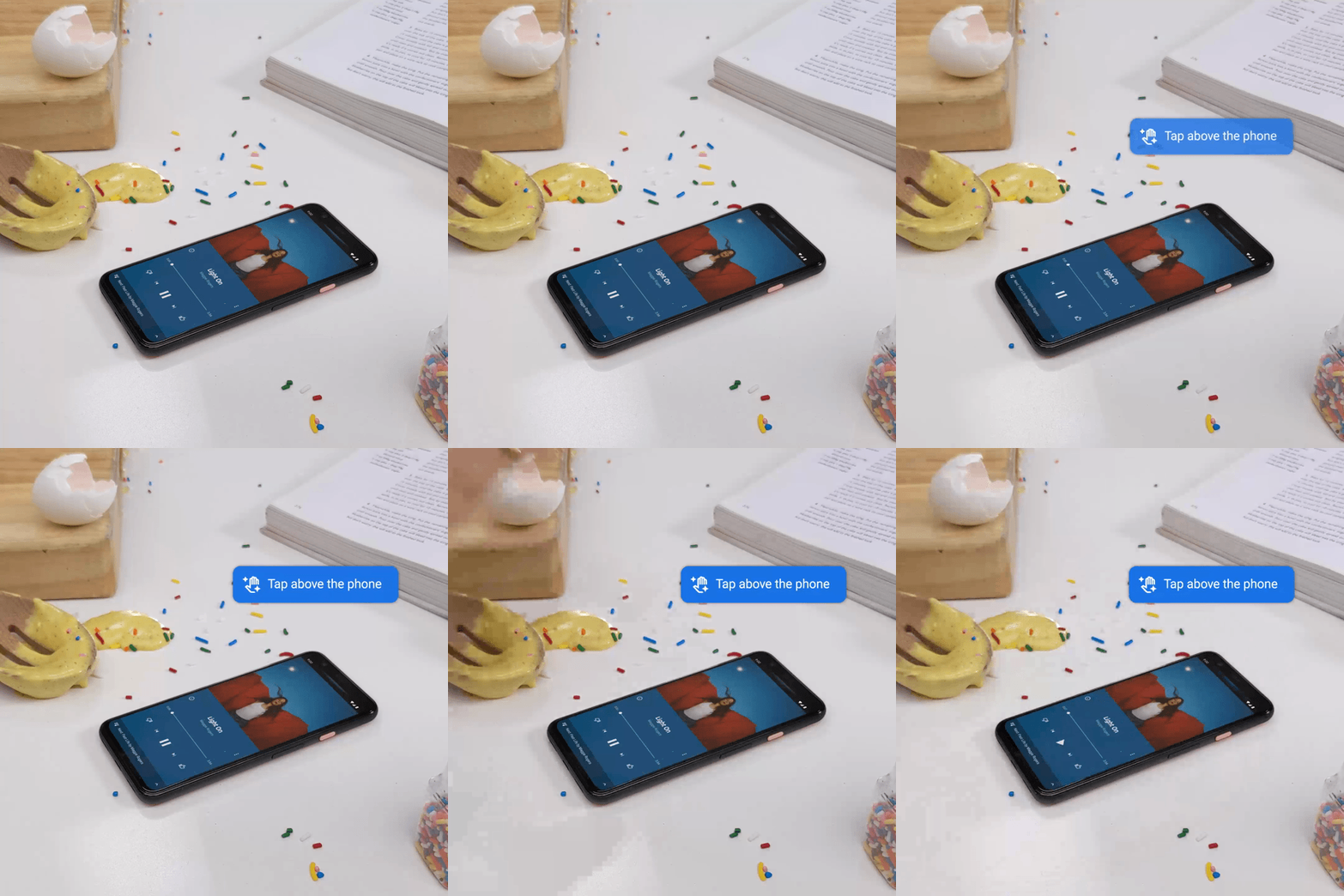
Already, Motion Sense allowed Pixel 4 owners to skip forward or go back to a previous song. With today’s update, they’ll also be able to pause and resume music by making a tapping gesture above the phone.

Google suggests this will be an easy way to pause your music when you need to have a conversation. But in reality, it will only be useful if it works consistently — and so far, reviews have said the Motion Sense system was finicky and underdeveloped. That could change in time, of course.

Another improvement today is an update to Pixel 4’s Personal Safety app, which first arrived in October. The app uses the phone’s sensors to detect if you’ve been a severe car crash and checks with you to see if you need help. It also lets U.S. users call 911 with a tap or voice command. If you’re unresponsive, the phone shares your location and details with emergency responders. Now the feature is coming to users in Australia (000) and the U.K. (999).

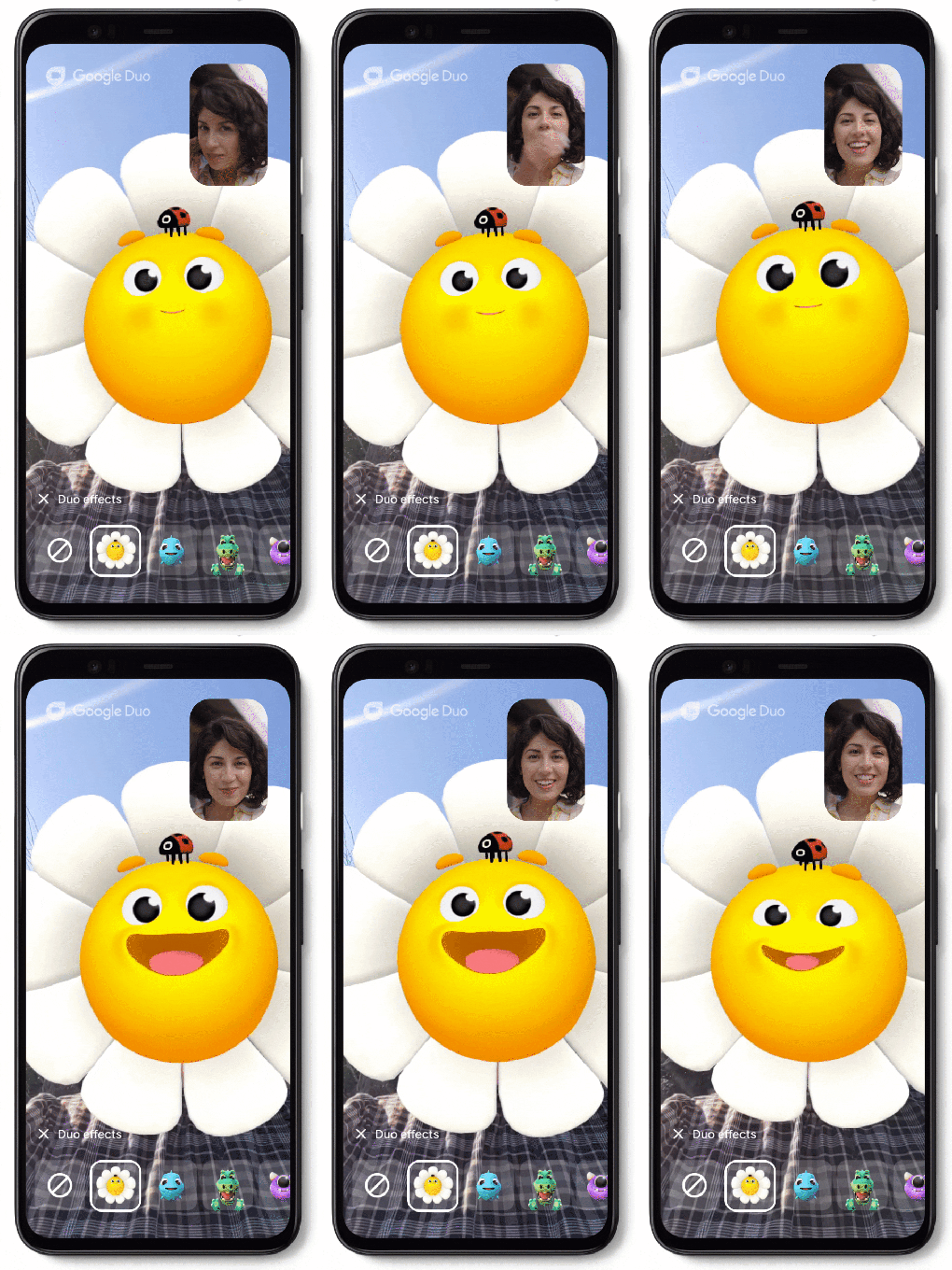
The new set of updates also includes added AR effects for Google’s video calling app Duo which can change with your expression and move around the screen. These aren’t Duo’s first set of effects, but keeping the roster of effects updated is critical for social communication apps.
Meanwhile, the Pixel 4’s selfie camera can now create images with depth, which improves Portrait Blur and color pop, and lets you create 3D photos for Facebook.

Pixel phones will also now receive the emoji version 12.1 update which hit iPhone with the iOS 3.2 update in October 2019, and which arrived on Twitter in January 2020. The set includes 169 new and more inclusive emoji, offering a wider array of gender and skin tones as well as more couple combinations.

A change to Google Pay will now let you press and hold the power button to swipe through your debit and credit cards, event tickets, boarding passes, and other stored items. This is coming first to the U.S., U.K., Canada, Australia, France, Germany, Spain, Italy, Ireland, Taiwan, and Singapore.
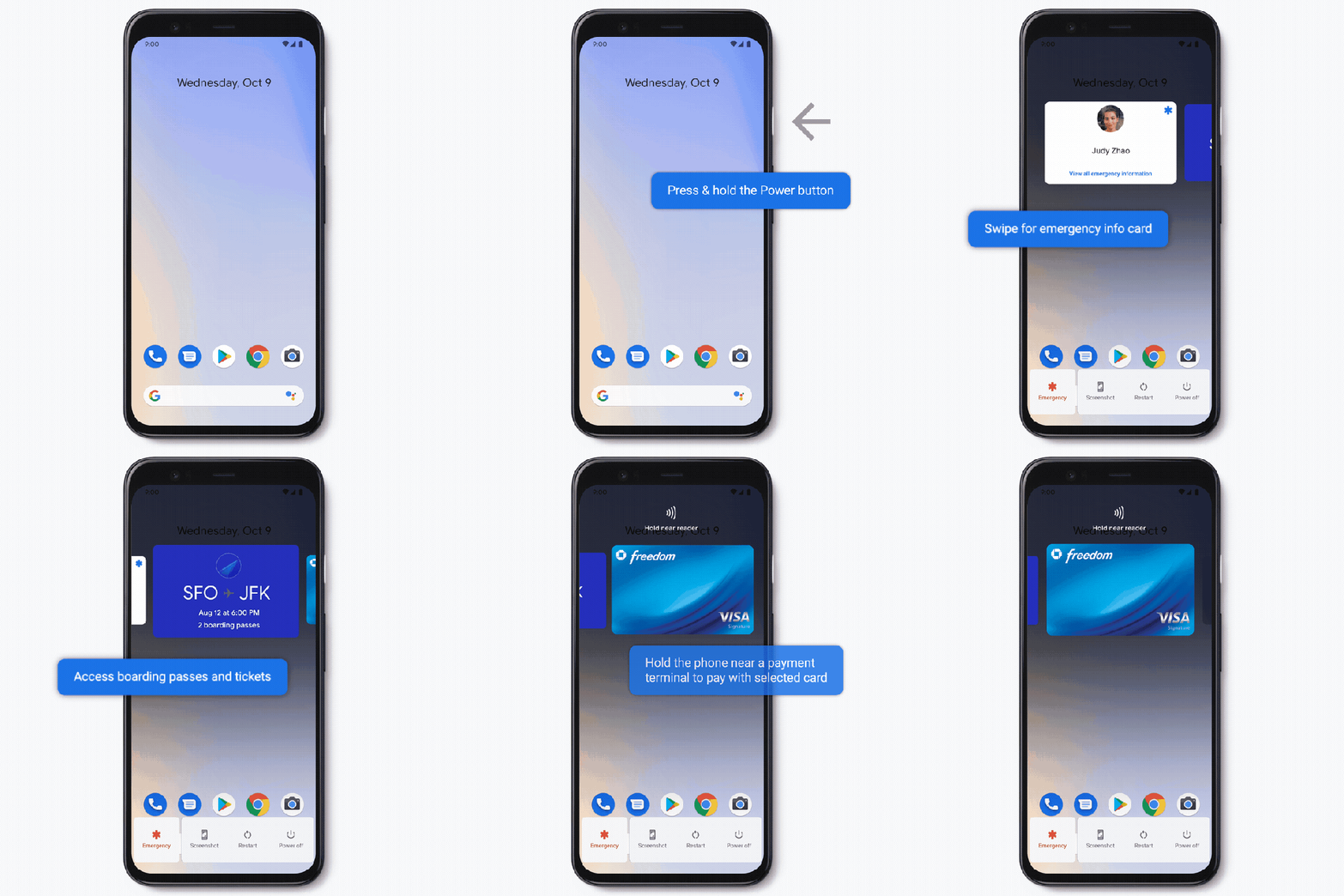
You can also now take a screenshot of a boarding pass’s barcode then tap a notification to add it to Google Pay, to then receive real-time flight updates as notifcations. This is rolling out to all countries with Google Play on Pixel 3, 3a, and 4 during March.

For power users, another useful addition lets you now configure rules based on Wi-Fi or physical location. For example, you can set your phone to automatically silence your ringtone when you arrive at work, or go to Do Not Disturb mode when you get home, among other things.

Other new features include the rollout of Live Caption (automatic captions) to Pixel 2 phones, the ability to schedule when Pixel’s Dark theme turns off and on, an easier means of accessing emergency contacts and medical info, improved long-press options for getting faster help from your apps, and an update to Adaptive brightness to make reading in direct sunlight easier.

Google says the new feature set is rolling out starting today. You may not see it immediately, but should fairly soon.


from Android – TechCrunch https://ift.tt/3crGbMk
via IFTTT

Silicon Valley could be Biden’s funding lifeline post South Carolina

Presidential candidate Joe Biden is likely to throw a fundraising lifeline to Silicon Valley donors after his commanding South Carolina victory and into the next wave of primaries.

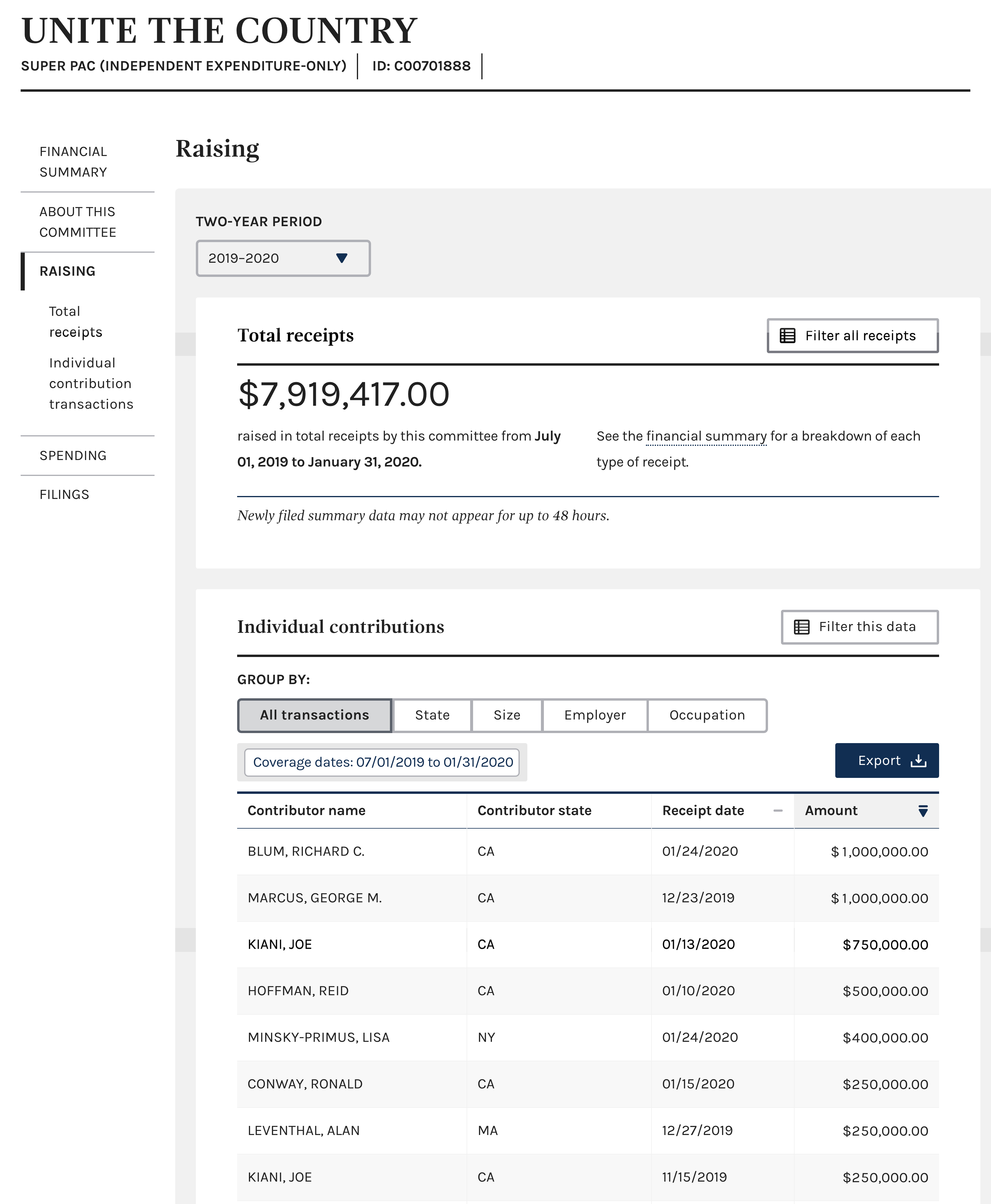
A pro-Biden super Pac, Unite the Country — whose past backers include senior tech figures — is picking up efforts to tap wealthy donors, Treasurer Larry Rasky told CNBC. The group made several ad-buys in Super-Tuesday states (per a February 28 Federal Election Committee filing).

Past Unite the Country’s benefactors include LinkedIn founder and Greylock Partners VC Reid Hoffman (who contributed $500,000) and Angel Investor Ronald Conway ($250,000), according to FEC data.

Source: FEC filing

Biden revived his presidential-bid from life-support with a resounding 29 point win over Bernie Sanders in Saturday’s South Carolina primary.

But after flailing in the first three contests — Iowa, New Hampshire and Nevada — the former Vice-President’s campaign has reportedly been running on financial fumes.

The last Federal Election Campaign disclosures before South Carolina’s democratic primary showed Biden with $7.1 million cash on hand, compared to Sanders’ nearly $17 million.

The race to become the Democratic-nominee for president is consolidating, post South Carolina, to a Sanders-Biden match-up — after Mayor Pete Buttigieg and billionaire Tom Steyer dropped out. Mayor Mike Bloomberg, who entered the race late, will be on the ballot for the first-time on Super Tuesday, though its not clear if he’ll shift dynamics between the front-runners.

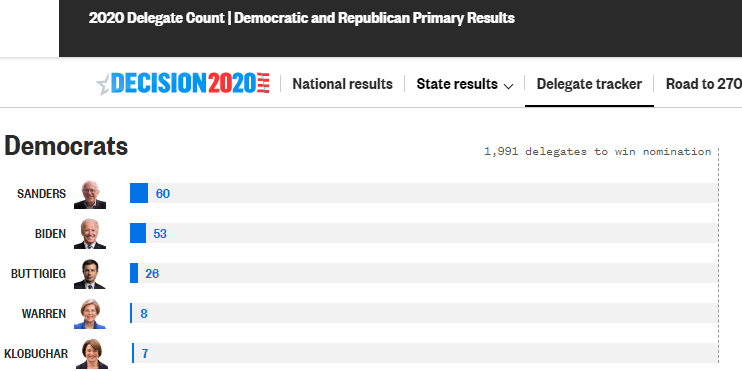
To capture Sanders, who now leads Biden in the delegate count, Biden will need to close the fundraising gap between himself and the Vermont Senator, who doesn’t accept super Pac funds and has raised a large portion of his total $126 million presidential fundraising haul from small contributions.

Source: NBC News

For Democrats, fundraising is a big focus of campaign efforts in uncontested states (like New York and California) where they are nearly certain to win in the general-election. Areas with affluent residents, such as the Bay Area and Manhattan, have served as piggy-banks for tapping wealthy donors.

But a fundraising push by Biden and surrogates in Silicon Valley could further expose a political rift within big tech: that of founders and senior executives favoring a moderate candidate, while rank-and file workers “feel the Bern” on campaign donations.

FEC data and analysis by and the LA Times and the Center for Responsive Politics indicate Bernie Sanders has substantially outperformed all candidates in raising small-donations from workers in tech companies. By Times reporting, Sanders has raised, $1 million, or nearly four-times as much as Biden, in small donations from employees at Google, Amazon, Apple, Microsoft, and Facebook.

This preference divide within big-tech could align with the differences in each candidate’s policy platforms. Biden’s positions are generally milder on initiatives to police and potentially split up big-tech companies, such as Facebook.

Sanders has been vocal about driving policies that address the pay gap across major tech companies and has called for breaking up Facebook and Amazon.

Founders and tech-workers in California will have a non-monetary option to express their preferences in voting booths tomorrow — as the Golden State is one of 13 in the super Tuesday primary contest. Those results will roll into more primaries, more fundraising and a decision on the 2020 presidential nominee at the Democratic National Convention in Milwaukee this July.


from Apple – TechCrunch https://ift.tt/38muAv6

Sunday, 1 March 2020

China Roundup: Apple closes a 4-year-old App Store loophole

Hello and welcome back to TechCrunch’s China Roundup, a digest of recent events shaping the Chinese tech landscape and what they mean to people in the rest of the world. This week, Apple made some major moves that are telling of its increasingly compliant behavior in China where it has seen escalating competition, but investors are showing dissatisfaction with how it is approaching hot-button issues in the country.

Virus game gone

Plague Inc., a simulation game where a player’s goal is to infect the entire world with a deadly virus, was removed from the China iOS App Store this week. Since the outbreak of the COVID-19 coronavirus in late January, Chinese users had flocked to download the eight-year-old game, potentially seeking an alternative way to understand the epidemic.

Data from market research firm App Annie shows that the title remained the most downloaded app in China from late January through most of February, up from No. 28 at the beginning of the year.

Ndemic Creations, the U.K. studio behind the game, said in a statement that the “situation” — the removal of Plague Inc. from the Apple App Store — “is completely out of our control.” The Chinese government provided an opaque reason for the takedown, saying the game “includes content that is illegal in China as determined by the Cyberspace Administration of China,” which is the country’s internet watchdog.

The incident has gotten plenty of attention in and outside of China. Some speculate that Apple has caved to pressure from Beijing, which could find Plague Inc.’s gameplay troubling. One sticking point is that its tutorial by default picks China as the starting country, although in the main game a user can begin anywhere in the world. The Information reported in 2018 that Plague Inc. actually applied for official permission to distribute in China but was turned down on account of its “socially inappropriate” content.

Others including Niko Partners games analyst Daniel Ahmad suggested that the Chinese authority might have taken issue with a December version update that allowed players to create “fake news,” which could mislead them in seeking advice in the midst of the health crisis.

Ahmad also suggested that the ban might have been linked to the ongoing crackdown of unlicensed mobile games in China. Notably, the Plague Inc. ban coincided with Apple’s announcement this week that would require all games in its Chinese app store to obtain government approval in the form of an ISBN number beginning in July. Few details have come to light about what this new regulatory process entails. Nor do developers know whether currently published games without official approval will be removed.

Apple investors are not sitting well with the firm’s app takedowns in China. 40% of its shareholders cast support for a proposal that would force Apple to uphold human rights commitment and be more transparent on how it responds to Beijing’s requests to censor apps.

Apple’s Delay

The gaming permit requirement is not new, though. In fact, Apple is just closing a regulatory loophole that had existed for years. Back in 2016, the Chinese government stipulated that video games — both PC and mobile — must apply for an ISBN number before entering circulation China. Within months, alternative Android stores operated by domestic tech giants swiftly moved to weed out illegal games. The official Google Play store is unavailable in China.

But Apple has managed to keep unlicensed titles in stock in the world’s largest gaming market, where content is strictly monitored. The American behemoth has many incentives to do so. Despite iPhone’s eroding share in China (to be fair, all Chinese phone makers but Huawei have recently suffered declining market share), iOS apps in China, especially games, remain an important revenue source for Apple.

So it’s in Apple’s best interest to clear hurdles for apps publishing in the country. Where there is a will, there is a way. Prior to 2016, publishing a game in China was relatively hassle-free. Following the regulatory change that year, Apple began asking games for proof of government license — but it didn’t go all out to enforce the policy. Local media reported that developers could get by with fabricated ISBN numbers or circumvent the rule by publishing in an overseas iOS App Store first and switching to China later.

This questionable practice did not go unnoticed. In August 2018, a Chinese state media lambasted Apple for its lousy oversight over App Store approvals.

Stepping up inspection on games will likely have little impact on China’s gaming titans who enjoy the financial and operational resources to secure the much-needed permit. Rather, their challenge is devising content that aligns with Beijing’s ideological guidelines, exemplified by Tencent’s patriotic makeover of PUBG.

Those that will be worst hit will most likely be small-time, independent studios, as well as firms that create “sockpuppet games” (马甲包), a practice whereby a developer exploits app stores’ loopholes to publish a troop of clones with similar gameplay and mask their appearance with altered names, logos and characters. Doing so can often help the publisher gain more traffic and revenue, but these sockpuppets will have a low chance of passing the authority’s strict scrutiny, which, as a Chinese gaming blog speculates, will potentially put an end to the surreptitious practice.


from Android – TechCrunch https://ift.tt/2x3wKmp
via IFTTT

Saturday, 29 February 2020

This Week in Apps: Coronavirus impacts app stores, Facebook sues mobile SDK maker, Apple kicks out a cloud gaming app

Welcome back to This Week in Apps, the Extra Crunch series that recaps the latest OS news, the applications they support and the money that flows through it all.

The app industry is as hot as ever, with a record 204 billion downloads in 2019 and $120 billion in consumer spending in 2019, according to App Annie’s recently released “State of Mobile” annual report. People are now spending 3 hours and 40 minutes per day using apps, rivaling TV. Apps aren’t just a way to pass idle hours — they’re a big business. In 2019, mobile-first companies had a combined $544 billion valuation, 6.5x higher than those without a mobile focus.

In this Extra Crunch series, we help you keep up with the latest news from the world of apps, delivered on a weekly basis.

This week, we’ll look at the coronavirus outbreak’s impact on the App Store, China’s demand for App Store removals — and soon-to-be-removals, it seems. We’re also talking about Facebook’s lawsuit over a data-grabbing SDK, Tinder’s new video series, the TSA ban on TikTok, Instagram’s explanation for its lack of an iPad app and how Democratic presidential primary candidates are performing on mobile and social, among other things.

Headlines

Coronavirus concerns send Chinese ride-hailing apps crashing, games surging


from Apple – TechCrunch https://ift.tt/39hge0k

Friday, 28 February 2020

Apple has blocked Clearview AI’s iPhone app for violating its rules

An iPhone app built by controversial facial recognition startup Clearview AI has been blocked by Apple, effectively banning the app from use.

Apple confirmed to TechCrunch that the startup “violated” the terms of its enterprise developer program.

The app allows its users — which the company claims it serves only law enforcement officers — to use their phone camera or upload a photo to search its database of 3 billion photos. But BuzzFeed News revealed that the company — which claims to only cater to law enforcement users — also includes many private-sector users, including Macy’s, Walmart and Wells Fargo.

Clearview AI has been at the middle of a media — and legal — storm since its public debut in The New York Times last month. The company scrapes public photos from social media sites, drawing ire from the big tech giants that claim Clearview AI misused their services. But it’s also gained attention from hackers. On Wednesday, Clearview AI confirmed a data breach in which its client list was stolen.

The public Amazon S3 page containing the iPhone app. (Image: TechCrunch)

TechCrunch found Clearview AI’s iPhone app on an public Amazon S3 storage bucket on Thursday, despite a warning on the page that the app is “not to be shared with the public.”

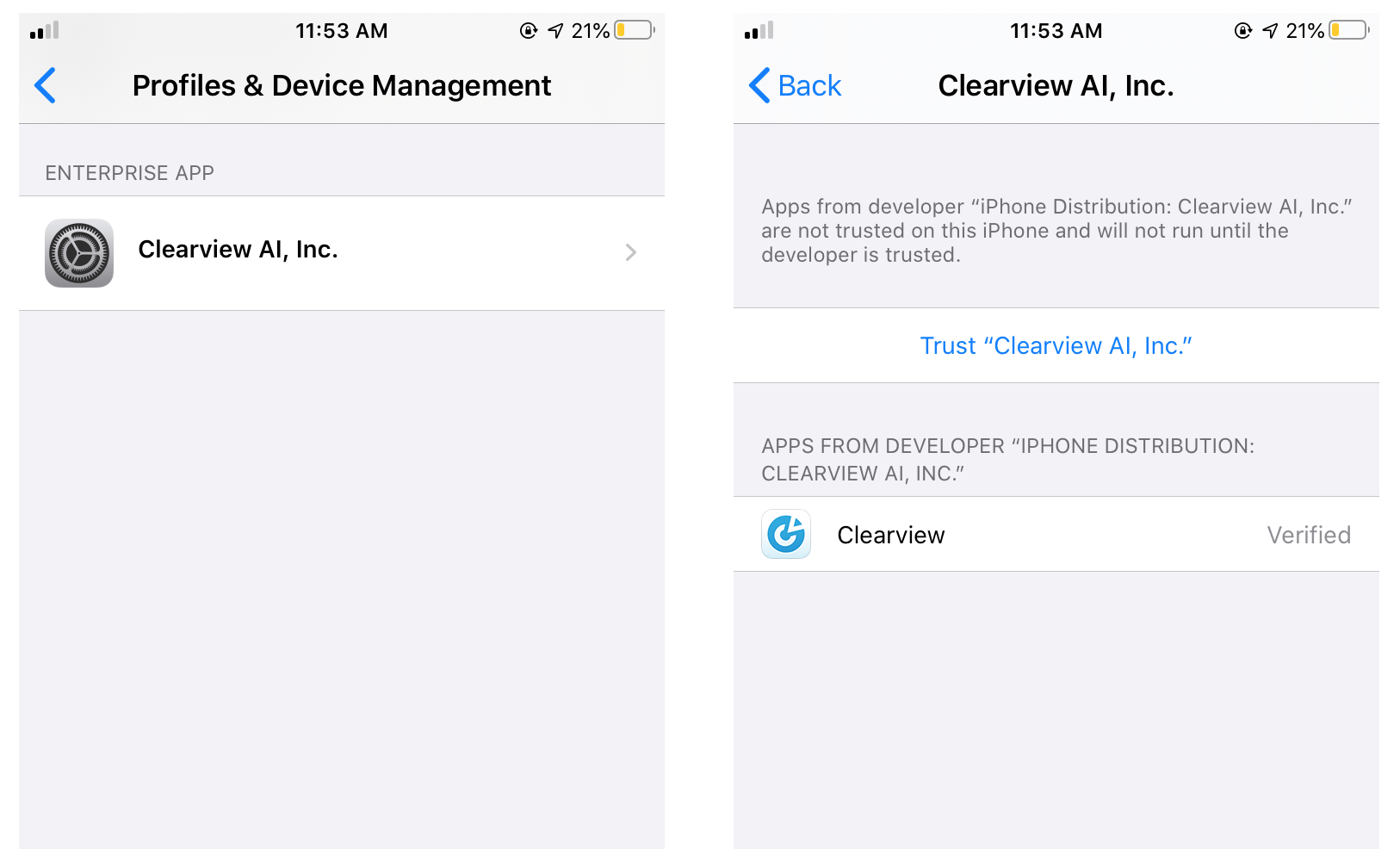
The page asks users to “open this page on your iPhone” to install and approve the company’s enterprise certificate, allowing the app to run.

But this, according to Apple’s policies, is prohibited if the app’s users are outside of Clearview AI’s organization.

Clearview AI’s use of an enterprise certificate on an iPhone. (Image: TechCrunch)

Enterprise certificates are issued by Apple to allow companies to build and approve iPhone and iPad apps designed for internal company use only. It’s common for these certificates to be used to test apps internally before they are pushed out to the App Store. Apple maintains a strict set of rules on use of enterprise certificates, and says they cannot be used by consumers. But there have been cases of abuse.

Last year, TechCrunch exclusively reported that both Facebook and Google were using their enterprise certificates for consumer-facing apps in an effort to bypass Apple’s App Store. Apple revoked the tech giants’ enterprise certificates, disabling the infracting app but also any other app that relied on the certificate, including their catering and lunch menu apps.

The app was labeled as “beta” — typically a pre-release or a test version of the app. Besides this claim, there is no evidence to suggest this app was not used by Clearview AI customers.

Clearview AI chief executive Hoan Ton-That told TechCrunch: “We are in contact with Apple and working on complying with their terms and conditions.”

A brief analysis of the app through network traffic tools and disassembly tools shows it works largely in the same way as Clearview AI’s Android app, which was discovered by Gizmodo on Thursday.

Like the Android app, a user needs a Clearview AI-approved username and password to use the app.


from iPhone – TechCrunch https://ift.tt/3afgI7c

Wednesday, 26 February 2020

Apple to begin online sales in India this year, open first retail store in 2021

For a decade, Apple has solely relied on third-party sellers, stores, and marketplaces to sell its products in India. That will begin to change this year.

At the company’s annual shareholder meeting Wednesday, chief executive Tim Cook told investors that Apple will open its online store in India, the world’s second largest smartphone market, at some point this year, and set up its first flagship brick-and-mortar store next year.

“I’m a huge believer in the opportunity in India,” said Cook. “It’s a country with a vibrancy and demographics that are just unparalleled.”

TechCrunch reported last month that Apple was planning to open its online store in Q3 this year and was unlikely to be able to have its brick-and-mortar store ready in the country this year.

India, perhaps the last great growth market for American technology giants, has been a conundrum for Apple and several firms that sell premium items.

It’s a big market that continues to report growth, but most people in the country can’t afford Apple’s products. In fact, the vast majority of smartphones that ship in India carry a price tag of $150 or lower, according to research firm Counterpoint.

For Apple, the other challenge has been the heavy import duty that New Delhi levies on electronic items. This has made iPhone even more expensive for people in India as the company passes the additional cost to customers.

Apple has attempted to broaden its appeal in India by looking to reduce prices of its handset. For years, it urged the government to provide it with some tax benefits. When those talks did not materialize, Apple moved to do something that all the Chinese phone makers have done in India: Assemble smartphones locally.

New Delhi provides companies that assemble electronic items locally with several incentives. Two years into the process, Apple contractors Foxconn and Wistron are assembling a range of iPhone models in India, and that has lowered the prices for a number of models (except those in the current generation lineup.)

These moves have already proven useful for the company. Apple shipped close to 925,000 iPhone units in India in the quarter that ended in December, research firm Canalys estimated. That figure, up 200% year-over-year, was the iPhone-maker’s best year in the country to date, the research firm added.

Madhumita Chaudhary, an analyst with Canalys, said Apple’s decision to become more aggressive with pricing — partnering with banks to offer more incentives to customers — helped the company improve its position in a market with 99% Android smartphones.

Apple has also held discussions with content studios to bulk up its movies and TV shows offerings for the Indian audience. Two years ago, for instance, it was in late stages of talks to acquire the Indian business of Eros Now for $300 million — something which has not been previously reported — with option to expand its stake in the publicly listed global company, sources with direct knowledge of the matter told TechCrunch a few months ago.

But the deal did not materialize.

TechCrunch also reported last month that Cook may plan an India visit for the opening of the online store. Apple did not comment on that story.

India eased sourcing norms for single-brand retailers last year, which paved the way for companies like Apple to open online stores before they establish presence in the brick-and-mortar market.


from Apple – TechCrunch https://ift.tt/2ThkfuO

Apple to begin online sales in India this year, open first retail store in 2021

For a decade, Apple has solely relied on third-party sellers, stores, and marketplaces to sell its products in India. That will begin to change this year.

At the company’s annual shareholder meeting Wednesday, chief executive Tim Cook told investors that Apple will open its online store in India, the world’s second largest smartphone market, at some point this year, and set up its first flagship brick-and-mortar store next year.

“I’m a huge believer in the opportunity in India,” said Cook. “It’s a country with a vibrancy and demographics that are just unparalleled.”

TechCrunch reported last month that Apple was planning to open its online store in Q3 this year and was unlikely to be able to have its brick-and-mortar store ready in the country this year.

India, perhaps the last great growth market for American technology giants, has been a conundrum for Apple and several firms that sell premium items.

It’s a big market that continues to report growth, but most people in the country can’t afford Apple’s products. In fact, the vast majority of smartphones that ship in India carry a price tag of $150 or lower, according to research firm Counterpoint.

For Apple, the other challenge has been the heavy import duty that New Delhi levies on electronic items. This has made iPhone even more expensive for people in India as the company passes the additional cost to customers.

Apple has attempted to broaden its appeal in India by looking to reduce prices of its handset. For years, it urged the government to provide it with some tax benefits. When those talks did not materialize, Apple moved to do something that all the Chinese phone makers have done in India: Assemble smartphones locally.

New Delhi provides companies that assemble electronic items locally with several incentives. Two years into the process, Apple contractors Foxconn and Wistron are assembling a range of iPhone models in India, and that has lowered the prices for a number of models (except those in the current generation lineup.)

These moves have already proven useful for the company. Apple shipped close to 925,000 iPhone units in India in the quarter that ended in December, research firm Canalys estimated. That figure, up 200% year-over-year, was the iPhone-maker’s best year in the country to date, the research firm added.

Madhumita Chaudhary, an analyst with Canalys, said Apple’s decision to become more aggressive with pricing — partnering with banks to offer more incentives to customers — helped the company improve its position in a market with 99% Android smartphones.

Apple has also held discussions with content studios to bulk up its movies and TV shows offerings for the Indian audience. Two years ago, for instance, it was in late stages of talks to acquire the Indian business of Eros Now for $300 million — something which has not been previously reported — with option to expand its stake in the publicly listed global company, sources with direct knowledge of the matter told TechCrunch a few months ago.

But the deal did not materialize.

TechCrunch also reported last month that Cook may plan an India visit for the opening of the online store. Apple did not comment on that story.

India eased sourcing norms for single-brand retailers last year, which paved the way for companies like Apple to open online stores before they establish presence in the brick-and-mortar market.


from Android – TechCrunch https://ift.tt/2ThkfuO
via IFTTT