Wednesday, 18 March 2020

Apple announces new iPad Pro

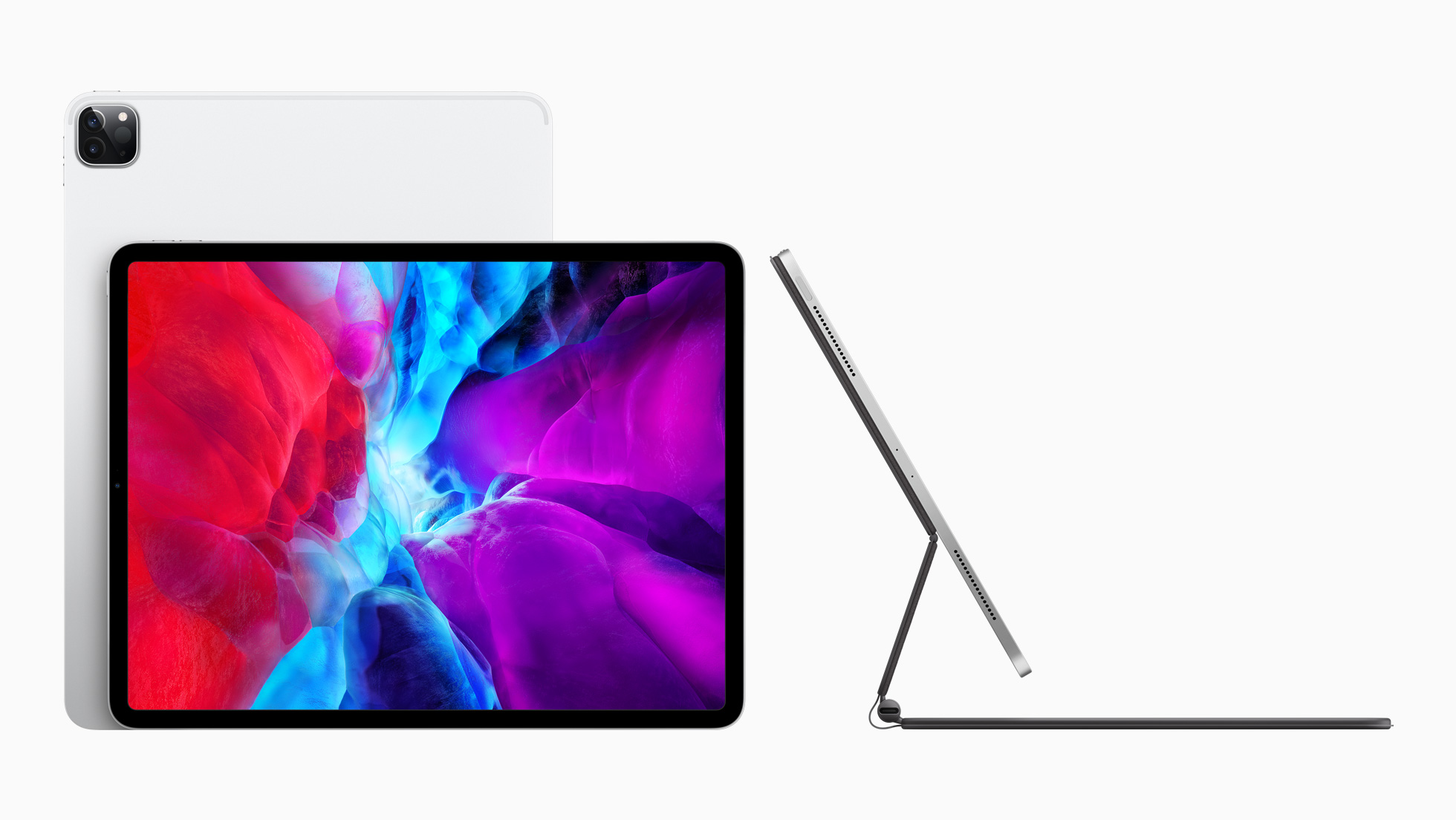
Apple has announced new iPad Pro models in a press release. In addition to better specifications, Apple is also releasing a new Magic Keyboard with backlit keys, a trackpad and a hinge that allows you to move the iPad freely.

The iPad Pro looks more or less like the existing iPad Pro. You can choose between an 11-inch display and a 12.9-inch display. It features an eight-core A12Z Bionic system on a chip — the previous version came with an A12X Bionic system on a chip.

The new iPad Pro features a 10MP ultra-wide camera sensor as well as a LiDAR sensor on the back of the device — LiDAR sensors can be useful for augmented-reality apps for instance. There’s a standard 12MP camera sensor as well. The microphones have been improved and Apple promises “studio-quality” sound.

Wi-Fi and LTE should be slightly faster, like on the iPhone 11 Pro. On the display front, the iPad Pro supports a refresh rate of 120 Hz and True Tone like previous models as well as a wide range of colors thanks to P3 support.

Apple also says that the thermal architecture has been improved, which should let you run demanding apps at peak performance for a longer time.
But let’s talk about the trackpad. 9to5mac previously noticed references to full mouse cursor support in iOS 14. It turns out that Apple will release that feature before iOS 14 this fall.

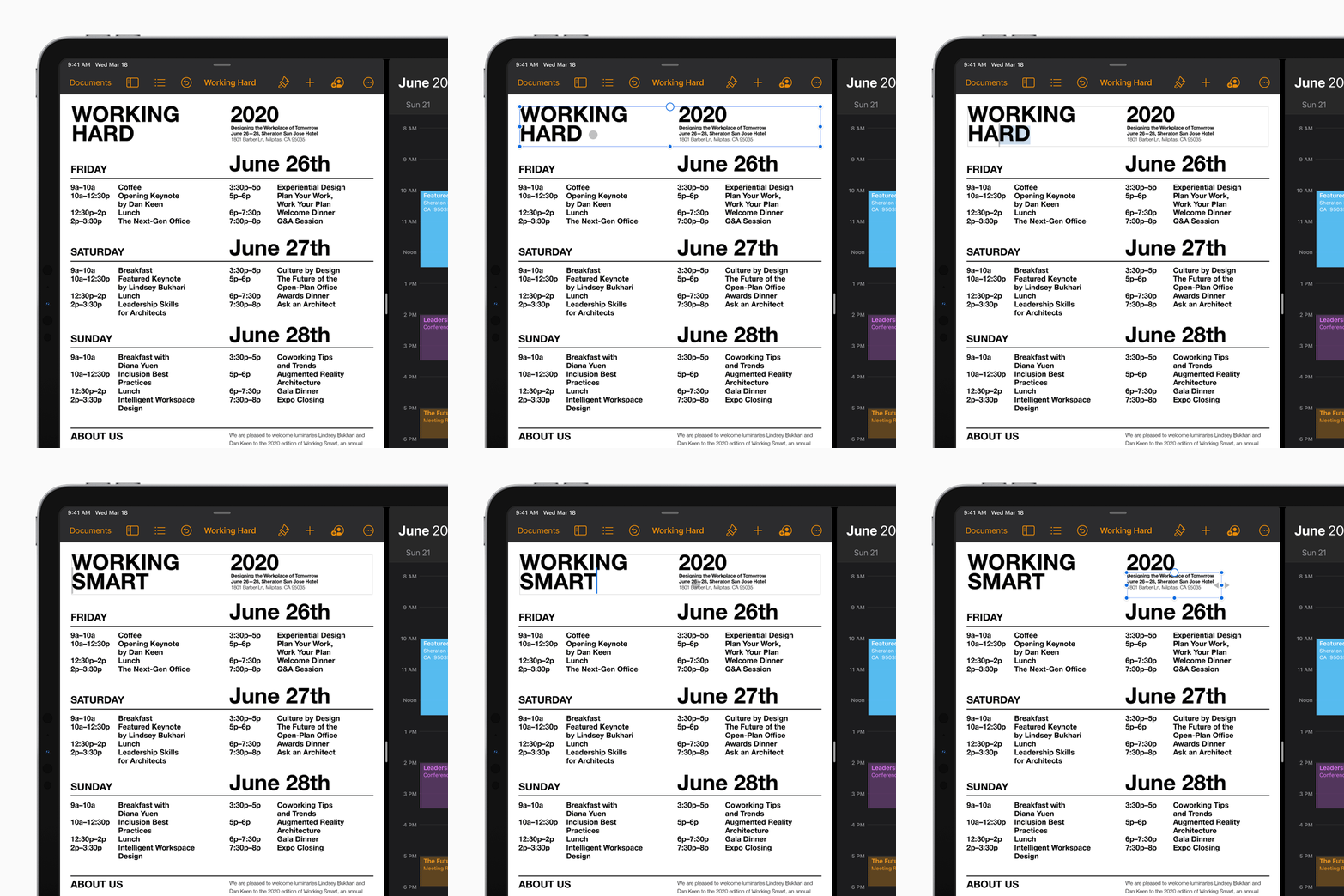
By default, Apple shows a rounded cursor. But the cursor changes depending on what you’re hovering over. If you’re moving a text cursor for instance, it becomes a vertical bar. If you’re resizing a text zone in a Pages document, it becomes two arrows. In other words, it works pretty much like a cursor on a desktop computer.

The new trackpad will support gestures that let you switch between apps, open the app switcher, activate the Dock or Control Center. Third-party apps already support the trackpad without any change. But developers can release updates to improve support thanks to new APIs.

The keyboard of the Magic Keyboard now looks more like a traditional keyboard with separate keys. There’s a USB-C port, which recharges both the keyboard and the iPad attached to it. This way, you can recharge your device and plug another accessory to the iPad Pro itself.

The new keyboard accessory will be available in May and will cost $299 or $349 depending on the size of your iPad Pro. Yep, that’s an expensive keyboard.

The iPad Pro will be available next week — orders start today. There are two finishes — silver and space gray. The 11-inch iPad Pro with 256GB of storage costs $799. The 12.9-inch model with 256GB of storage costs $999. You can add cellular support for an additional $150. There are also more expensive options with more storage (512GB and 1TB).


from Apple – TechCrunch https://ift.tt/393B6Hg

Apple updates Mac Mini with more storage options

Apple today announced the Mac Mini will ship with more standard storage space. Starting at $799, the base model Mac Mini now ships with a 256GB SSD, up from 128GB previously. The CPU, GPU and system memory remains the same from the previous model.

This refresh is a slight but welcomed bump to Apple’s least expensive Mac. With the updated specs, the Mac Mini offers a bit more bang for the buck but the specs still lags sorely behind similarly priced pre-packaged Windows PCs.

The $799 Mac Mini runs an Intel Core i3 CPU with a clock-speed of 3.6Ghz. It also sports an Intel HD Graphics 630 GPU and 8 GB of RAM. The $1,099 package ups the specs to a 3.0GHz Intel Core i5 CPU and a 512GB SSD hard drive.

Both of the new models ship on March 20. Apple Store pickup is currently unavailable as Apple closed all its stores outside of mainland China in response to the coronavirus.


from Apple – TechCrunch https://ift.tt/2Qowu86

The MacBook Air gets an updated keyboard and souped-up specs, starting at $999

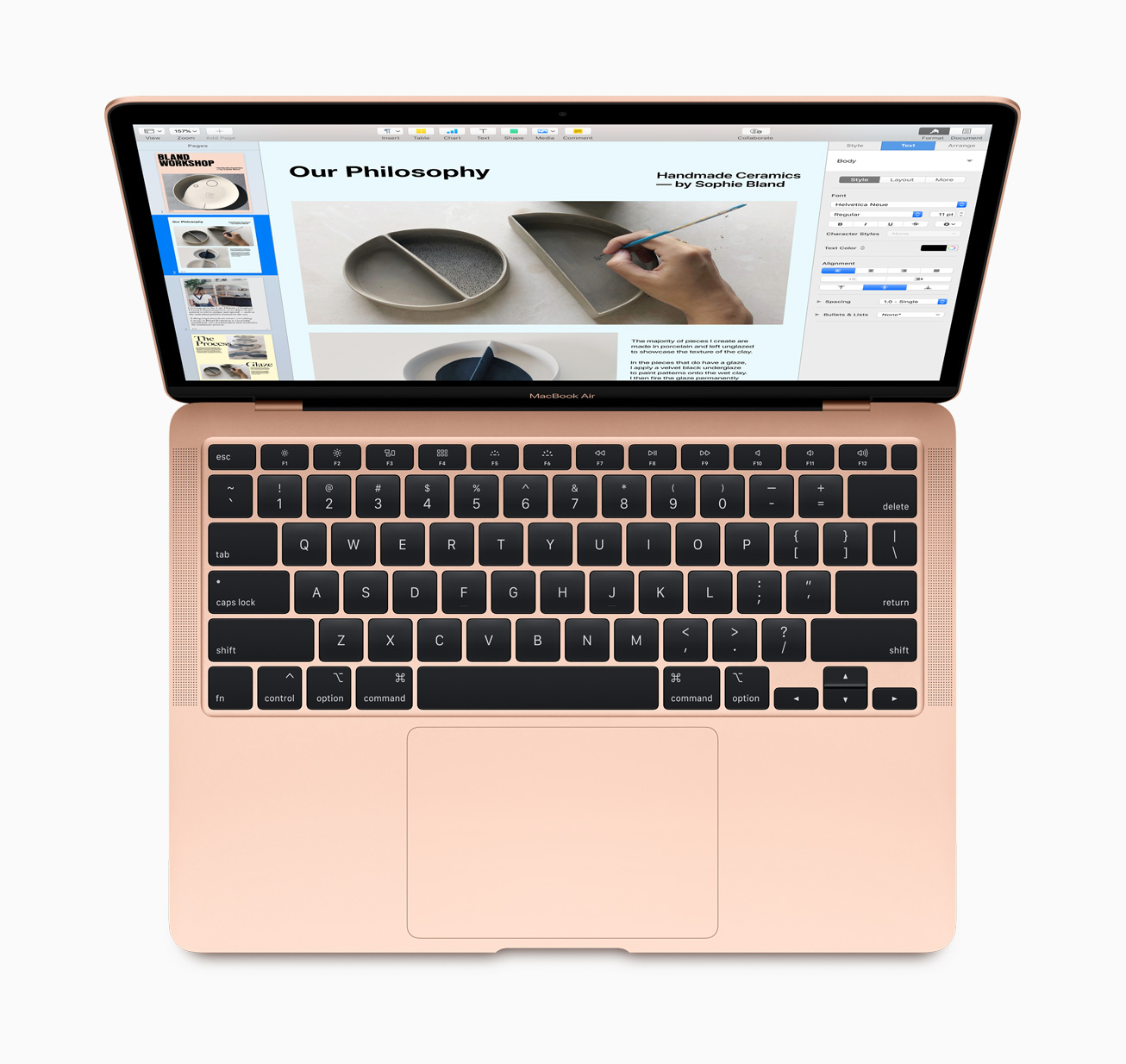
Apple just offered up a new version of the the MacBook Air with some souped up internals, including a 10th-generation Intel processor and double the storage. Honestly, the big news here for many is probably the updated keyboard, doing away with a couple of generations of misfires on that front.

Starting at $999 (or $899 for education users), the latest version of Apple’s perennial favorite thin and light promises up to double the performance, from Apple’s numbers, courtesy of the new silicon, configurable to up to a 1.2GHz quad-core Core i7 with Turbo boost up to 3.8GHz (the default configuration is a 1.1GHz dual-core Intel Core i3).

That’s bolstered by Intel Iris Plus Graphics, which the company says are up to 80 percent faster than their predecessor. The systems start at 256GB of storage — double the previous model. That’s configurable to up to a 2TB SSD. Both configurations sport 8GB of RAM. 

Perhaps the update, however, is that the the Air is getting the same Magic Keyboard mechanism that was introduced with the 16-inch MacBook Pro last year. The new scissor mechanisms offer more travel than earlier, maligned MacBook keyboard and should hold up much better. Per the released the system is made from 100% recycled aluminum and is available in gold (pictured), silver and space gray. It sports a 13.3-inch Retina display and can support an external 6K monitor via the two Thunderbolt 3 ports, making it the first Air to do so.

There are two base models: $999 and $1,299. The later can be configured up to a $2,249 price point, if you really want to go wild. They’re available now through Apple’s site.


from Apple – TechCrunch https://ift.tt/3d9csrU

Tuesday, 17 March 2020

U.S. government reportedly in talks with tech companies on how to use location data in COVID-19 fight

U.S. government officials are currently in discussion with a number of tech companies, including Facebook and Google, around how data from cell phones might provide methods for combatting the ongoing coronavirus pandemic, according to a new Washington Post report. The talks also include health experts tracking the pandemic and its transmission, and one possible way in which said data could be useful is through aggregated, anonymized location data, per the report’s sources.

Location data taken from the smartphones of Americans could help public health experts track and map the general spread of the infection, the group has theorized, though of course the prospect of any kind of location tracking is bound to leave people uncomfortable, especially when it’s done at scale and involves not only private companies with which they have a business relationship, but also the government.

These efforts, however, would be strictly aimed at helping organizations like the Centers for Disease Control and Prevention (CDC) get an overview of patterns, decoupled from any individual user identity. The Post’s sources stress that this would not involve the generation of any kind of government database, and would instead focus on anodized, aggregated data to inform modelling of the COVID-19 transmission and spread.

Already, we’ve seen unprecedented collaboration among some of the largest tech companies in the world on matters related to the coronavirus pandemic. Virtually every large tech company that operates a product involved in information dissemination came together on Monday to issue a statement about working closely together in order to fight the spread of fraud and disinformation about the virus.

The White House has also been consulting with tech companies around the virus and the U.S. response, including via a meeting last week that included Amazon, Apple, Facebook, Google, Microsoft and Twitter, and Amazon CEO Jeff Bezos has been in regular contact with the current administration as his company is increasingly playing a central and important role in how people are dealing with essentially global guidelines of isolation, social distancing, quarantine and even shelter-in-place orders.

Earlier this week, an open letter co-signed by a lengthy list of epidemiologists, excecutives, physicians and academics also sought to outline what tech companies could contribute to the ongoing effort to stem the COVID-19 pandemic, and one of the measures suggested (directed at mobile OS providers Apple and Google specifically) is an “opt-in, privacy preserving OS feature to support contact tracing” for individuals who might have been exposed to someone with the virus.

Of course, regardless of assurances to the contrary, it’s natural to be suspicious of any widespread effort to collect personal data. Especially when it’s historically been the case that in times of extreme duress, people have made trade-offs about personal freedoms and protections that have subsequently backfired. The New York Times also reported this week on an initiative to track the location data of people who have contracted the virus using an existing, previously undisclosed database of cellphone data from Israeli cellphone selfie providers and their customers.

Still, there’s good reason not to instantly dismiss the idea of trying to find some kind of privacy-protecting way of harnessing the information available to tech companies, since it does seem like a way to potentially provide a lot of benefit – particularly when it comes to measuring the impact of social distancing measures currently in place.


from Apple – TechCrunch https://ift.tt/3aadcLP

Android app reviews may slow to over a week due to COVID-19 impacts, Google warns developers

Google this week warned Android developers that Play Store app review times will be much longer than normal due to the impacts of the COVID-19 crisis. Developers should expect app reviews to take up to a week or even longer, the company informed its community by way of an alert on the Google Play Console.

This slowdown in moderation efforts isn’t something that’s just impacting Google Play.

Yesterday, YouTube announced it would more heavily rely on its automated systems during this time, which meant more videos will likely be taken down by machine learning-powered systems before they received a review from a human moderator.

In both cases, the slowdowns are related to the reduced in-office staffing levels — a result of the COVID-19 pandemic, which is impacting employee scheduling at Google and elsewhere.

Up until now, Google Play had a fairly quick app review process.

For years, the company differentiated its Play Store from Apple’s App Store by allowing developers to publish without a lengthy review. This, of course, led to issues as the store was over-filled with low-quality and sometimes even malicious apps. In 2015, Google revealed it had begun to utilize an internal team of reviewers to analyze apps for policy violations prior to publication.

Despite the change in process, apps were being approved within hours instead of days, Google said at the time.

That changed last year, however, as the company implemented a more stringent review. It then began to advise developers to plan for review times of at least three days between submission and the app going live. But the length was reduced for established, trusted developers who continued to see faster reviews, Google had noted.

Review times of a week or even longer are unprecedented, much like the COVID-19 crisis itself.

News of the increased app reviews was first reported by Android Police.

A Google spokesperson confirmed the delay to TechCrunch, saying: “Due to adjusted work schedules at this time, we are currently experiencing longer than usual review times. While the situation is currently evolving, app review times may fluctuate, and may take 7 days or longer.”

The delay is also confirmed in the Play Console’s Help documentation.


from Android – TechCrunch https://ift.tt/2QDHYVF
via IFTTT

Apple now says its retail stores are closed “until further notice”

Apple appears to be expecting a longer disruption to shopping at its physical retail stores as a result of the public health crisis posed by the COVID-19 pandemic.

Earlier this week, in a press release, the iPhone maker said it would be closing retails stores outside China until March 27. A note on its website now says the shut down is open ended. Apple writes that the bricks-and-mortar stores “are closed until further notice” — so at very least it’s signalling to customers to expect ongoing disruption to its retail business as usual.

Those looking to buy Apple products are told to shop on the website. Service and support is also offered online or via telephone.

We’ve reached out to Apple to ask for confirmation on a policy change.

In its March 13 missive, the company wrote that it is committed to paying all its hourly workers as if the stores remained open, and also said it was expanding its leave policies to “accommodate personal or family health circumstances created by COVID-19”.

Late yesterday six Bay Area countries issued a ‘shelter in place’ order to restrict potential spread of the novel coronavirus. Additional measures seem likely in the coming days.

Multiple countries in European Union have already ordered the closure of non-essential shops — instructing residents to stay at home unless they need to venture out to obtain essential supplies or are required to work and cannot work from home.


from Apple – TechCrunch https://ift.tt/2Qnzhys

Apple now says its retail stores are closed “until further notice”

Apple appears to be expecting a longer disruption to shopping at its physical retail stores as a result of the public health crisis posed by the COVID-19 pandemic.

Earlier this week, in a press release, the iPhone maker said it would be closing retails stores outside China until March 27. A note on its website now says the shut down is open ended. Apple writes that the bricks-and-mortar stores “are closed until further notice” — so at very least it’s signalling to customers to expect ongoing disruption to its retail business as usual.

Those looking to buy Apple products are told to shop on the website. Service and support is also offered online or via telephone.

We’ve reached out to Apple to ask for confirmation on a policy change.

In its March 13 missive, the company wrote that it is committed to paying all its hourly workers as if the stores remained open, and also said it was expanding its leave policies to “accommodate personal or family health circumstances created by COVID-19”.

Late yesterday six Bay Area countries issued a ‘shelter in place’ order to restrict potential spread of the novel coronavirus. Additional measures seem likely in the coming days.

Multiple countries in European Union have already ordered the closure of non-essential shops — instructing residents to stay at home unless they need to venture out to obtain essential supplies or are required to work and cannot work from home.


from iPhone – TechCrunch https://ift.tt/2Qnzhys