Monday, 23 March 2020

Daily Crunch: Tech giants take steps to fight coronavirus

Tech companies are donating supplies and adjusting priorities in response to the COVID-19 pandemic, an activist investor takes three seats on the Box board and aircraft taxi company Lilium raises $240 million. Here’s your Daily Crunch for March 23, 2020.

1. Amazon, Apple and Microsoft CEOs detail their companies’ efforts to combat coronavirus pandemic

Over the weekend, the CEOs of Amazon, Apple and Microsoft all shared updates regarding some aspects of their companies’ ongoing COVID-19 efforts, which range from donations of medical supplies and personal protective equipment for frontline healthcare workers to software projects that help track and analyze the global spread.

For example, Apple CEO Tim Cook shared on Twitter that the company has been attempting to source necessary supplies that are needed for healthcare workers both in the U.S. and Europe, and that the company is providing “millions of masks” for this purpose. Meanwhile, Amazon founder and CEO Jeff Bezos said the company’s warehouse and logistics operations will now focus on essential items, including daily household staples, baby and medical supplies.

2. Activist investor Starboard Value taking three Box board seats as involvement deepens

At the same time, two long-time Box investors and allies, Rory O’Driscoll from Scale Venture Partners and Josh Stein from DFJ, will be retiring from the board and not seeking re-election at the annual stockholder’s meeting in June.

3. Lilium raises another $240M to design, test and run an electric aircraft taxi service

Lilium, a Munich-based startup that is designing and building vertical take-off and landing aircraft with speeds of up to 100 km/h, eventually plans to run in its own taxi fleet. It is deploying its latest round of funding to continue developing its aircraft and to start building manufacturing facilities for an expected launch date in 2025.

4. Uber, Ola suspend all rides in India’s capital

The companies have suspended all ride operations in Delhi until March 31. They said the move was in compliance with the local state government’s lockdown order in response to the COVID-19 outbreak.

5. Corporate venture business strategies that work

Bill Taranto, president at Merck Global Health Innovation Fund, lays out four business strategies that he says have ensured the firm’s scale and staying power. (Extra Crunch membership required.)

6. The CDC launches a ‘coronavirus self-checker’ bot called Clara for people in the United States

The U.S. Centers for Disease Control and Prevention introduced a bot over the weekend to help people make decisions about what to do if they have potential symptoms of COVID-19. Called Clara, the “coronavirus self-checker” was created in partnership with CDC Foundation and — speaking of Microsoft — the Azure Healthcare Bot service.

7. This week’s TechCrunch podcasts

Social distancing isn’t stopping the TechCrunch team from cranking out podcasts. Equity has a full episode about fundraising during a recession and a Monday news roundup that discusses a new $116 million funding round for Cazoo. And on Original Content, we’ve got episodes reviewing Hulu’s “Hillary” documentary and the Apple TV+ reboot of “Amazing Stories.”

The Daily Crunch is TechCrunch’s roundup of our biggest and most important stories. If you’d like to get this delivered to your inbox every day at around 9am Pacific, you can subscribe here.


from Apple – TechCrunch https://ift.tt/2Uy7r3B

Oprah Winfrey’s new Apple TV+ show, ‘Oprah Talks COVID-19,’ arrives for free streaming

Over the weekend, Apple introduced the first two episodes of its new Apple TV+ show, “Oprah Talks COVID-19,” for free viewing. In the first episode, Oprah Winfrey interviews actor Idris Elba, who recently tested positive for coronavirus, as well as his wife, Sabrina Dhowre, who is also positive. In the second episode, Oprah talks to longtime friend and supporter Reverand Wintly Phipps about the pandemic.

The interviews are conducted over FaceTime video calls with guests and are meant to offer hope and thought leadership, Oprah explained on Twitter.

“Like millions of people all over the world, I’ve been staying safer at home for over a week now. I know a lot of people are feeling stressed, overwhelmed, & uncertain,” Oprah wrote in a tweet. “[Because] of that, I want to offer some hope & gather thought leaders & people going through it to add some perspective,” she said.

In her interview with Elba, they talk about his decision to go public and his wife’s decision to quarantine with him, plus the result of her test. The shows have a more inspirational tone, compared with traditional news interviews.

“I think we all lose as human beings if we just think of this as a physical virus. I think it’s here to teach us, show us something about ourselves, as a world. This is a moment for our humanity to either rise or not,” Oprah says in one episode.

Though the majority of Apple TV+ programming is only available on a subscription basis, this COVID-19 show is available for free.

It can be watched across platforms, including via the Apple TV app for Mac, iPad, iPhone, tv.apple.com and Apple TV, as well as through the Apple TV+ app for streaming platforms or via AirPlay-enabled TVs.

The program is one of several Oprah is involved with for Apple TV+.

In 2018, Oprah and Apple announced a multi-year partnership on original content for the Apple TV+ streaming service. That has already resulted in an Apple TV+ show that brings back Oprah’s Book Club as a series of author interviews. Another show, produced in partnership with Prince Harry and focused on mental health, has yet to arrive. A third, a documentary about sexual assault in the music industry, was canceled.

This new show, put together quickly in reaction to the COVID-19 crisis and using lower-production values, is the first show of its kind on Apple TV+, where the content is typically highly produced and made available in 4K. Apple hasn’t said how many episodes will arrive in total, but this is a unique situation.


from Apple – TechCrunch https://ift.tt/3bk8afB

Sunday, 22 March 2020

Amazon, Apple and Microsoft CEOs detail their companies’ efforts to combat coronavirus pandemic

The tech industry is mobilizing its considerable resources to attempt to support efforts against the growing global coronavirus pandemic. Over the weekend, the CEOs of Amazon, Apple and Microsoft all shared updates regarding some aspects of their company’s ongoing contributions, which range from donations of medical supplies and personal protective equipment (PPE) for frontline healthcare workers, to software projects that help track and analyze the global spread of infection.

Apple CEO Tim Cook shared on Twitter that the company has been attempting to source necessary supplies that are needed for healthcare workers both in the U.S. and Europe, and that the company is joining “millions of masks” for this use. Apple also detailed some of its other updates via earlier releases, including a $15 million donation, along with two-to-one corporate matching for all employee donations that go towards COVID-19 response.

Amazon founder and CEO Jeff Bezos provided an update on Saturday on the company’s official blog that included details about the change in Amazon’s prioritization for its warehousing and logistics operations, which now focus on essential items including daily household staples, baby and medical supplies. Bezos also reiterated Amazon’s commitment to hiring 100,000 new roles, along with raising hourly wages for fulfilment workers.

Bezos notes that while the company has “placed purchase orders for millions of face masks” that it intends to distribute to its full-time and contract workers who are not able to work from home, “very few of those orders have been filled” to to the global supply shortage. He further notes that these resources are likely to go to frontline healthcare workers first, and that the company will focus on getting them to their staff in order of priority once they become available.

Microsoft CEO Satya Nadella provided a lengthy update about his company’s various efforts in a LinkedIn post on Saturday, publishing an email he sent to all Microsoft employees for external consumption. Nadella describes some of its telehealth platform software work, as well as a number of collaborative data projects, including the John Hopkins University global COVID-19 confirmed case tracker. The Centers for Disease Control and Prevention (CDC) also released a chatbot assessment tool for COVID-19 that uses Microsoft’s health chatbot tech as its underlying framework.

Microsoft is also seeing Teams and Minecraft being used globally for remote learning iniativies designed to supplement in-perosn school closures, and it’s working on machine learning and big data projects to support global research efforts. Earlier this week, Microsoft’s Chief Scientific Officer Eric Horvitz announced that it would be providing an open research data set in partnership with colleagues at academic institutions around the world, as well as the White House Office of Science and Technology Policy and the Chan Zuckerberg initiative. The data set, called the COVID-19 Open Research Data Set, includes more than 29,000 scholarly articles about the virus, and will grow as more are published.


from Apple – TechCrunch https://ift.tt/2xXIRBH

Saturday, 21 March 2020

Original Content podcast: Apple’s ‘Amazing Stories’ is thoroughly unamazing

It’s been two-and-a-half years since the news first broke that Steven Spielberg would be rebooting his ’80s anthology series “Amazing Stories” for Apple’s then-unnamed streaming service.

Now, after some behind-the-scenes drama, “Amazing Stories” has launched on Apple TV+, with the first two segments currently available. The first, “The Cellar,” is a time travel romance, while “The Heat” is a combination ghost story/murder mystery/sports drama.

As we explain on the latest episode of the Original Content podcast, it’s hard to tell exactly who this show was made for. Both of the episodes aired so far get pretty goofy, as if the show was made for kids — but they also move into surprisingly dark territory. Both start with familiar setups, then take some surprising twists and turns, but the results aren’t very satisfying.

In the end, it was hard for any of us to muster any enthusiasm for watching the show’s remaining three episodes.

You can listen to our full review in the player below, subscribe using Apple Podcasts or find us in your podcast player of choice. If you like the show, please let us know by leaving a review on Apple. You can also send us feedback directly. (Or suggest shows and movies for us to review!)

And if you’d like to skip ahead, here’s how the episode breaks down:

0:00 Intro
0:44 “Amazing Stories” review
25:50 “Amazing Stories” spoiler discussion


from Apple – TechCrunch https://ift.tt/3alGery

WhatsApp tests new feature to fight misinformation: Search the web

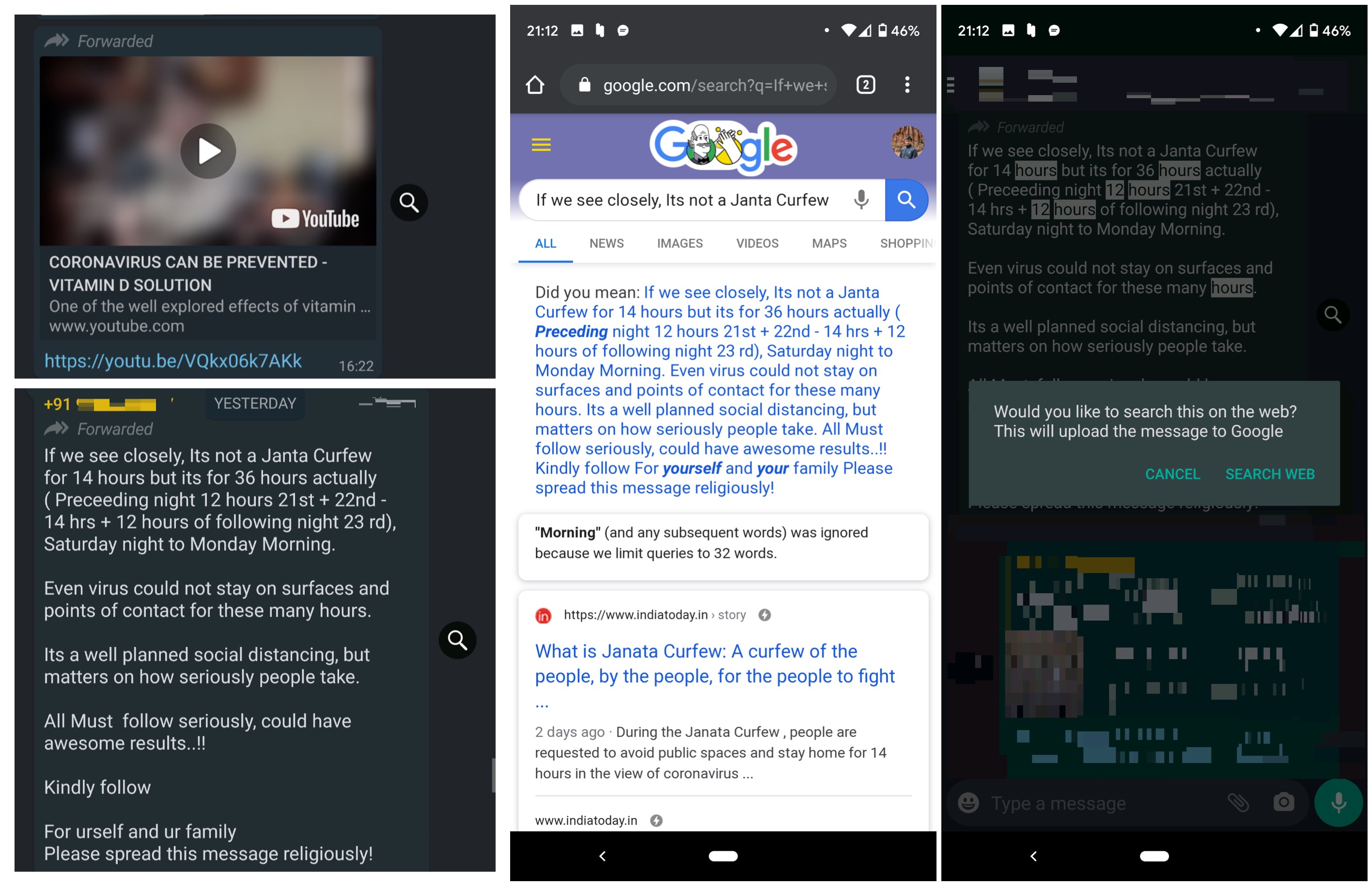
WhatsApp, one of the most popular instant messaging platforms on the planet, is testing a feature that could make it simpler for its 2 billion users to tell whether the assertion made in messages they have received is true.

In the recent most beta version of its Android app, the Facebook-owned service has given users the ability to quickly comb through the web with the text or video they have received for more context.

WhatsApp has been testing this feature in some capacity for several quarters now (last year, it allowed some users to look up an image on the web), but a spokesperson has now told TechCrunch that the platform plans to roll out this feature in the near future.

“We are working on new features to help empower users to find out more information about the messages they receive that have been forwarded many times. This feature is currently in testing, and we look forward to rolling it out in the near future,” a spokesperson said in a statement.

Images credit: @shrinivassg

The timely test of this feature comes at a time when WhatsApp and other messaging platforms are being used more often than ever before as people stay in touch with their friends, families, and colleagues in the face of a global pandemic.

And as it has happened in the past, several platforms including WhatsApp are grappling with spread of misinformation — this time about the coronavirus.

But WhatsApp has moved to take action much swiftly this time. It began reaching out to dozens of governments last month to assist in their efforts to provide accurate information to the general public, it said today.

Earlier today, India announced a WhatsApp bot to help its citizens be better informed about coronavirus. Earlier this week, the World Health Organization also announced a WhatsApp bot for people globally to bust myths about the coronavirus and answer some of the most frequently asked questions about the disease.

“The WHO Health Alert is the latest official NGO or government helpline to become available on WhatsApp, joining the Singapore Government, The Israel Ministry of Health, the South Africa Department of Health, and KOMINFO Indonesia. We are actively working to launch local services with other countries as well,” WhatsApp said in a statement.


from Android – TechCrunch https://ift.tt/3djAZec
via IFTTT

Friday, 20 March 2020

Apple MacBook Air review

Let’s address the elephant in the room. There’s an undeniable irony reviewing an ultraportable laptop when you’re not allowed to leave your house. Of course, Apple didn’t see this coming. None of us did, with the possible exception of Bill Gates, I suppose.

I bring this up not as a reminder of everything that’s wrong with the world at the present moment — you certainly didn’t need a reminder of that. Instead, I just figured it was important to note here that the testing situation is less than ideal for the MacBook Air. I haven’t left my one-bedroom New York City apartment with the thing since it arrived this morning.

In fact, I’ve mostly been working with the laptop sitting directly in front of a larger computer. One that’s big and not designed to be moved. I was feeling adventurous, however, so now I’m sitting on my bed, writing this with the Air on my lap. Damn, it feels good to live again.

There’s not a lot I can tell you about the MacBook Air that you don’t already know. One of the mainstays of the MacBook line, the Air turned 12 in January. It’s a testament to the original that the design still feels fresh well over a decade into its existence. There have been important updates to the device over the years, of course, but the laptop that hit the market nearly a year to the day before Barack Obama’s first inauguration still very much forms the foundation of the device.
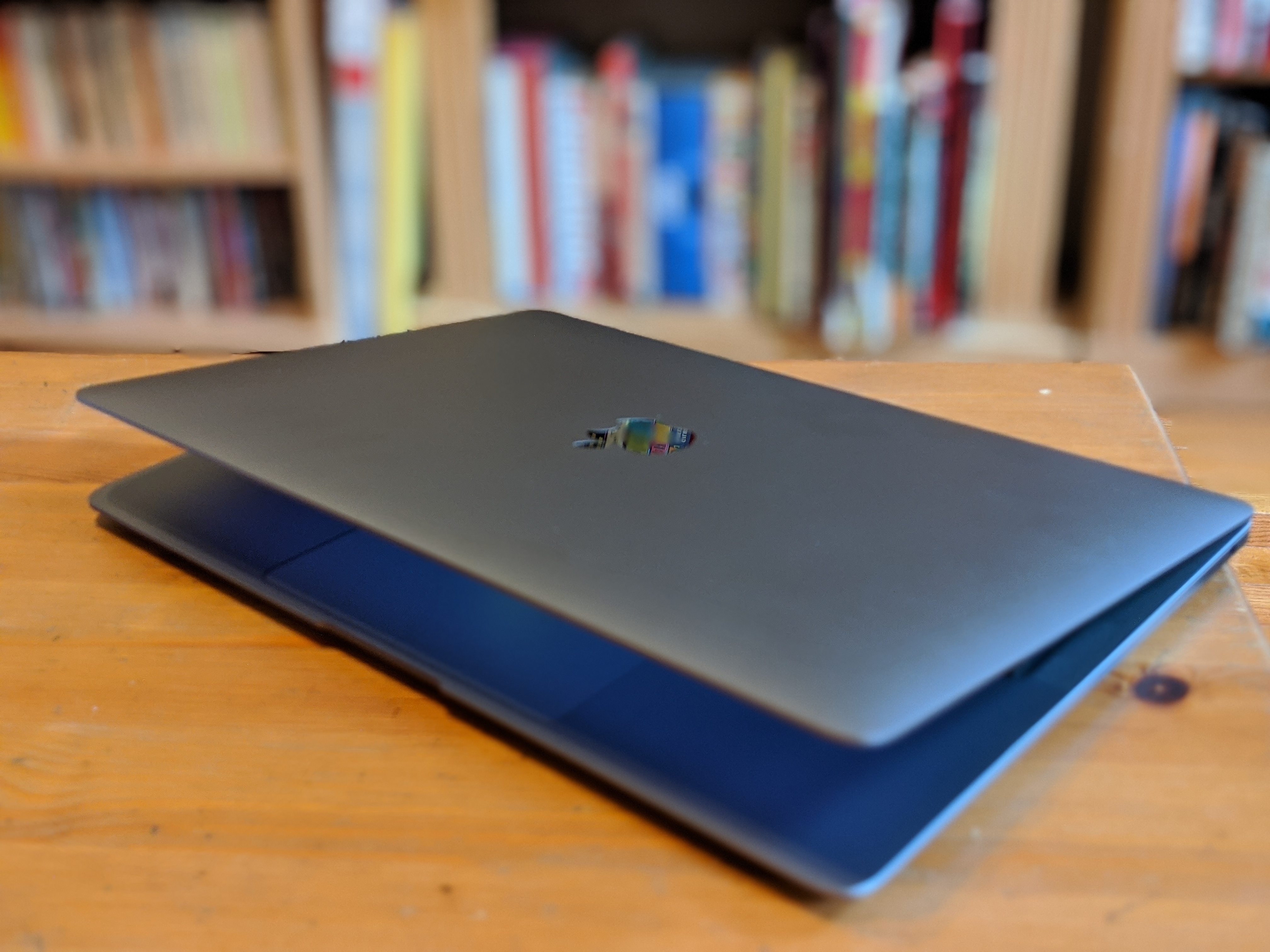
“Thin” and “light” are still very much the qualities that define the Air. It’s a product that trades the processing power of the rest of the MacBook family in favor of a design that slips comfortably into the seat-back pocket in front of you on the plane. Indeed, the device has never been the one you want for heavy video processing or other resource-intensive applications. And while the 2020 model gets some important internal updates, that remains the case here.

If, however, you’re worried about lower-back pain, this is probably the MacBook for you.

The familiar wedge shape is in tact, of course. A few generations ago, that design was married with the prevailing aesthetic of the rest of the MacBook line, with a unibody design and reflective Apple logo up top.

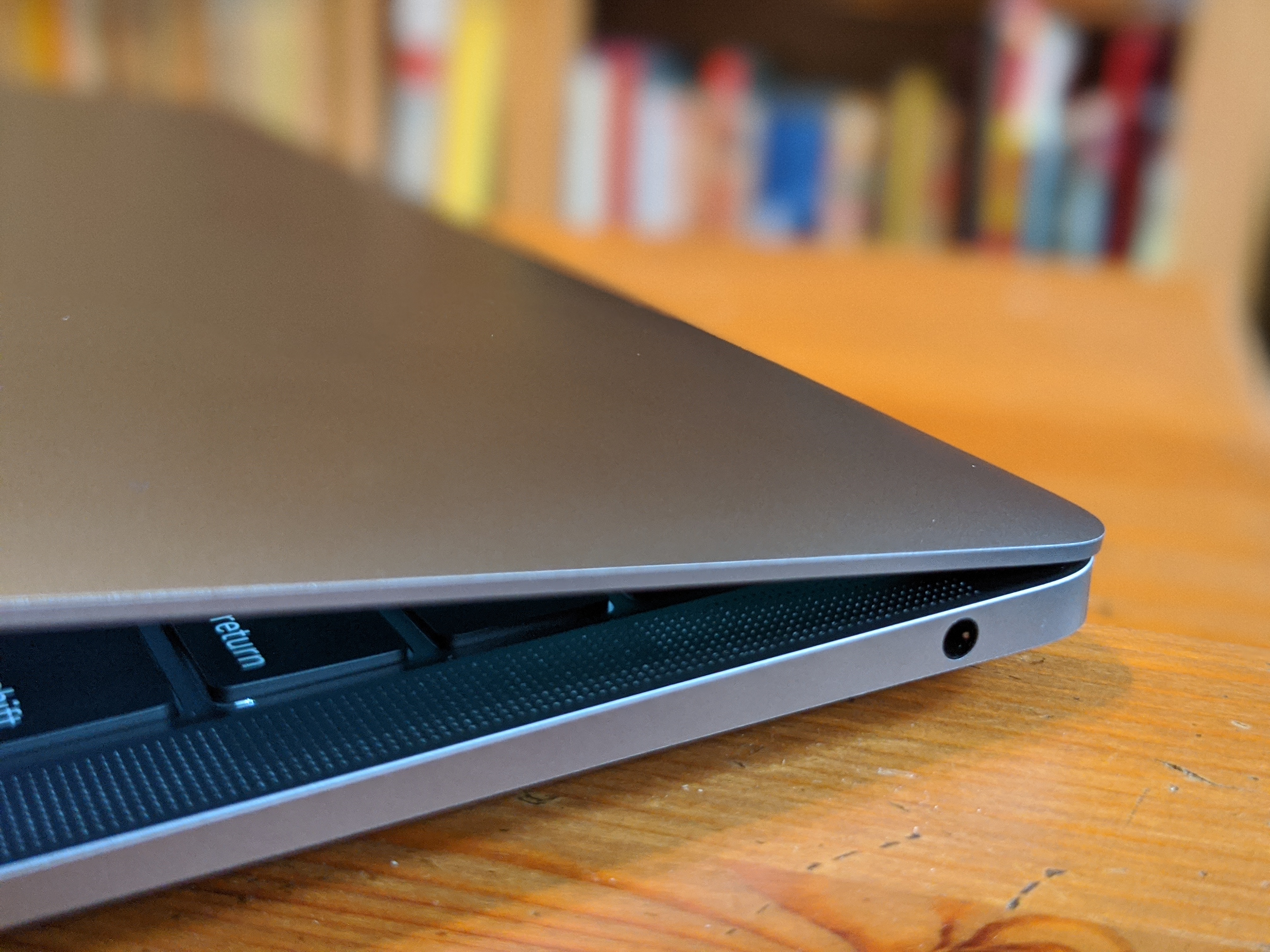
There are still just the two Firewire 3/USB C ports onboard. Once again, they’re both on the same side. This has always been one of the bigger complaints since the redesign. Two on either side would be the best-case scenario, but until then, I’d settle for one on either, so as to avoid blocking the other one and to make it easier to plug the power cable into either side, depending on where you’re sitting relative to the outlet.

The biggest design change to the 2020 is much more subtle, however. After a rough couple of years for MacBook keyboards that culminated with a couple of consumer suits and countless jammed keys, Apple introduced a new design on last year’s 16-inch MacBook Pro. Mercifully, that upgrade has also come to the Air.

The system has returned to a scissor-switch design, which, among other things, results in more key travel, meaning the keys actually retract as you type, like a traditional keyboard. It’s like night and day, honestly. The butterfly mechanisms were a clear misstep for the company. In addition to lacking the tactile feedback, the fact that they were more or less flush with the laptop meant that if any debris got stuck in there, the key might just stop working. I had at least one instance of requiring some emergency compressed air at an event after the S key jammed. That’s an important key, mind.
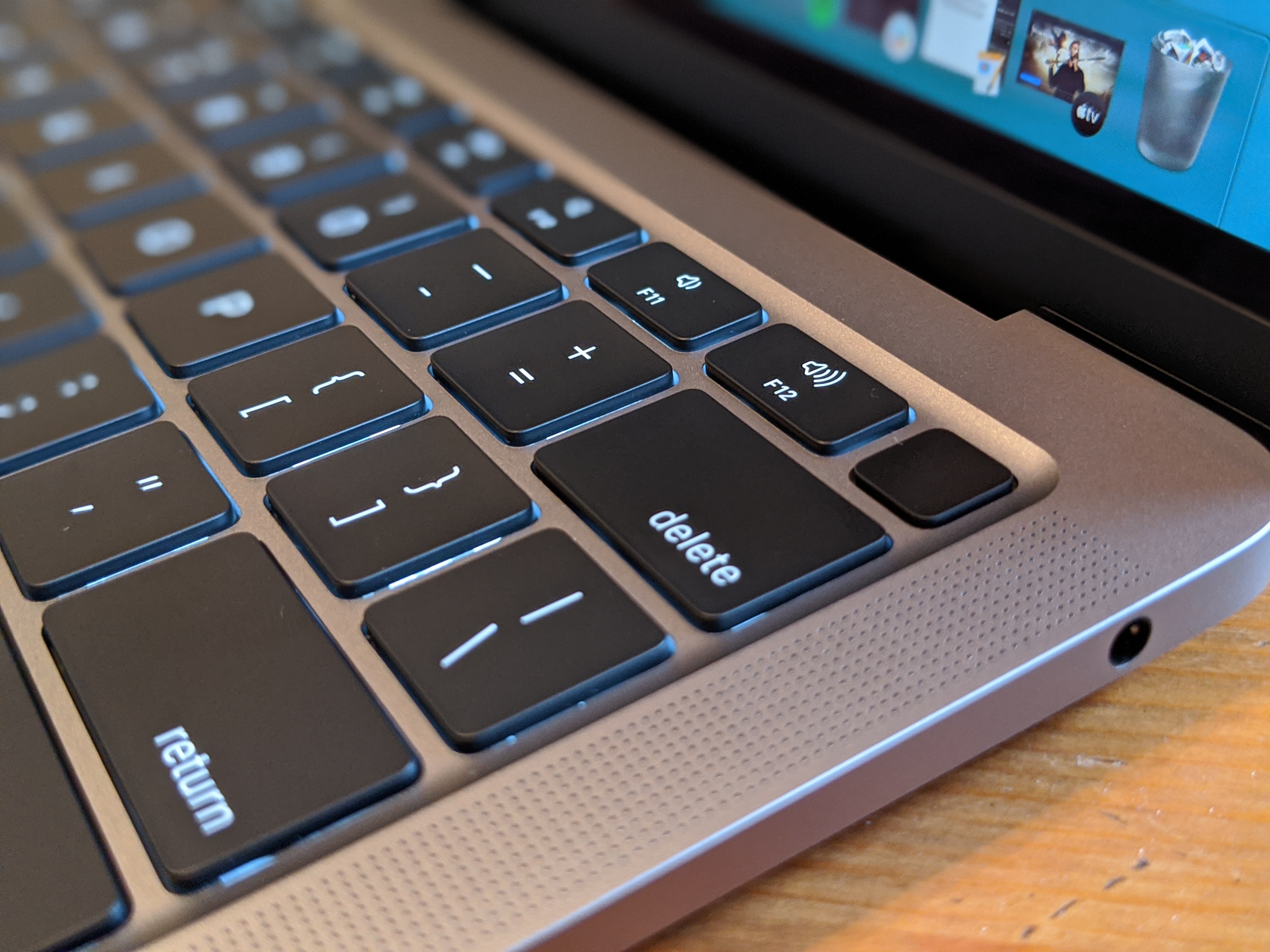
Unlike other iterative attempts to update the butterfly mechanism, the move back to a scissor switch is a marked improvement. The keys are still relatively soft compared to other systems, but the feel is much improved — not to mention not as loud while typing. The feeling here is pretty similar to what you get with Apple’s Bluetooth Magic Keyboard peripheral. Honestly, that makes it a valuable upgrade in and of itself. There’s no Touchbar up top, instead opting for the standard function keys. The best part of the Touchbar setup — TouchID — is present, however. 

A lot about the Air remains unchanged from the big 2018 overhaul. That was, of course, the first major update in some time, bringing, most notably, the Retina display to the model for the first time ever. That’s a 2560 x 1600 IPS. It’s higher res and much better viewing angles than previous models — a big update for a model that many thought had been largely abandoned by Apple.

That’s still here. What is new, however, are some key upgrades to the inside. The default configuration ships with a tenth-generation 1.1GHz dual-core Intel Core i3. While the device has evolved over last year’s eighth-generation chip, that model shipped with the Core i5 standard. Apple’s clearly made some calculations to drop the base price of the system from $1,099 to $999. Apple likely wants to further differentiate the device from the rest of the line.

For even basic users, however, I’d recommend adding $100 back onto the system price in order to upgrade to an i5. That’s the chip ours came with. The system scored 5244 and 14672 on Geekbench 4’s single and multi-core tests, respectively, presenting a marked upgrade over the last model we tested, back in 2018.
The other meaningful update to the silicon is the switch from Intel UHD 617 to Iris Plus graphics. Among other things, that will help with the ability to support external monitors. The Air is capable of supporting up to a 6K external monitor, with help from display compression. RAM is once again 8GB by default (as in our configuration), upgradable to 16GB. Much bigger news on the storage side, however, as that’s been upgraded to 256GB on the base model (up from 128GB), and can be configured all the way up to a generous 2TB (from 1TB).

Interestingly, the stated battery life has actually contracted, from 12 down to 11 hours. That, of course, largely depends on usage. After several hours, I’m down to 35% left. I’ve had the brightness and everything else at default levels and have mostly been typing, using Chrome and Slack and listening to music on headphones via Spotify (along with the occasional benchmark).

All-day battery life seems like a fair enough description, when you’re multitasking; 11 hours is probably a stretch. It’s worth noting that this can vary quite a bit based on a number of factors. I’ve only really had a full day with the laptop, so I’ll update retroactively.
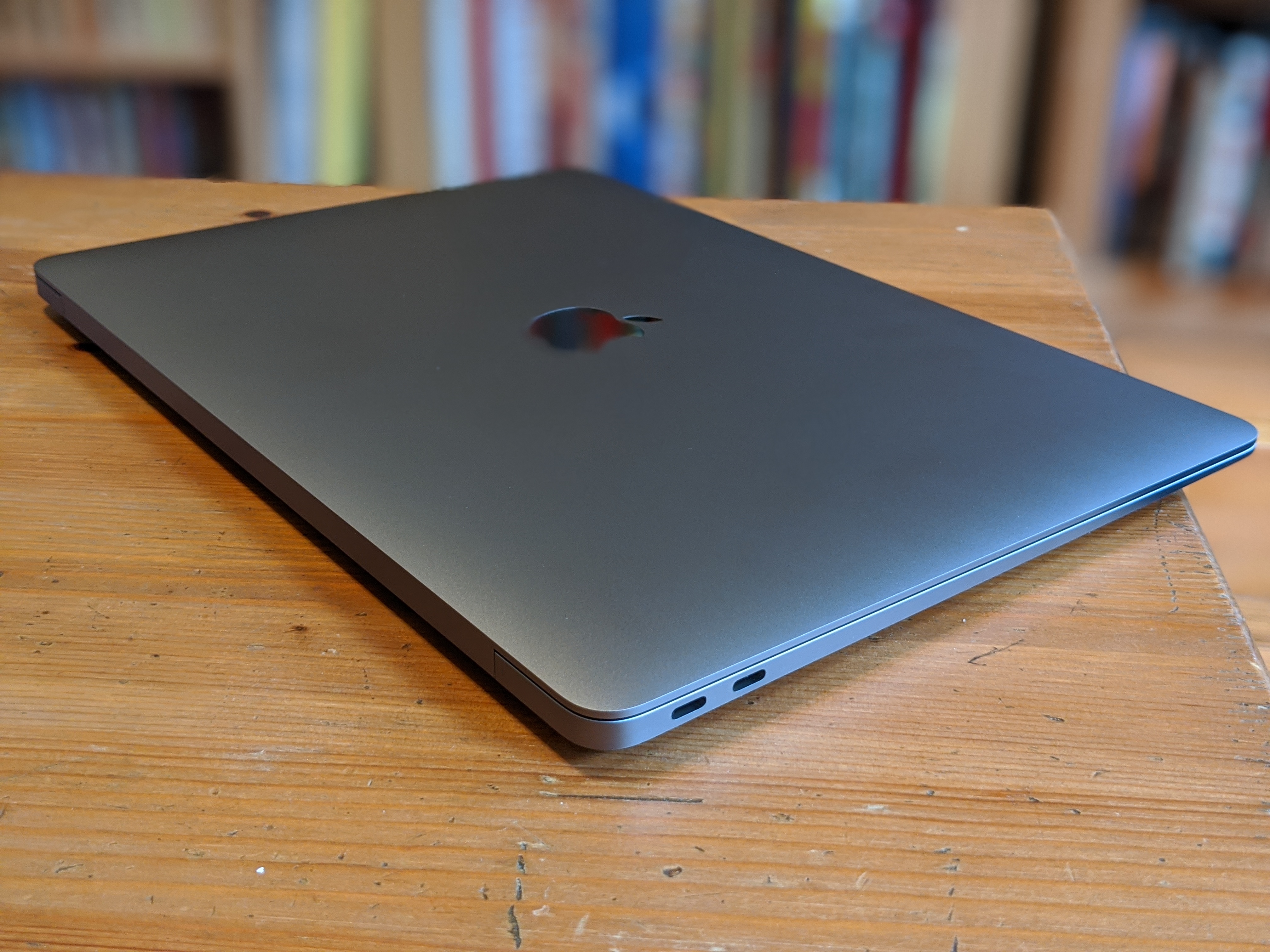
There are some nice upgrades here. Between the keyboard, processor and the overhaul the model got back in 2018, it’s nice to see Apple keeping the beloved line fresh a dozen years after it was first introduced.

I suspect that, for many, the fact that the laptop was introduced alongside the new iPad Pro (and its new keyboard) drove home how much the lines between the products are continuing to blur. The question comes up a lot when critics talk about Apple, as the company has traditionally taken a relatively minimalistic approach to product lines, versus, say, Samsung’s tendency to provide a wide range of different products.

But as personal computing has become more complex, so have our needs. And so, in turn, has Apple’s lineup. For a while there, it seemed like the MacBook Air was going to fade away, in favor of the standard MacBook. Ultimately, however, the Air won out, and understandably so. The focus on portability is a strong selling point, when coupled with the workflow versatility of MacOS (versus iPadOS). The Air looks like it’s going to be sticking around for a bit, and that’s something for Apple users to be thankful for.


from Apple – TechCrunch https://ift.tt/2xO88y6

Thursday, 19 March 2020

Conan O’Brien will return to TV with shows shot on iPhone and over video chat

Apple’s promise of high-quality videoshot on iPhone” is getting another real-world stress test, as late-night TV host Conan O’Brien announced on Wednesday he will return to doing full shows that will be shot using Apple’s mobile device. On Monday, March 30, new episodes of O’Brien’s show “Conan” will air on TBS, with production staff working from home, video that’s shot on iPhone and interviews filmed over video chat.

The news was first reported by Variety and confirmed by O’Brien in the form of a tweet, where he jokes the experience “will not be pretty.”

The move to shoot shows remotely is an interesting attempt at restarting daily TV production at a time when everyone’s been ordered to work from home.

Typically, late-night shows are put on with a sizable crew of writers and producers and filmed in front of a live audience. With the CDC advising people to stay at home and gather in groups of no more than 10 due to the threat of the coronavirus outbreak, TV production industry-wide is being shut down.

Until now, that also included all major late-night productions, like Stephen Colbert, Jimmy Fallon, Jimmy Kimmel and James Corden.

O’Brien’s team consists of 75 people and, like others, it went on hiatus in order to protect staff safety. But during the shut down, O’Brien continued to film short videos, which led the team to this idea of doing a full show, but in a different format.

“Conan” isn’t the only show trying to work around the shutdown. Jimmy Fallon has been filming YouTube videos that are incorporated into the evening’s rerun of the “Tonight Show.” Colbert has been filming a new monologue for “The Late Show” reruns. And Kimmel has been sharing his own “#minilogue” on social media.

However, “Conan” is promising full episodes, not just new segments.

“The quality of my work will not go down because technically that’s not possible,” O’Brien said in a statement shared by Variety.

Image credit: Kevin Mazur/Getty Images for WarnerMedia


from iPhone – TechCrunch https://ift.tt/2QwmlX3