Sunday, 5 April 2020

Internet of Elephants launches Wildeverse, an AR game about endangered animals and conservation

On Friday, the Kenyan augmented reality game developer Internet of Elephants launched its latest game in partnership with the conservation science experts from the Borneo Nature Foundation, Goualougo Triangle Ape Foundation, Zoo Atlanta and Chester Zoo.

The new game, called “Wildeverse”, uses AR to create a virtual forest that players can explore to find certain animals — or clues to an animal’s whereabouts.

Though the game was intended to be played outdoors, the COVID-19 crisis forced the team to pivot, creating an option that lets people move about virtually using in-game controls, or walk around in more confined spaces.

The game starts with a chat-based segment introducing players to the gameplay and setting up some context around the virtual environment players will be exploring. Its graphics aren’t focused on recreating a completely immersive jungle environment, but create an abstracted forest and canopy of trees which players explore. A timer keeps track of how long a player takes to complete a mission, which involve identifying certain animals or looking for traces of their presence in the AR-created forest.

Once a mission is complete, the player runs through a scripted interaction with an actual conservationist who helped the Internet of Elephants game developers come up with the concept for the game and provided research assistance and support for the actual animals represented in the gameplay.
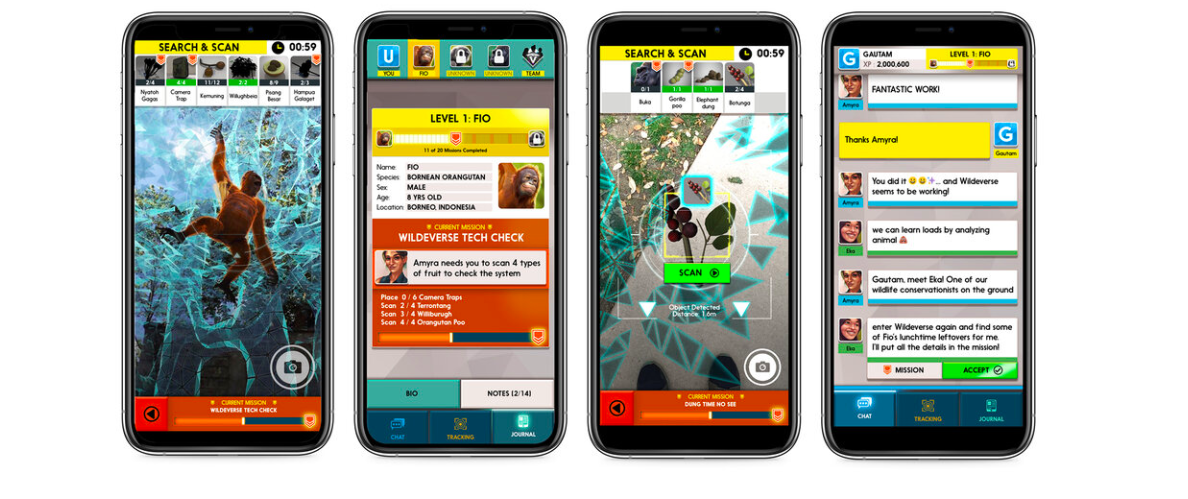
Image courtesy of Internet of Elephants

The game can be played on any iOS or Android device that support ARKit or ARCore.

Challenges range from searching for the animals themselves or their footprints, food leftovers or poop to looking for illegal human activity and threats to the habitat of four real orangutans, chimpanzees, gorillas and gibbons.

To make the game, Internet of Elephants developers led by company founder Gautam Shah, actually went to the jungles of Borneo and Congo to speak with conservationists about their work and scout for wildlife to use in te game, the company said in a statement. The game developers tracked several families of monkeys 


“Ape populations are being decimated across the world. Wildlife protection will only become a global priority if enough people take an interest. Conservationists on the ground are fighting an uphill battle with the support of only a handful of people,” said Shah in a statement. “We are on a mission to turn the 2 billion people playing games today, into wildlife lovers and supporters of conservation efforts.”

For Shah, the newest launch for Internet of Elephants continues the company’s mission, which began in 2015 when the American-born Shah forsook a career in consulting to launch his AR-based gaming company. Other members of the Internet of Elephants team have equally interesting stories, including product lead, Jake Manion, who had spent six years as the creative director for Aardman Animations, the Academy-award winning studio behind Wallace & Gromit and Shaun the Sheep.

Shah sees three primary conservation elements to the Wildeverse game. First, he says, it creates a link between players and the conservation societies that the company works with, giving people a better sense of what conservation organizations actually do. The game also forces players to confront issues like forest fires, illegal logging, poaching, and the challenges surrounding conservation work that are exacerbated by development and human consumption changing the composition of the jungles these animals call home. Finally there’s an educational element to the game.

“You really really do learn a lot of juicy stuff and we don’t shy away from getting technical,” says Shah. “All that collectively is about creating a connection between you sitting in St. Louis and someone in Borneo trying to study orangutans,”

Originally, the game was meant to be played outdoors, with a thirty-meter radius of space to get the full sense of the gameplay, but it can work in a small studio apartment in Los Angeles equally well, given the modifications the team made before the game’s launch.

The text component of the game is informative and gives players a chance to learn about the foods orangutans eat, their habitat and their lives in the jungle. The script is slightly clunky, but not tiresome, and is based on conversations with the actual conservationists working in these different forests.

Ultimately Shah hopes to expand the number of habitats and the breadth of the game so players can explore different geographies and learn about endangered species on every continent.

There’s no monetization in the game yet and it will remain free-to-play, but Shah hopes to add some revenue-generating elements as development continues along with multi-player features, he said.

Ultimately, the game is about connecting and educating a new generation to the wonders of nature conservancy through the newest tech tools and gameplay.

“We want to make wildlife a positive, exciting topic of daily conversation for millions of people currently unconnected to conservation. We want to make Fio, Buka, Chilli and Aida celebrities, just like Kim Kardashian, Messi, and Donald Trump,” says Shah. “People’s attention matters so much more than they think.”


from Android – TechCrunch https://ift.tt/3e0gALh
via IFTTT

Saturday, 4 April 2020

This Week in Apps: Zoom has issues, Pinterest founder’s new COVID-19 research app, record Q1 spending

Welcome back to This Week in Apps, the Extra Crunch series that recaps the latest OS news, the applications they support and the money that flows through it all.

The app industry saw a record 204 billion downloads and $120 billion in consumer spending in 2019, according to App Annie’s “State of Mobile” annual report. People are now spending 3 hours and 40 minutes per day using apps, rivaling TV. Apps aren’t just a way to pass idle hours — they’re a big business. In 2019, mobile-first companies had a combined $544 billion valuation, 6.5x higher than those without a mobile focus.

In this Extra Crunch series, we help you keep up with the latest news from the world of apps, delivered on a weekly basis.

This week, we’re continuing our special coverage of how the COVID-19 outbreak is impacting apps and the wider mobile app industry — or rather, the boost many apps are receiving as a result. In fact, the first quarter saw consumer spending hit record levels in Q1 as everyone was staying indoors. But as some apps shoot up the charts, scrutiny over their practices increases. This week saw No. 1 app Zoom defending itself against a host of complaints over security issues, for example, while social video app Houseparty defended itself against a possible smear campaign. There’s also a new app from the Pinterest CEO for tracking the spread of COVID-19.

Also this week: more leaks about the new version of iOS, Apple bought Dark Sky, Niantic pivoted, TikTok moved up the charts and more.

Coronavirus/COVID-19 special coverage

Pinterest CEO, scientists team up on COVID-19 tracking app


from Apple – TechCrunch https://ift.tt/34gwuwH

Friday, 3 April 2020

Apple brings its hardware microphone disconnect feature to iPads

Apple has brought its hardware microphone disconnect security feature to its latest iPads.

The microphone disconnect security feature aims to make it far more difficult for hackers to use malware or a malicious app to eavesdrop on a device’s surroundings.

The feature was first introduced to Macs by way of Apple’s T2 security chip last year. The security chip ensured that the microphone was physically disconnected from the device when the user shuts their MacBook lid. The idea goes that physically cutting off the microphone from the device prevents malware — even with the highest level of “root” device permissions — from listening in to nearby conversations.

Apple confirmed in a support guide that its newest iPads have the same feature. Any certified “Made for iPad” case that’s attached and closed will trigger the hardware disconnect.

It’s a subtle acknowledgement that Apple devices get malware, too. Although rare, there has been a steady stream of exploits targeting Macs and iOS devices in the past few years, prompting Apple to raise its bug bounty payouts to compete with the growing exploit market. Just last year, Apple patched a number of vulnerabilities that were used by China to break into the iPhones belonging to the phones of Uyghur Muslims, a persecuted minority group in China’s Xinjiang state.

Apple also said that all apps running on iOS or iPadOS 13.4 will be sandboxed in a “data vault,” to help prevent apps from accessing data without authorization.


from Apple – TechCrunch https://ift.tt/2V3ast0

Thursday, 2 April 2020

Pinterest CEO and a team of leading scientists launch a self-reporting COVID-19 tracking app

There have been a few scattered efforts to leverage crowd-sourced self-reporting of symptoms as a way to potentially predict and chart the progress of COVID-19 across the U.S., and around the world. A new effort looks like the most comprehensive, well-organized and credibly backed yet, however – and it’s been developed in part by Pinterest co-founder and CEO Ben Silbermann.

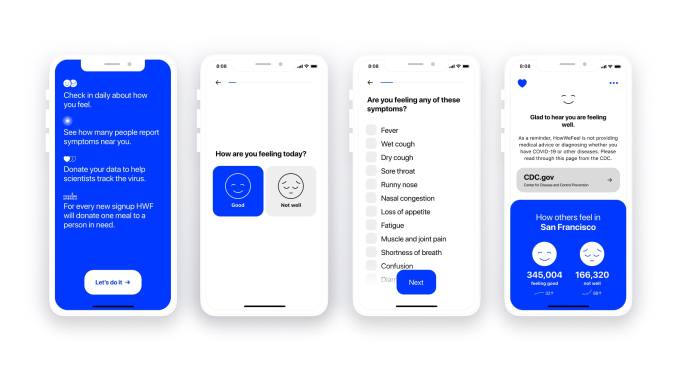
Silbermann and a team from Pinterest enlisted the help of high school friend, and CRISPR gene-editing pioneer / MIT and Harvard Broad Institute member Dr. Feng Zhang to build what Silbermann termed in a press release a “bridge between citizens and scientists.” The result is the ‘How We Feel’ app that Silbermann developed along with input from Zhang, and a long list of well-regarded public health, computer science, therapeutics, social sincere and medical professors from Harvard, Stanford, MIT, Weill Cornell and more.

How We Feel is a mobile app available for both iOS and Android, which is free to download, and which is designed to make it very easy to self-report whether or not they feel well – and if they’re feeling unwell, what symptoms they’re experiencing. It also asks for information about whether or not you’ve been tested for COVID-19, and whether you’re self-isolation, and for how long. The amount of interaction required is purposely streamlined to make it easy for anyone to contribute daily, and to do so in a minute or less.

The app doesn’t ask for or collect info including name, phone numb or email information. It includes an up-front request that users agree to donate their information, and the data collected will be aggregated and then shared with researchers, public health professionals and doctors, including those who are signed on as collaborators with the project, as well as others (and the project is encouraging collaborators to reach out if interested). Part of the team working on the project are experts in the field of ‘differential privacy,’ and a goal of the endeavor is to ensure that people’s information is used responsibly.

The How We Feel app is, as mentioned, one of a number of similar efforts out there, but this approach has a number of advantages when compared to existing projects. First, it’s a mobile app, whereas some rely on web-based portals that are less convenient for the average consumer, especially when you want continued use over time. Second, they’re motivating use through positive means – Silbermann and his wife Divya will be providing a donated meal to non-profit feeding America for every time a person downloads and uses the app for the first time, up to a maximum of 10 million meals. Finally, it’s already designed in partnership with, and backed by, world-class academic institutions and researchers, and seems best-positioned to be able to get the information it gathers to the greatest number of those in a position to help.

How We Feel is organized as an entirely independent, non-profit organization, and it’s hoping to expand its availability and scientific collaboration globally. It’s an ambitious project, but also one that could be critically important in supplementing testing efforts and other means of tracking the progress and course of the spread of SARS-CoV-2 and COVID-19. While self-reported information on its own is far fro a 100 percent accurate or reliable source, taken in aggregate at scale, it could be a very effective leading indicator of new or emerging viral hotspots, or provide scientific researches with other valuable insights when used in combination with other signals.


from Android – TechCrunch https://ift.tt/3bK82pT
via IFTTT

Apple accidentally confirms the existence of an unreleased product, AirTags

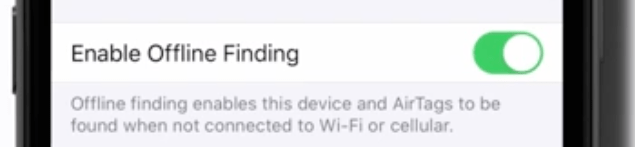
Whoops! Apple inadvertently revealed the existence of an unreleased product, AirTags, in a support video uploaded to its YouTube account today. The video, “How to erase your iPhone,” offers a tutorial about resetting an iPhone to factory settings. Around the 1:43 mark, it instructs users to turn off “Find my iPhone” as part of the process. On the Settings page that then appears, another option for “Enable Offline Finding” is shown, and beneath that, the text references AirTags by name.

Specifically, it says: “Offline finding enables this device and AirTags to be found when not connected to Wi-Fi or cellular.”

The discovery was first spotted by the eagle-eyed blog Appleosophy.

Apple has since pulled down the video. (A copy of the video is embedded below.)

AirTags, essentially Apple’s Tile competitor, were already known to be in the works. Based on details and assets found in Apple’s iOS code, AirTags are believed to be small tracking tiles with Bluetooth connectivity that can be used to find lost items — just like Tile.

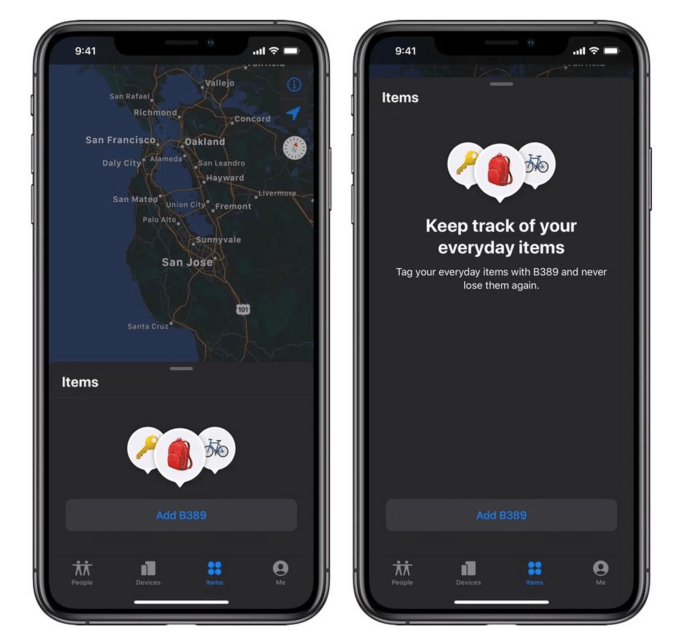
The difference is that Apple’s AirTags will benefit from deeper integration with iOS, including within its “Find My” app. There, the tags will show up in a new “Items” tab allowing you to keep track of items that tend to get lost or stolen — like your keys, wallet or even your bike.

According to reports from MacRumors, the tags will feature a removable CR2032 coin cell battery, also similar to Tile.

Apple’s intention to copy Tile’s concept has not gone unnoticed by Tile.

The company on Wednesday told a congressional panel that Apple’s anticompetitive behavior has “gotten worse, not better.”

During the hearing, Tile referenced Apple’s plans to integrate its own product into the “Find My” app. Tile and other Bluetooth trackers won’t be able to do the same. They also have to ask for background location access repeatedly, while Apple’s AirTags, presumably, will not. That gives Apple’s own product an advantage as it owns the platform.

Apple has been asked for comment.

Image credits: Apple, via YouTube; MacRumors 


from iPhone – TechCrunch https://ift.tt/2R809mp

Apple accidentally confirms the existence of an unreleased product, AirTags

Whoops! Apple inadvertently revealed the existence of an unreleased product, AirTags, in a support video uploaded to its YouTube account today. The video, “How to erase your iPhone,” offers a tutorial about resetting an iPhone to factory settings. Around the 1:43 mark, it instructs users to turn off “Find my iPhone” as part of the process. On the Settings page that then appears, another option for “Enable Offline Finding” is shown, and beneath that, the text references AirTags by name.

Specifically, it says: “Offline finding enables this device and AirTags to be found when not connected to Wi-Fi or cellular.”

The discovery was first spotted by the eagle-eyed blog Appleosophy.

Apple has since pulled down the video. (A copy of the video is embedded below.)

AirTags, essentially Apple’s Tile competitor, were already known to be in the works. Based on details and assets found in Apple’s iOS code, AirTags are believed to be small tracking tiles with Bluetooth connectivity that can be used to find lost items — just like Tile.

The difference is that Apple’s AirTags will benefit from deeper integration with iOS, including within its “Find My” app. There, the tags will show up in a new “Items” tab allowing you to keep track of items that tend to get lost or stolen — like your keys, wallet or even your bike.

According to reports from MacRumors, the tags will feature a removable CR2032 coin cell battery, also similar to Tile.

Apple’s intention to copy Tile’s concept has not gone unnoticed by Tile.

The company on Wednesday told a congressional panel that Apple’s anticompetitive behavior has “gotten worse, not better.”

During the hearing, Tile referenced Apple’s plans to integrate its own product into the “Find My” app. Tile and other Bluetooth trackers won’t be able to do the same. They also have to ask for background location access repeatedly, while Apple’s AirTags, presumably, will not. That gives Apple’s own product an advantage as it owns the platform.

Apple has been asked for comment.

Image credits: Apple, via YouTube; MacRumors 


from Apple – TechCrunch https://ift.tt/2R809mp

Apple, Laurene Powell Jobs and Leonardo DiCaprio launch a GoFundMe with $12M for the hungry

Apple has made a donation to a new fundraising campaign, America’s Food Fund, along with Laurene Powell Jobs, Leonardo DiCaprio, and the Ford Foundation. Together, they’ve contributed $12 million towards the $15 million goal for the new initiative being hosting on fundraising platform GoFundMe. The proceeds will go to benefit World Central Kitchen and Feeding America.

The former was founded in 2020 by Chef José Andrés to provide meals to the hungry in the wake of man-made and natural disasters worldwide. Since its debut, World Central Kitchen has served over 15 million meals across 19 disasters, including Hurricane Dorian in the Bahamas and Hurricane Maria. It has also served 3.7 million meals in 2017-2018 in Puerto Rico.

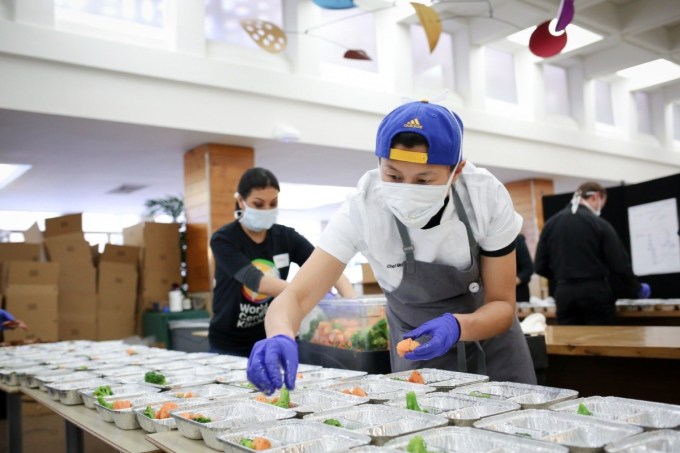
The organization began its COVID-19 relief efforts by deploying food to cruise ship passengers under quarantine. It’s now working to feed vulnerable communities and frontline medical professionals through mobile distributions and restaurant partners.

Chef José Andrés and World Central Kitchen CEO Claire Babineaux-Fontenot also sat down with Oprah Winfrey on her new Apple TV+ show, “Oprah Talks COVID-19” to discuss their efforts.

Feeding America, meanwhile, is the U.S.’s largest hunger-relief organization serving more than 40 million Americans through a network of 200 food banks and 60,000 food pantries and meal programs with a presence across the U.S. Its COVID-19 relief efforts involve its Response Fund, launched to help member food banks secure the resources they need to continue operations.

The choice to essentially run a GoFundMe campaign for America’s Food Fund is unsual. Frankly, the optics aren’t great here.

Most of the philanthropic efforts from corporations or high net worth individuals so far during the COVID-19 outbreak have involved direct donations to nonprofits, food banks, and other relief efforts. If $15 million is what’s needed now, then the donors involved here should just have given the $15 million. But instead, they’ve donated $12 million and presented this campaign in the hopes that “us regular folks” will pitch in the rest.

“If you are in a position to contribute and you have the means to take action, we hope you will donate today. No dollar amount is too small,” the GoFundMe campaign reads.

That’s asking people who are far more impacted by the coronavirus crisis than Jobs or DiCaprio to step up at a time when job security is questionable, food prices are going up, and the threat of losing work due to infection is also a serious concern. It is wonderful that people are willing to do this, but there’s something just odd about billionaires and millionaires acting like we’re all in this together. They have their yachts, after all. Everyone else is just trying to survive.

The campaign is also losing a percentage of donations to fees. (GoFundMe will charge 2.9% and a $0.30 per donation transaction fee.) An in-cash donation directly to the organizations in need would be preferable. Even a campaign where you can donate online directly to the selected organization would be an improvement.

On World Central Kitchen’s site, for example, there’s a checkbox where you can opt to cover the fees with your donation. On Feeding America’s site, you have the option to commit to a monthly donation and also are told explicitly how much your cash donation will provide, in terms of meals.

To date, several high net worth individuals have donated to various relief efforts during the COVID-19 outbreak on their own. Winfrey, for instance, gave $10 million to coronavirus relief efforts, with $1 million of that towards this new America’s Food Fund campaign. Jeff Bezos donated $25 million to the Amazon Relief Fund. Michael Bloomberg donated $40 million to fight the spread of the virus in low and middle-income countries. Dolly Parton donated $1 million to coronavirus research. Actors Ryan Reynolds and Blake Lively said they were donating $1 million to food banks.

And through their respective foundations, Bill gates contributed $100 million; Jack Ma pledged $14 million; Ralph Lauren donated $10 million; and Mark Zuckerberg and Priscilla Chan donated $30 million to various COVID-19 efforts.

If you want to donate to a local food bank feeding the hungry — or volunteer — in your own neighborhood, you can do so from Feeding America’s website here. From its search results, you’ll get the web addresses for the food banks in your city. And from their own websites, you can find out how to give directly.


from Apple – TechCrunch https://ift.tt/2wO7jFH