Thursday, 18 June 2020

UK gives up on centralized coronavirus contacts tracing app — will “likely” switch to model backed by Apple and Google

The UK has given up building a centralized coronavirus contacts tracing app and will instead switch to a decentralized app architecture, the BBC has reported. This suggests its any future app will be capable of plugging into the joint ‘exposure notification’ API which has been developed in recent weeks by Apple and Google.

The UK’s decision to abandon a bespoke app architecture comes more than a month after ministers had been reported to be eyeing such a switch. They went on to award a contract to an IT supplier develop a decentralized tracing app in parallel as a backup — but continued to test the centralized app, called NHS COVID-19.

A number of European countries have now successfully launched contracts tracing apps with a decentralized app architecture that’s able to plug into the ‘Gapple’ API — including Denmark, Germany, Italy, Latvia and Switzerland. Several more such apps remain in testing. While EU Member States just agreed on a technical framework to enable cross-border interoperability of apps based on the same architecture.

Germany — which launched its decentralized ‘Corona Warning App’ this week — announced the software had been downloaded 6.5M times in the first 24 hours. The country had initially favored a centralized approach but switched to a decentralized model back in April in the face of pushback from privacy and security experts.

The UK’s NHS COVID-19 app, meanwhile, has not progressed past field tests, after facing a plethora of technical barriers and privacy challenges — as a direct consequence of the government’s decision to opt for a proprietary system which uploads proximity data to a central server, rather than processing exposure notifications locally on device.

Apple and Google’s API, which is being used by all Europe’s decentralized apps, does not support centralized app architectures — meaning the UK app faced challenges related to accessing Bluetooth in the background.

The centralized choice also raised big questions around cross-border interoperability, as we’ve explained before. So the UK’s move to abandon the approach and adopt a decentralized model is hardly surprising — although the time it’s taken the government to arrive at the obvious conclusion does raise some major questions over its competence at handling technology projects.

Michael Veale, a lecturer in digital rights and regulation at UCL — who has been involved in the development of the DP3T decentralized contacts tracing standard, which influenced Apple and Google’s choice of API — welcomed the UK’s decision to ditch a centralized app architecture but questioned why the government has wasted so much time.

“This is a welcome, if a heavily and unnecessarily delayed, move by NHSX,” Veale told TechCrunch. “The Google-Apple system in a way is home-grown: Originating with research at a large consortium of universities led by Switzerland and including UCL in the UK. NHSX has no end of options and no reasonable excuse to not get the app out quickly now. Germany and Switzerland both have high quality open source code that can be easily adapted. The NHS England app will now be compatible with Northern Ireland, the Republic of Ireland, and also the many destinations for holidaymakers in and out of the UK.”

Perhaps unsurprisingly, ministers are now heavily de-emphasizing the importance of having an app in the fight against the coronavirus at all. The Department for Health and Social Care’s, Lord Bethell, told the Science and Technology Committee yesterday the app will not now be ready until the winter. “We’re seeking to get something going for the winter, but it isn’t a priority for us,” he said.

Yet the centralized version of the NHS COVID-19 app has been in testing in a limited geographical pilot on the Isle of Wight since early May — and up until the middle of last month health minister, Matt Hancock, had said it would be rolled out nationally in mid May.

Of course that timeframe came and went without launch. And now the launch is being booted right into the back end of the year. Compare and contrast that with government messaging at its daily coronavirus briefings back in May — when Hancock made “download the app” one of the key slogans.

NHSX relayed our request for comment on the switch to a decentralized system and the new timeframe for an app launch to the Department of Health and Social Care (DHSC) — but the department had not responded to us at the time of publication.

Earlier this week the BBC reported that a former Apple executive, Simon Thompson, was taking charge of the delayed app project — while the two lead managers, the NHSX’s Matthew Gould and Geraint Lewis — were reported to be stepping back.

Government briefings to the press today have included suggestions that app testers on the Isle of Wight told it they were not comfortable receiving COVID-19 notifications via text message — and that the human touch of a phone call is preferred.

However none of the European countries that have already deployed contacts tracing apps has promoted the software as a one-stop panacea for tackling COVID-19. Rather tracing apps are intended to supplement manual contacts tracing methods — the latter involving the use of trained humans making phone calls to people who have been diagnosed with COVID-19 to ask who they might have been in contact with over the infectious period.

Even with major resource put into manual contacts tracing, apps — which use Bluetooth signals to estimate proximity between smartphone users in order to calculate virus expose risk — could still play an important role by, for example, being able to trace strangers who are sat near an infected person on public transport.

Update: The DHSC has now issued a statement addressing reports of the switch of app architecture for the NHS COVID-19 app — in which it confirms, in between reams of blame-shifting spin, that it’s testing a new app that is able to plug into the Apple and Google API — and which it says it may go on to launch nationally, but without providing any timeframe.

It also claims it’s working with Apple and Google to try to enhance how their technology estimates the distance between smartphone users.

“Through the systematic testing, a number of technical challenges were identified — including the reliability of detecting contacts on specific operating systems — which cannot be resolved in isolation with the app in its current form,” DHSC writes of the centralized NHS COVID-19 app.

“While it does not yet present a viable solution, at this stage an app based on the Google / Apple API appears most likely to address some of the specific limitations identified through our field testing.  However, there is still more work to do on the Google / Apple solution which does not currently estimate distance in the way required.”

Based on this, the focus of work will shift from the current app design and to work instead with Google and Apple to understand how using their solution can meet the specific needs of the public,” it adds. 

We’ve reached out to Apple and Google for comment. Apple declined to comment.


from Apple – TechCrunch https://ift.tt/2zJ6U8J

Wednesday, 17 June 2020

Apple doubles down on its right to profit from other businesses

Apple this week is getting publicly dragged for digging in its heels over its right to take a cut of subscription-based transactions that flow through its App Store. Almost unbelievably, it’s doing so so in the middle of antitrust investigations both in the E.U. and the U.S. — the latter which CEO Tim Cook may decide to skip— in which lawmakers will attempt to determine if Apple abuses its market position and power to disadvantage its competitors.

This is not a new complaint, but one that came to a head this week over Apple’s decision to reject app updates from Basecamp’s newly launched subscription-based email app called “Hey.”  

Hey offers a $99-per-year subscription for access to its nouveau email service that works across web, Mac, Windows, Linux, iOS and Android, but not via standard email protocols. The Hey iOS app was initially approved by Apple, but then put on pause — meaning Basecamp couldn’t submit any updates or bug fixes until it added an option for users to subscribe to Hey’s service through an in-app purchase.

This decision on Apple’s part was met with shock, horror and outrage by Basecamp co-founder and Chief Technology Officer David Heinemeier Hansson and, to some extent, the broader iOS developer community.

Heinemeier Hansson has been a vocal opponent to Apple’s policies well before the launch of Hey. He testified before Congress as part of a series of hearings over online platforms and market power. Last year, he called out Apple Card for discriminatory practices. Of all people for Apple to antagonize amid multiple antitrust probes — and the week before Apple’s Worldwide Developer Conference — this was certainly a bold choice.

In a series of tweets, Heinemeier Hansson made the case as to why Apple’s reasoning made no sense.

Arguably, the whole debacle served as a nice bit of high-profile marketing for a brand-new app that would have otherwise flown under the radar. But, nonetheless, his larger points appear correct: Apple’s policies are confusing, inconsistently applied, and anti-competitive.

For starters, Basecamp’s new email app Hey competes with Apple’s built-in Mail app. That means it already has to convince users to forgo the iPhone’s free email experience for its differentiated one. And when it does acquire a user, Apple wants it to hand over a commission no matter if the new user discovered the app for the first time on the App Store or somewhere else. (Like a TechCrunch article!)

Apple argues its policies around the use of in-app purchases are not new. In fact, they’ve been in place since the first set of App Store Review Guidelines were published in September 2010, the company told TechCrunch when questioned about its decision.

The section around in-app purchases was relocated to 3.X from 11.X in 2016, but today states that multi-platform apps can allow access to subscriptions provided elsewhere so long as in-app purchases are also offered with the iOS app. The rules also state that developers can’t directly or indirectly tell iOS users how to make a purchase outside the app. (Hey has a Help screen that says you can’t sign up in the app and “we know that’s a pain.”) The rules also say you can’t discourage the use of in-app purchases.

In other words, Apple seems to argue, Basecamp should have known better.

That argument would hold up if Apple enforced its rules uniformly, but it does not.

As Apple observer John Gruber of Daring Fireball pointed out, Apple makes a distinction between business services and consumer apps when enforcing in-app purchase policies. This has to do with how business software is often paid for — by the company, not the end user, as a report by Protocol first noted. That’s why Basecamp’s flagship service for businesses can be offered in the App Store without a subscription sign-up, but its consumer app Hey cannot.

That’s a confusing distinction to make — and one not documented by Apple’s rules — as the line between software meant for business versus consumer use has long since been blurred. In fact, that blurring comes about, in part, because of the democratized access to business-grade software made possible through platforms like the Apple App Store.

Business apps aren’t the only exception Apple makes.

Apple also carves out exceptions for a type of apps it broadly refers to as “reader” apps, even though they aren’t necessarily about parsing the printed word.

This set does include reading apps — like magazines, newspapers, and books. And it’s why the Kindle app lets you read your ebooks, but doesn’t tell you how to buy more or offer a way to do so in the app. The group has also expanded to include audio, music, video, access to professional databases, VoIP, cloud storage, and other approved services, like classroom management apps.

Not surprisingly, this group of apps where Apple permits the companies to forgo the in-app purchase option (so long as they never ever mention how else to subscribe) are also among those with a direct competitor to an Apple paid service.

For example, Spotify, which competes with Apple Music, is considered a “reader” app. The group also includes rivals to Apple TV+, iCloud, Podcasts, Classroom, Books, and others.

Spotify has been among the most vocal about how Apple’s policy negatively impacts its business. Last year, it filed an antitrust complaint against Apple in the E.U. That investigation is now underway which Spotify says is great news for consumers.

“Apple’s anticompetitive behavior has intentionally disadvantaged competitors, created an unlevel playing field, and deprived consumers of meaningful choice for far too long,” Spotify’s statement read. “We welcome the European Commission’s decision to formally investigate Apple, and hope they’ll act with urgency to ensure fair competition on the iOS platform for all participants in the digital economy,” it added.

But for the most part, only larger companies have been willing to stand up to Apple publicly on this front.

Among these is Fortnite maker Epic Games, which wants to sell software through its own iOS app. Its CEO, Tim Sweeney, said he wants all iOS developers to have the option to process payments directly and install software from any source, and won’t seek out any “special deal just for ourselves.”

More recently, ebook seller Kobo added its voice to growing list of anticompetitive complaints, saying it can’t fairly compete against Apple Books when it has to share 30% of revenue from purchases with Apple. (The company, like many others, currently sells only from its website to avoid this fee.)

Tinder parent Match has also released a lengthy statement against Apple’s in-app purchase policy, saying it’s “acutely aware of [Apple’s] power over us.” Match also said it’s unfair how only digital service providers have to share revenue with Apple when others — like ride-share apps and social networking apps — do not.

But many developers bite their tongue and play along with Apple’s rules out of fear. Stratechery founder Ben Thompson posted to Twitter on Tuesday how he’s hearing from a number of developers who claim Apple is refusing to update their app until they add an in-app purchase option for their SaaS (software as a service) business. It’s unclear, given these developers didn’t go on record, how many of their apps had been mistakenly approved by App Store reviewers in the first place.

Of course, the line between Apple enforcing an existing policy it’s been lax on and a change in direction around enforcement of App Store policies has always been a gray area at best. (Remember how all of a sudden Amazon’s Prime Video app could rent and sell movies once Apple had its own Apple TV+ app it wanted to distribute on Fire TV? And Apple said that fell under an existing policy — one that magically now included permission for Amazon?)

In a third exception, Apple also turns a blind eye towards companies that incentivize users to pay for access to their upgraded features outside the App Store. For example, Google sells its YouTube Premium service for $11.99 per month via the web, but for $15.99 per month on the App Store to account for Apple’s commission. Apple allows this, despite its rule about about companies that discourage the use of in-app purchases. (Apparently, giving users a way to save nearly $50 per year by shopping outside the App Store doesn’t count as “discouraging” an in-app purchase?)

The solution to this whole matter is tricky, of course.

As much as developers want to sell directly to consumers without sharing a cut with Apple, it would be wrong to say that apps don’t benefit from Apple’s distribution platform. Would iOS apps ever have found as large an audience if they were all side-loaded bits of software instead of being organized, ranked, curated and featured in a built-in App Store?

Plus, consumers want the convenience of making easy purchases inside an app with a payment card they keep on file. Amazon proved consumer demand for this with 1-click checkout, which allowed it to capture massive ecommerce market share over the years. In other words, take away the option to make purchases directly in iOS apps via Apple Pay and prepare for a consumer backlash.

A better compromise would be a reduction in the cut that Apple takes. Today, Apple currently charges a 30% commission on subscriptions in year 1 which drops to 15% in year 2. These commissions are often for apps that have built sizable brands without Apple’s help — Spotify, YouTube, Pandora, Hulu, Netflix, Tinder, Fortnite, etc. These apps don’t need the App Store to be “discovered” by users or curated into “must” lists by App Store editors, they simply need to serve their existing users who happen to carry an iPhone.

Apple may deserve to stick its hand in the pot to some extent for making apps easy to find, install and pay for, but it’s getting much harder to argue that 30% is the right price for such a system.


from Apple – TechCrunch https://ift.tt/2Y8Lk75

Software will reshape our world in the next decade

As I was wrapping up a Zoom meeting with my business partners, I could hear my son joking with his classmates in his online chemistry class.

I have to say this is a very strange time for me: As much as I love my family, in normal times, we never spend this much time together. But these aren’t normal times.

In normal times, governments, businesses and schools would never agree to shut everything down. In normal times, my doctor wouldn’t agree to see me over video conferencing.

No one would stand outside a grocery store, looking down to make sure they were six feet apart from one another. In times like these, decisions that would normally take years are being made in a matter of hours. In short, the physical world — brick-and-mortar reality— has shut down. The world still functions, but now it is operating inside everyone’s own home.

This not-so-normal time reminds me of 2008, the depths of the financial crisis. I sold my company BEA Systems, which I co-founded, to Oracle for $8.6 billion in cash. This liquidity event was simultaneously the worst and most exhausting time of my career, and the best time of my career, thanks to the many inspiring entrepreneurs I was able to meet.

These were some of the brightest, hardworking, never-take-no-for-an-answer founders, and in this era, many CEOs showed their true colors. That was when Slack, Lyft, Uber, Credit Karma, Twilio, Square, Cloudera and many others got started. All of these companies now have multibillion dollar market caps. And I got to invest and partner with some of them.

Once again, I can’t help but wonder what our world will look like in 10 years. The way we live. The way we learn. The way we consume. The way we will interact with each other.

What will happen 10 years from now?

Welcome to 2030. It’s been more than two decades since the invention of the iPhone, the launch of cloud computing and one decade since the launch of widespread 5G networks. All of the technologies required to change the way we live, work, eat and play are finally here and can be distributed at an unprecedented speed.

The global population is 8.5 billion and everyone owns a smartphone with all of their daily apps running on it. That’s up from around 500 million two decades ago.

Robust internet access and communication platforms have created a new world.

The world’s largest school is a software company — its learning engine uses artificial intelligence to provide personalized learning materials anytime, anywhere, with no physical space necessary. Similar to how Apple upended the music industry with iTunes, all students can now download any information for a super-low price. Tuition fees have dropped significantly: There are no more student debts. Kids can finally focus on learning, not just getting an education. Access to a good education has been equalized.

The world’s largest bank is a software company and all financial transactions are digital. If you want to talk to a banker live, you’ll initiate a text or video conference. On top of that, embedded fintech software now powers all industries.

No more dirty physical money. All money flow is stored, traceable and secured on a blockchain ledger. The financial infrastructure platforms are able to handle customers across all geographies and jurisdictions, all exchanges of value, all types of use-cases (producers, distributors, consumers) and all from the start.

The world’s largest grocery store is a software and robotics company — groceries are delivered whenever and wherever we want as fast as possible. Food is delivered via robot or drones with no human involvement. Customers can track where, when and who is involved in growing and handling my food. Artificial intelligence tells us what we need based on past purchases and our calendars.

The world largest hospital is a software and robotics company — all initial diagnoses are performed via video conferencing. Combined with patient medical records all digitally stored, a doctor in San Francisco and her artificial intelligence assistant can provide personalized prescriptions to her patients in Hong Kong. All surgical procedures are performed by robots, with supervision by a doctor of course, we haven’t gone completely crazy. And even the doctors get to work from home.

Our entire workforce works from home: Don’t forget the main purpose of an office is to support companies’ workers in performing their jobs efficiently. Since 2020, all companies, and especially their CEOs, realized it was more efficient to let their workers work from home. Not only can they save hours of commute time, all companies get to save money on office space and shift resources toward employee benefits. I’m looking back 10 years and saying to myself, “I still remember those days when office space was a thing.”

The world’s largest entertainment company is a software company, and all the content we love is digital. All blockbuster movies are released direct-to-video. We can ask Alexa to deliver popcorn to the house and even watch the film with friends who are far away. If you see something you like in the movie, you can buy it immediately — clothing, objects, whatever you see — and have it delivered right to your house. No more standing in line. No transport time. Reduced pollution. Better planet!

These are just a few industries that have been completely transformed by 2030, but these changes will apply universally to almost anything. We were told software was eating the world.

The saying goes you are what you eat. In 2030, software is the world.

Security and protection no longer just applies to things we can touch and see. What’s valuable for each and every one of us is all stored digitally — our email account, chat history, browsing data and social media accounts. It goes on and on. We don’t need a house alarm, we need a digital alarm.

Even though this crisis makes the near future seem bleak, I am optimistic about the new world and the new companies of tomorrow. I am even more excited about our ability to change as a human race and how this crisis and technology are speeding up the way we live.

This storm shall pass. However the choices we make now will change our lives forever.

My team and I are proud to build and invest in companies that will help shape the new world; new and impactful technologies that are important for many generations to come, companies that matter to humanity, something that we can all tell our grandchildren about.

I am hopeful.


from iPhone – TechCrunch https://ift.tt/3fx7tlb

Google is launching a way to buy Android app subscriptions outside of the app itself

Alongside the Android 11 beta news and updates to Android developer tools, Google has quietly rolled out a significant change in how Android app developers can market their subscriptions on the Google Play Store. The company confirmed a select set of developers are testing a new feature that allows consumers to purchase an app’s subscription outside of the app itself. That is, instead of having to click through in-app pop-ups and read the fine print inside an app, consumers can choose to buy an app’s subscription directly from its Play Store listing page — even if they don’t yet have the app installed.

Google vaguely announced the change in a blog post, but didn’t offer concrete details as to how this feature worked, instead describing it only as way for users “to discover and purchase items outside your app.”

The functionality is being made available through the Android Billing Library version 3, which Google recently introduced. The new library can power a subscription promo code redemption experience, where users can redeem free trials before the app is installed. And it allows consumers to resubscribe to subscriptions they used to pay for from the Google Play subscriptions center.

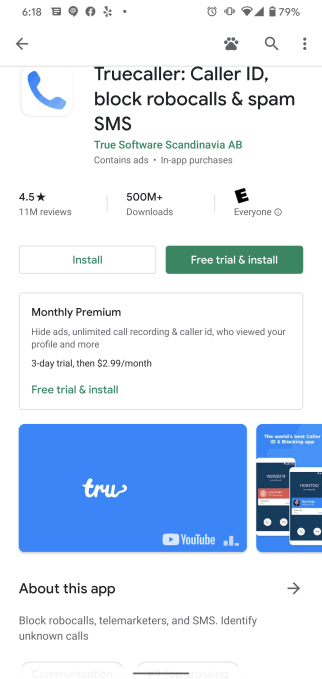
But the most notable part of the update is how it allows developers to sell subscriptions directly on their app’s details page. Now, next to the app’s “Install” button, consumers will be able to instead choose to click a separate button to purchase the app’s subscription and even its free trial.

In an example, the robocall-blocking app Truecaller shows a button next to “Install” which reads, instead, “Free trial & Install.” Beneath this, a window provides all the details about the app’s subscription, including the free trial length, the cost when the trial ends, and what the subscription offers, in terms of feature set.

This more transparent marketing option benefits consumers and developers alike.

Today, too many consumers are still being duped by tricky subscriptions that don’t play by app store guidelines. The problem isn’t unique to Android apps, unfortunately. A report from security firm Sophos found that more than 3.5 million iOS users have installed fleeceware apps from Apple’s App Store, for example.

Google, for its part, introduced a new set of Play Store policies in April with the goal of ensuring that users are able to understand the terms of the subscription offer, the free trial period, and how they can cancel the subscription, if desired. The updated policy bans things like hidden terms, unclear billing frequencies, and hidden pricing.

This new feature offering a separate button just for subscriptions could give users another way to learn about the app’s pricing and feature set before making a commitment to download the app.

This, in turn, could help reduce user churn — as fewer users would drop out of the app once they realize the features they needed were only offered as a paid option. It could also help developers attract more valuable paid subscribers by allowing potential users an easy way to compare their subscription pricing with competitors, while additionally reducing user requests for refunds.

For now, Android users can only purchase subscriptions outside the app from a limited set of developers who have been testing the feature, Google says.

The company tells us it will expand this feature to include other virtual goods in the future.

This latest change isn’t the only way Google is trying to increase transparency around subscriptions.

In a video shared with developers, the company noted it’s made improvements to its checkout cart on Google Play to add further distinctions between trial periods and regular pricing. Google also now sends out email reminders to alert users when free trials are ending and it now pops up a notification when an app is uninstalled to remind users they may also want to cancel the app’s subscription.

Google is also changing the option that lets a customer pause a subscription. Starting on November 1, 2020, this will default to “on,” and other features like Account Hold and Restore will be required for app subscription-based apps. Plus, developers will be able to pop-up a list of reasons to keep a subscription when a user hits the cancel button.

“We believe that in increasing user trust around subscriptions, you will benefit from an increase higher-quality subscribers and lower refund and chargeback rates,” says Google Play Commerce product manager, Mrinalini Loew, in the video.


from Android – TechCrunch https://ift.tt/2AJRoKl
via IFTTT

Global smartwatch shipments grew 12%, in spite of…everything

Wearables have proven to be a surprisingly resilient category amid the global COVID-19-fueled shutdown. As noted earlier this month, shipment growth slowed — but didn’t stop — in Q1, even as many potential customers have far fewer steps to track. And according to new numbers from Canalys out today, smartwatches in particular continued to grow in spite of it all.

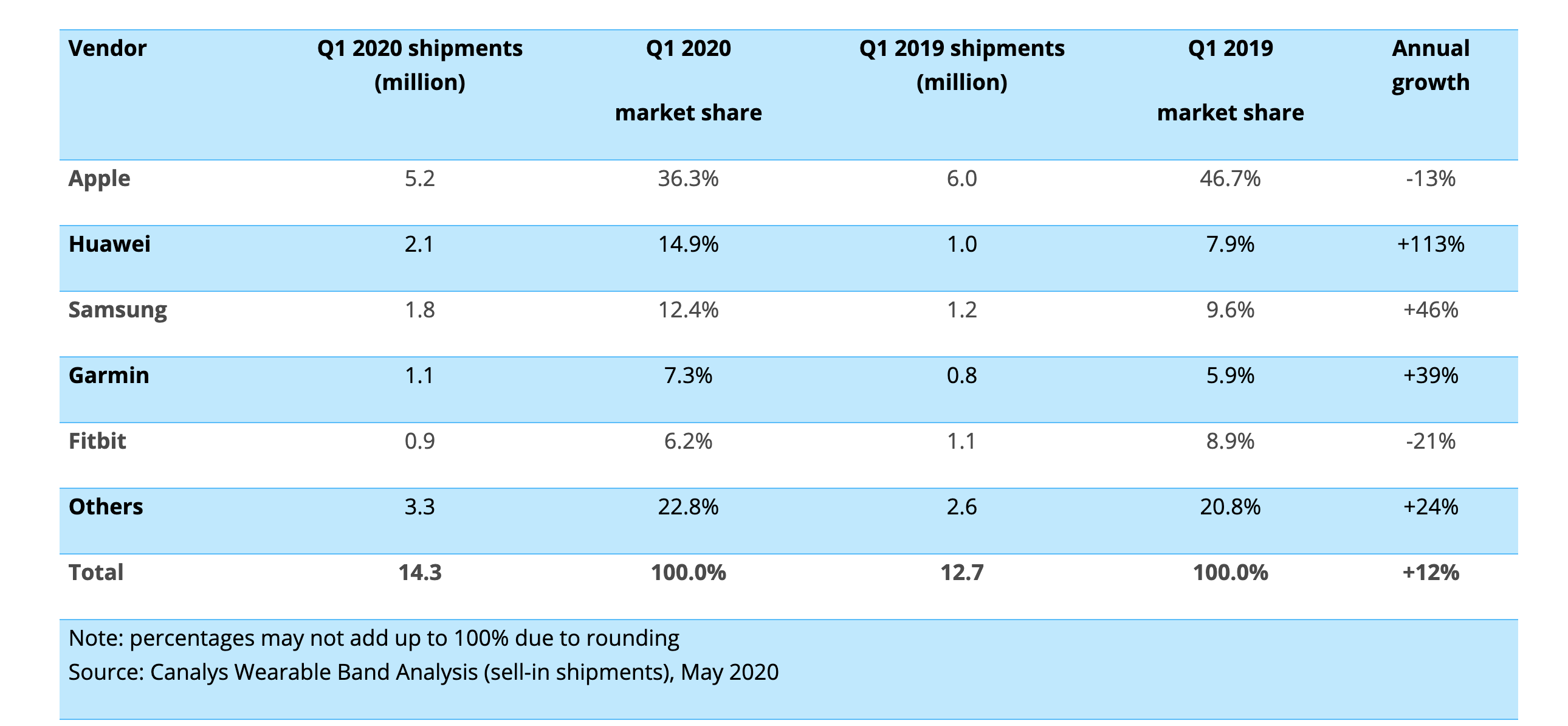
Overall, the category grew 12% year-over-year for Q1, up to 14.3 million. China, in particular, saw a big uptick in shipments — a full 66% over Q1 2019. Cellular models from Xiaomi and Apple were big hits, owing to a nationwide push for eSIM adoption. North America continued to see an increase, as well, but made up less than a third of all shipments for the first time in the firm’s reporting.

Image Credits: Canalys

Apple actually saw a 13% dip in shipments for the quarter, but remained the leader in marketshare by a significant margin, at 36.3%. Analysts believe that a shift in focus toward AirPods has been part of the slow down for the company in North America and Europe. Second place Huawei is gaining fast, too. A 113% increase in shipments put the company at 14.9% of the total market — up from 7.9 percent the year prior. Huawei continues to have a strong presence in China, and other local electronics giants Xiaomi and Oppo are expected to be strong drivers in the category moving forward.

Beyond that, the report doesn’t go into great detail with regard to what continued driving smartwatch sales as categories like smartphones sputtered along. I suspect that while consumers have been put off by an inability to meet personal activity goals, an increased interest in vital signs and other quantifiable statistics has driven some to take a closer look at such products, as they become an increasingly viable tool for day-to-day health tracking.


from Apple – TechCrunch https://ift.tt/2YHPS3s

Tuesday, 16 June 2020

Spike raises $8 million to make your email look like a chat app

Asynchronous chat apps like Slack have done their best to kill email, but maybe the key to chat replacing email is just making email look like chat? That’s the idea of Spike, a productivity startup that has built an email app that organizes emails into chat bubbles with an interface that encourages users to keep it short and simple.

Spike’s software began with a focus solely on re-skinning the email experience, but today they’re also launching support for collaborative notes and tasks into their interface as they look to provide a cohesive solution for productivity. The company is fitting an awful lot of functionality into one window, but they hope that streamlining these apps together can leave users spending less time tabbing through separate windows and more time getting stuff done.

“Email is a collection of your tasks, so why should it be separated from where your other tasks are?” asks CEO Dvir Ben-Aroya.

The new functionality widens the ambitions of the software but also refocuses the app on a more complete business use case. Ben-Aroya admits that the company hasn’t pushed monetization very hard in the past, instead looking to scale up its base of free users in an effort to eventually scale up inside organizations. As the app looks to bring small businesses and larger enterprises onboard, the app is keeping its free tier, but to get past limits on message history and note/task creation users are going to have to upgrade to a $7.99 per month per user plan ($5.99 per month when billed annually).

Alongside its product news, the startup also shared today that it has raised $8 million in a Series A round led by Insight Partners. Wix, NFX and Koa Labs also participated in the round. The company plans to use the cash to aggressively scale hiring and double its team this year.

“[W]e see a massive addressable market for centralized communication hubs to connect disparate messaging channels,” Insight Partners VP Daniel Aronovitz said in a statement. “The current climate and associated macro-tailwinds behind remote teamwork have only strengthened our belief that there is a sizable and growing demand for digital collaboration tools.”

The company’s platform is compatible with most email services and the app is available on Android, iOS, Mac and Windows.

Email startups are often privy to some of a user’s most sensitive data and can receive a lot of inquiries regarding privacy. As a result, Ben-Aroya believes his company is far ahead of competitors when it comes to safety. “Unlike many other available email clients, we’re never touching, manipulating, using, reusing or selling any part of the user data,” he says.

Spike has raised $16 million in funding to date.


from Android – TechCrunch https://ift.tt/3hjFvuW
via IFTTT

Apple expands Apple Card’s interest-free financing to iPad, Mac, AirPods & more

Last year, Apple introduced interest-free financing for new iPhone purchases when you pay with an Apple Card. Today, it’s expanding interest-free Apple Card monthly installments to a range of Apple products, including Mac and iPad, Apple TV, HomePod and AirPods, plus select accessories and related products. However, the financing options available will vary by product and device — and none offer a term as long as the 24-month interest-free option that’s offered for iPhone purchases made using Apple Card.

Instead, Apple says that Apple TV, HomePod and AirPods can be financed over six months with no interest.

Meanwhile, other products like Mac, iPad and related products and accessories can be paid for over 12 months without interest.

This latter group includes Mac and related products and accessories like the Pro Display XDR, Pro Stand, VESA Mount Adapter Kit for iMac Pro, Apple Afterburner Card and Leather Sleeves for MacBook Air and MacBook Pro.

Meanwhile, in addition to the iPad, you can also finance iPad accessories like the Magic Keyboard for iPad Pro, Apple Pencil, Smart Keyboard Folio for iPad Pro, Smart Keyboard for iPad and iPad Air, Smart Folios, and Covers for iPad Pro and iPad.

All Apple products purchased with Apple Card will also receive the 3% cash back in the form of Apple Card’s Daily Cash, as before. This cash can be used with Apple Pay, sent to family and friends via iMessage or put toward your Apple Card bill.

Apple had already offered interest-free financing for its iPhone through the iPhone Upgrade Program before its launch of Apple Card interest-free financing last year. But the earlier program required a 24-month installment loan from Citizens One and could still include other fees — like those on late payments, for example. Apple Card’s financing program for iPhone and now this wider range of Apple devices promises zero fees in addition to the interest-free financing and cash back, which ultimately makes it a better deal for customers.

The expansion also brings Apple closer to what some hope will be the company’s end goal: offering Apple devices and optional add-on services, like Apple Music or Apple TV+, as a packaged subscription. On that front, Apple has been said to be considering an Apple services bundle, with music, news and TV, but its music licensing deals may derail those plans and would make a full bundle of devices and services difficult to launch. In the meantime, being able to finance other Apple devices, interest-free, is a good first step.

Apple’s iPhone sales have largely held steady so far in the face of the coronavirus pandemic, but the full economic impacts on Apple’s hardware business related to the crisis may have yet to be seen. The new interest-free financing offer is an acknowledgment that, for some customers, access to Apple’s devices may have gotten out of reach.

Bloomberg had previously reported on Apple’s plans to expand its monthly installment program.


from iPhone – TechCrunch https://ift.tt/30LDz8W